Knowledge Bank — Free Health & Safety Guides | Nexis CPD
How Often Should Emergency Lighting Be Tested?
Health & Safety

How Often Should Emergency Lighting Be Tested?

No UK law says ‘test your emergency lighting every month’. The Fire Safety Order requires emergency lighting where escape routes need it and requires it to be maintained in efficient working order; the monthly flick test and annual full-duration test come from the emergency lighting standards and government guidance. This guide covers the legal position across the UK, the types of emergency lighting, a step-by-step monthly test and checklist, the annual test and battery recharge, self-testing systems, the logbook, common faults and small premises.


Is Wearing a Hard Hat a Legal Requirement in the UK?
Health & Safety

Is Wearing a Hard Hat a Legal Requirement in the UK?

Is wearing a hard hat a legal requirement in the UK? There is no longer a dedicated hard hat law: the Construction (Head Protection) Regulations 1989 were revoked on 6 April 2013 by SI 2013/448, and head protection now falls under the Personal Protective Equipment at Work Regulations 1992, the employer’s risk assessment and site rules. HSE says that on almost all construction sites a risk of head injury remains, so suitable head protection must be provided free of charge (section 9 HSWA, extended to limb (b) workers from 6 April 2022) and worn (regulation 10). Covers when hard hats are required, who pays, refusing to wear one, hard hat vs bump cap, BS EN 397, EN 12492 and EN 14052, chin straps at height, a pre-use check, replacement, colours and visitors.

Is Welding Fume Dangerous? What HSE Requires for Welders
Health & Safety

Is Welding Fume Dangerous? What HSE Requires for Welders

Why all welding fume, including mild steel fume, is now treated as a cause of lung cancer (IARC Group 1 in 2017; HSE safety alert, February 2019); other health effects including occupational asthma, metal fume fever and manganese; what HSE expects under COSHH; the controls in order, from cold joining to LEV and RPE; choosing extraction and RPE for welders; welding outdoors; stainless, mild and galvanised steel; EH40 limits for manganese and chromium (VI); health surveillance; arc eye and welding screens; and hot work fire risk.

How Often Should Fire Alarms Be Tested at Work?
Health & Safety

How Often Should Fire Alarms Be Tested at Work?

No UK law says ‘test your fire alarm every week’. The Fire Safety Order requires fire alarms to be maintained in efficient working order; the weekly call point test and six-monthly servicing come from BS 5839-1 and government guidance. This guide covers the legal position in England, Wales, Scotland and Northern Ireland, a step-by-step weekly test and checklist, a testing and servicing schedule, who can test, the logbook, detectors, false alarms, small premises and HMOs.

How Do You Use a Fire Extinguisher? A Step-by-Step Guide for the Workplace
Health & Safety

How Do You Use a Fire Extinguisher? A Step-by-Step Guide for the Workplace

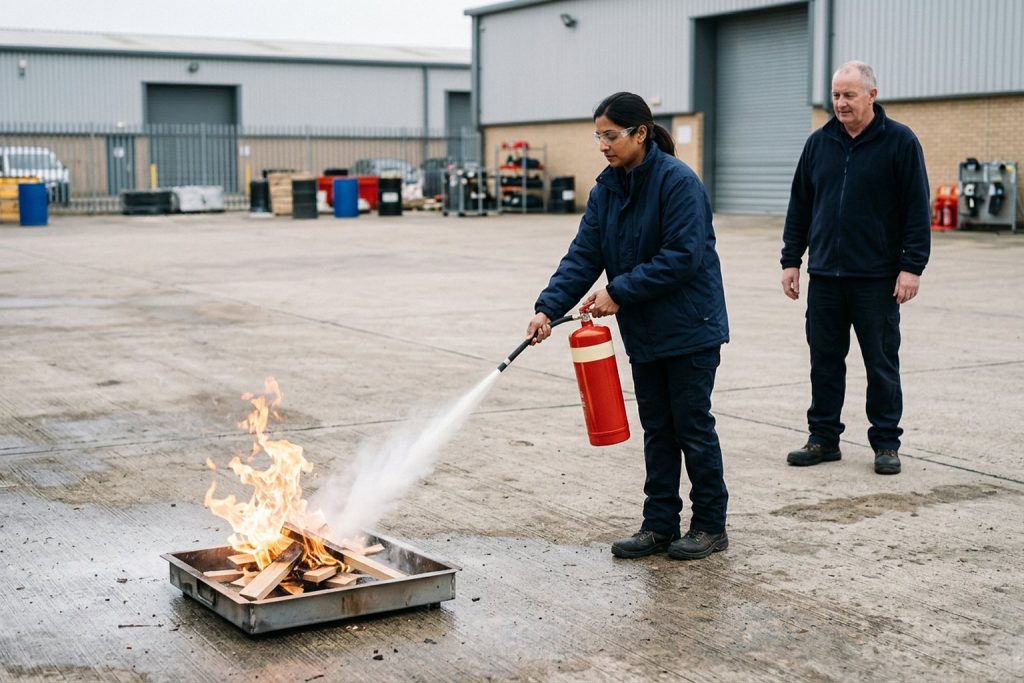
The first step in using a fire extinguisher is deciding whether to use one at all: only on a small fire, once the alarm is raised, with a clear escape route behind you and the right type in your hands. Otherwise get out and call 999. This guide covers the go/no-go check, the PASS technique step by step, distance and aim, how technique changes for water, foam, CO2, powder and wet chemical, what to do if the fire does not go out, what to do afterwards, and what the Fire Safety Order actually requires.

What Is CDM 2015? The Construction (Design and Management) Regulations Explained
Health & Safety

What Is CDM 2015? The Construction (Design and Management) Regulations Explained

A plain-English guide to the Construction (Design and Management) Regulations 2015 (SI 2015/51): why CDM applies to every construction project in Great Britain, including small and domestic jobs, and why only notification depends on size; what counts as construction work under regulation 2; the seven duty holders (client, domestic client, designer, principal designer, principal contractor, contractor, worker) with a summary table; how domestic client duties pass to the contractor or principal contractor under regulation 7; the HSE F10 notification thresholds in regulation 6 (more than 30 working days with more than 20 workers simultaneously, or more than 500 person days); why every project needs a construction phase plan and when a health and safety file is needed; competence under regulations 8 and 15; the removal of the CDM co-ordinator; Part 4 site requirements and Schedule 2 welfare; Northern Ireland’s CDM Regulations 2016; and the separate Building Regulations Part 2A dutyholder roles in England.

Is Lead Dangerous at Work? The Control of Lead at Work Regulations Explained
Health & Safety

Is Lead Dangerous at Work? The Control of Lead at Work Regulations Explained

Why lead is dangerous at work and who is most at risk (old lead paint, hot cutting, roofing, demolition, recycling, batteries and soldering); what the Control of Lead at Work Regulations 2002 require; why lead sits outside COSHH; what counts as significant exposure; the 0.15 mg/m3 air limit; blood-lead action and suspension levels in force on 10 October 2026, including the lower levels for women of reproductive capacity and young persons; HSE’s 2026 consultation on lowering them; symptoms of lead poisoning; safe ways to remove old lead paint; hygiene and taking lead home; and why lead poisoning is no longer a RIDDOR reportable disease.

What Is a Hate Crime? UK Law and How to Report It
Safeguarding

What Is a Hate Crime? UK Law and How to Report It

What counts as a hate crime in England and Wales: the police and CPS perception-based definition and the five monitored strands (race, religion, sexual orientation, disability, transgender identity); why hate crime is mostly not a separate offence but works through racially or religiously aggravated offences (Crime and Disorder Act 1998 ss.28-32) and the sentencing uplift in section 66 of the Sentencing Act 2020; stirring up hatred under the Public Order Act 1986; hate crimes vs hate incidents and the March 2026 decision to scrap non-crime hate incidents; whether misogyny or sex-based hostility is covered (Crime and Policing Act 2026 s.145, not yet in force; Scotland from 5 April 2027); Scotland and Northern Ireland; the latest Home Office figures; how to report (999, 101, True Vision, third-party reporting); supporting victims, preserving evidence, and what employers should do.

How Do You Care for a Urinary Catheter? A Guide for Care Workers
Health & Safety

How Do You Care for a Urinary Catheter? A Guide for Care Workers

Most of what keeps a urinary catheter safe is everyday care, not clinical skill: clean hands, a closed drainage system, a bag below bladder level but off the floor, a secured tube, good fluids and no constipation. NICE says adults with indwelling catheters should not have dipstick tests to diagnose a UTI, and cloudy or smelly urine alone is not a reliable sign of infection. This guide covers catheter types, who can change them, emptying bags, leg and night bags, warning signs, sepsis, dignity, recording and a daily checklist.

What Are Adverse Childhood Experiences (ACEs)? Trauma-Informed Practice Explained
Safeguarding

What Are Adverse Childhood Experiences (ACEs)? Trauma-Informed Practice Explained

What adverse childhood experiences (ACEs) are and where the idea comes from (the 1998 CDC-Kaiser Permanente ACE Study and its seven, later ten, categories); how common ACEs are in Wales and Scotland; why an ACE score is a research measure, not a diagnosis or a way to predict an individual child’s future; the OHID 2022 working definition and six principles of trauma-informed practice; how trauma can show up in behaviour; protective factors and resilience; trauma-informed practice in schools, early years, health and social care; responding to disclosures through safeguarding procedures; vicarious trauma; and Scotland’s National Trauma Transformation Programme.

Scroll to Top