
Yes, in most construction work, but not because of a “hard hat law”. The UK’s dedicated rules, the Construction (Head Protection) Regulations 1989, were revoked on 6 April 2013. Since then the duty has come from the Personal Protective Equipment at Work Regulations 1992 and the employer’s risk assessment: wherever there is a risk of head injury from falling objects or from striking the head that has not been controlled by other means, suitable head protection must be provided free of charge and worn. HSE’s view is that on almost all construction sites that risk remains, so on site the answer is nearly always yes.
At a glance: Nexis CPD offers a £9 CPD-accredited online Personal Protective Equipment (PPE) course — 100% online, with an instantly emailed, employer-verifiable certificate. Any three courses cost £18. This article is general information, not legal advice.
Is there a specific law that says you must wear a hard hat?
Not any more. Construction sites in Great Britain used to have their own rules: the Construction (Head Protection) Regulations 1989 (SI 1989/2209), which dealt with providing, maintaining and wearing head protection, site rules about wearing it, and reporting loss or defects. Because they existed, the general PPE Regulations excluded construction head protection from their own scope.
That changed on 6 April 2013. The Health and Safety (Miscellaneous Repeals, Revocations and Amendments) Regulations 2013 (SI 2013/448) revoked the 1989 Regulations in full and removed the construction exclusion in regulation 3(3)(f) of the PPE at Work Regulations 1992. The instrument’s explanatory note spells out the effect: all of the provisions of the PPE Regulations now apply to the wearing of suitable head protection by people engaged in construction work.
So when someone says “it’s the law to wear a hard hat on site”, they are right about the outcome but usually wrong about the source. The duty now comes from:
- The Personal Protective Equipment at Work Regulations 1992, which require employers to provide suitable PPE where a risk has not been adequately controlled by other means, and require workers to use it.
- The risk assessment required by regulation 3 of the Management of Health and Safety at Work Regulations 1999, which is where the head injury risk is identified.
- Site rules, which on a construction project the principal contractor must set out in the construction phase plan under regulation 12(2) of the Construction (Design and Management) Regulations 2015. Our guide to CDM 2015 explains how that plan works.
- The Health and Safety at Work etc. Act 1974, which sits behind all of these and also protects people who are not workers, such as visitors.
HSE’s construction PPE FAQ confirms that the PPE Regulations have applied to head protection on construction sites since 6 April 2013. Head protection is now treated like any other PPE: required where the risk assessment says it is needed.
When is a hard hat legally required at work?
When two things are true: there is a foreseeable risk of injury to the head, and that risk has not been adequately controlled by other means. Regulation 4(1) requires every employer to provide suitable PPE to workers who may be exposed to a risk to their health or safety “except where and to the extent that such risk has been adequately controlled by other means which are equally or more effective”.
That makes the hard hat the last line of defence, not the first. HSE’s construction guidance says to organise the work to minimise the risk of head injury first, for example by using scaffolds with toe boards and, if necessary, brick guards to stop objects falling. If a risk still remains, suitable head protection must be provided and worn.
HSE’s guidance on the Regulations, L25 Personal protective equipment at work, gives examples of situations where head protection could be required:
- low-level fixed objects, such as pipework, machines or scaffolding, where there is a risk of collision;
- transport activities, hoists, lifting plant and conveyors involving the risk of falling material;
- tree felling;
- blasting work, for example in quarries and opencast mining;
- construction sites, unless there is no foreseeable risk of head injury.
So hard hats are not only a construction issue: a warehouse with lifting equipment or a factory with overhead conveyors can create a head injury risk too.
Before choosing head protection, regulation 6 requires the employer to assess it: identify the risks not avoided by other means, define what the PPE must do to be effective against them, compare the options available, and check it works with any other PPE worn at the same time.

Are hard hats compulsory on every construction site?
Strictly, no; in practice, almost always. HSE’s construction FAQ says that if there is no risk of injury to the head, hard hats are not required by law. But it adds that on almost all construction sites, despite controls being put in place, there will almost always be situations where a risk of head injury remains, from falling objects or from hitting the head against something.
That is why hard hats are so often a site-wide rule rather than something decided area by area. Under CDM 2015, the construction phase plan sets out the site rules that everyone on site must follow. HSE’s leaflet Hard hats: what you need to know as a busy builder (CIS70) suggests making hard hats a site rule, always wearing your own to set an example, and checking that others are wearing theirs. A site can still designate areas where hard hats are not needed, such as offices and welfare facilities, where the risk assessment supports it.
The one statutory exemption is for turban-wearing Sikhs, under sections 11 and 12 of the Employment Act 1989 as amended; our guide to the PPE at Work Regulations explains how it works and its limits.
Who has to provide and pay for a hard hat?
The employer. Where head protection is needed, regulation 4 requires the employer to provide it, and section 9 of the Health and Safety at Work etc. Act 1974 prohibits an employer from charging employees for anything done or provided to meet a specific health and safety requirement. A worker should not be asked to buy their own hard hat or have the cost taken from their wages.
Since 6 April 2022 this goes beyond employees. The Personal Protective Equipment at Work (Amendment) Regulations 2022 (SI 2022/8) extended the Regulations to limb (b) workers, who personally do work under a contract but are not employees, and a new regulation 3A applies the section 9 ban on charging to them too. HSE’s guidance on the change says the employer must provide PPE free of charge to a limb (b) worker who needs it, and is responsible for its maintenance, storage and replacement.
The genuinely self-employed are different. Under regulation 4(2), a “relevant self-employed person” must make sure they have suitable PPE themselves, and work on a construction site is one of the prescribed activities that brings a self-employed person within that duty. Even so, HSE’s CIS70 leaflet tells builders to provide hard hats for workers and visitors even if they do not directly employ them.
Handing over a helmet is not the end of it. Regulation 7 requires PPE to be maintained, including replaced or cleaned as appropriate, at the employer’s cost. Regulation 8 requires suitable storage, which L25 says can be as simple as pegs for safety helmets. Regulation 9 requires information, instruction and training, although for simple PPE such as hard hats, L25 says some basic instructions will be all that is required.
Can you refuse to wear a hard hat at work?
Not where it is required. Regulation 10(2) says every worker must use PPE provided to them in line with the training and instructions they have received, and regulation 11 requires workers to report any loss of, or obvious defect in, their PPE straight away. Section 7 of the 1974 Act also requires employees to take reasonable care of themselves and others and to co-operate with their employer on health and safety.
Refusing can have consequences:
- Removal from site. Breaching a site rule on head protection can mean being asked to leave until you comply.
- Disciplinary action. Refusing a reasonable safety instruction without good reason can be treated as misconduct.
- Criminal liability. Under section 33 of the 1974 Act it is an offence for a person to contravene health and safety regulations or fail to discharge their section 7 duties, and that applies to workers as well as employers.
The duty runs both ways: regulation 10(1) requires the employer to take all reasonable steps to make sure the PPE it provides is properly used, not just to hand it out.
A refusal can also be a warning sign. A helmet that does not fit, slips when the wearer bends down or clashes with ear defenders is a suitability problem: regulation 4(3) says PPE is not suitable unless it can fit the wearer correctly and takes account of ergonomics and the wearer’s health. The answer is usually a different size or model, or a compatible combination of PPE.
Hard hat or bump cap: what is the difference?
A bump cap is not a hard hat, and it is not a lighter alternative to one. L25 describes industrial safety helmets as protecting against falling objects or impact with fixed objects, and bump caps as protecting against bumping the head, for example walking into a fixed object, and scalping. It is explicit that bump caps do not offer adequate protection where there is a risk of falling objects or moving or suspended loads.
| Question | Industrial safety helmet (hard hat) | Bump cap |
|---|---|---|
| Main protection | Falling objects and impact with fixed objects | Bumps and scrapes from walking into fixed objects |
| Protects against falling objects? | Yes, its primary purpose | No |
| Usual standard | BS EN 397 (industrial safety helmets) | BS EN 812 (industrial bump caps) |
| Typical settings | Construction sites, lifting operations, demolition, tree work, quarries | Low-headroom indoor areas with no overhead work, such as some plant rooms or vehicle pits |
| Acceptable on a construction site? | Yes, where it meets the site’s specified standard | Almost never, because a falling-object risk is nearly always present |
The bump cap standard, BS EN 812, draws the same line: bump caps protect against striking the head on hard, stationary objects and are not intended to protect against falling or thrown objects or moving or suspended loads.
Which standard should a hard hat meet in the UK?
The law does not name one. Regulation 4(3)(e) requires PPE to comply with the legal requirements that apply to its design and manufacture, and the employer’s assessment decides what protection is needed. Three standards cover most site helmets:
- BS EN 397, industrial safety helmets. The general site hard hat, intended primarily to protect against falling objects and the resulting brain injury and skull fracture. Optional extra performance requirements apply only where the manufacturer claims them.
- BS EN 12492, helmets for mountaineers. Written for climbing, but used for work at height and rope access because the helmet is designed to stay on the head.
- BS EN 14052, high-performance industrial helmets. Intended to protect against falling objects and off-crown impacts where more protection is needed than a standard industrial helmet gives.
The Build UK Safety Helmet Colours Standard, which many contractors follow, says all helmets must meet BS EN 397, BS EN 12492 or BS EN 14052. If you are working on someone else’s site, check which standard their rules specify.
HSE also warns that there are fake hard hats on the market and says head protection should only be obtained from a reputable supplier. Check for the standard number and manufacturer’s details marked inside the shell, the conformity marking and the user instructions.
Do you need a chin strap on a hard hat when working at height?
Often, yes, although neither the PPE Regulations nor the Work at Height Regulations 2005 say so in terms. A hard hat that falls off when a worker leans over a guardrail or slips on a platform protects no one, and becomes a falling object itself.
The helmet standards differ here. Manufacturers’ guidance explains that a chin strap is optional on a BS EN 397 helmet and, where fitted, is designed to release under load so the wearer is not held if the helmet catches on machinery. A BS EN 12492 helmet must have a chin strap, tested to stay secure rather than release, to keep the helmet on in a slip or fall.
L25’s first key point on head protection is to use an adjustable chinstrap, if fitted, to make sure the helmet does not fall off. For work on scaffolds, roofs, mobile elevating work platforms, ladders and steelwork, the PPE assessment should consider whether a helmet with a chin strap is needed, and site rules may require chin straps to be fastened at height. A helmet designed to release can be the safer choice near rotating machinery; a retained helmet suits work where falls are the main concern.
Head protection never replaces preventing the fall. The Work at Height Regulations give collective measures such as guardrails and toe boards priority over personal protection, and toe boards and brick guards also protect the people below from falling materials.

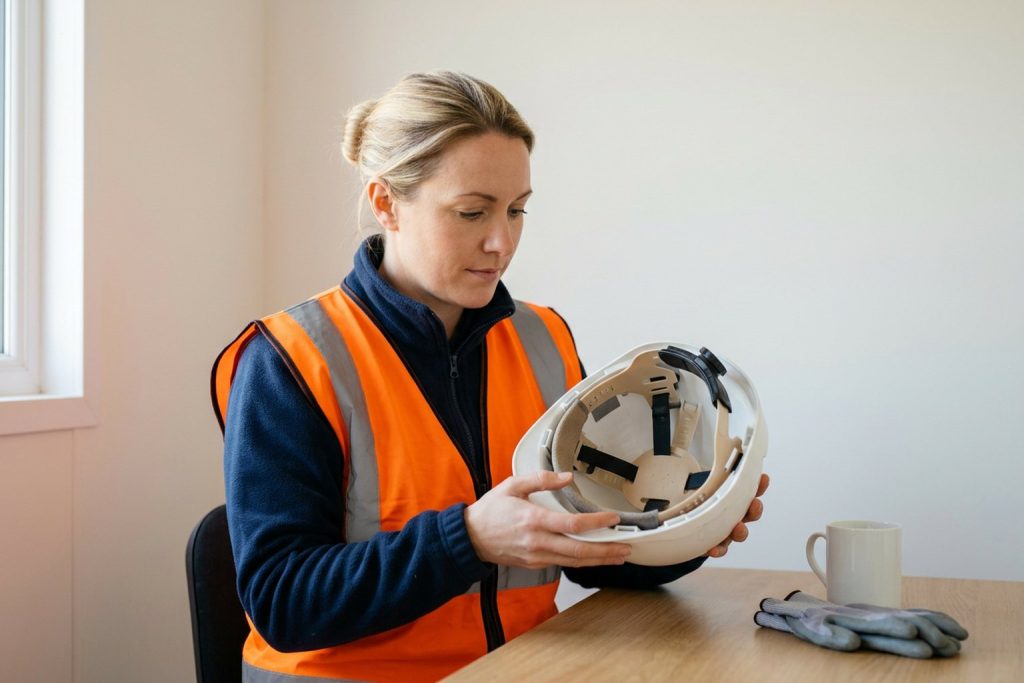
How do you check a hard hat before use?
A pre-use check takes less than a minute. This list is based on the key points in HSE’s L25 guidance; always follow the manufacturer’s instructions for your helmet too.
- Shell. Damage should be no more than shallow scratches or grazes. Deep scratches, cracks, dents, wear or deformation mean the helmet is unfit for use.
- Harness. Turn the helmet over. The harness, headband and fixings should not be damaged, deformed or missing.
- Impacts. If the helmet has taken a significant blow from a fixed or falling object, throw it away, even if it looks fine.
- Date. Find the date of manufacture and compare it with the manufacturer’s stated service life.
- Chin strap. If fitted, it should be intact, adjustable and fastened when the task calls for it.
- No customisation. L25 says not to make your own ventilation holes, or paint, mark or put stickers on head protection. Use only labels or accessories the manufacturer approves.
- Clean. Clean the inside and clean or replace sweatbands regularly.
- Fit. The helmet should sit firmly without being tight and should not move when you bend forward.
- Position. The brim should be level when the head is upright. L25 warns that wearing it sloping up or down significantly reduces protection, and not to wear it back to front.
- Compatibility. Ear defenders, visors and other PPE should fit with the helmet without pushing it out of position.
If you find a problem, take the helmet out of use and report it. Under regulation 11, reporting an obvious defect is a legal duty for workers.
How long does a hard hat last and when should it be replaced?
There is no fixed lifespan in UK law. Regulation 7 requires PPE to be kept in an efficient state, in efficient working order and in good repair, including replacing it when appropriate. How long that takes depends on the helmet, how it is used and how it is stored.
HSE’s L25 gives a general guide: industrial safety helmets should be replaced three years after manufacture, but always check with the manufacturer. That is guidance, not a legal deadline, and damage or a significant impact can end a helmet’s life much sooner.
Storage matters. Regulation 8 requires suitable accommodation for PPE, and HSE’s PPE guidance says PPE must be properly looked after and stored when not in use, for example in a dry, clean cupboard, following the manufacturer’s replacement schedule.
What do hard hat colours mean in the UK?
There is no legal colour code for hard hats in the UK. Neither the PPE Regulations nor CDM 2015 say which colour anyone must wear. Colours are a site convention, used so people can identify roles at a glance.
The most widely referenced scheme is the Build UK Safety Helmet Colours Standard, first published in 2016 and reviewed in 2023:
- Black for supervisors;
- White for site managers, competent operatives and vehicle marshals (marshals wear a different coloured high-visibility vest);
- Orange for slingers and signallers;
- Blue for everyone else on site.
The standard uses helmet stickers to identify first aiders and fire marshals, and notes that Network Rail only permits white and blue helmets on its infrastructure. Because it is an industry standard rather than law, sites can use their own schemes; the site induction should tell you which applies.
Do visitors have to wear hard hats on a construction site?
Yes, wherever the site rules or the risk require it. The PPE Regulations apply to workers, so they do not directly cover visitors. But L25 explains that section 3 of the 1974 Act requires employers to ensure, so far as is reasonably practicable, that people not in their employment are not exposed to risks, and gives the example of keeping a stock of hard hats and high-visibility jackets for visitors. HSE’s CIS70 leaflet tells builders the same. Clients, designers, inspectors and delivery drivers who leave their cabs should be given a suitable helmet and shown how to wear it; a visitor who refuses can be refused entry.
What hard hat and PPE training is available online?
Nexis CPD’s Personal Protective Equipment (PPE) course covers the law, how PPE should be selected, fitted, used, maintained and stored, and its limits as the last line of defence. Health and Safety in Construction covers why construction carries such high risk, the key legal duties including the CDM Regulations, and the controls that keep people safe on site. Working at Height Awareness covers one of the most serious construction hazards and the collective measures that should come before PPE.
£9 per course. CPD accredited, 100% online, verifiable e-certificate. Pay for 2, get 3 — any 3 courses for £18. These are CPD-accredited awareness courses. They are not a CSCS card, a site qualification or a regulated qualification, and they do not replace the employer’s PPE assessment, product-specific instruction, site induction or supervision.
Frequently asked questions
Is there still a hard hat law in the UK?
Not a dedicated one. The Construction (Head Protection) Regulations 1989 were revoked on 6 April 2013. Head protection is now covered by the Personal Protective Equipment at Work Regulations 1992, the employer’s risk assessment and site rules.
Is it a legal requirement to wear a hard hat on a building site?
Where there is a risk of head injury, yes. HSE says that if there is no risk of injury to the head, hard hats are not required by law, but that on almost all construction sites a risk of head injury remains, so suitable head protection must be provided and worn.
Does my employer have to pay for my hard hat?
Yes, where head protection is required. Section 9 of the Health and Safety at Work etc. Act 1974 stops employers charging employees for it, and since 6 April 2022 this also covers limb (b) workers. Genuinely self-employed people on a construction site must provide their own.
Can I wear a bump cap instead of a hard hat?
Only where there is no risk of falling objects. HSE’s L25 guidance says bump caps do not offer adequate protection where there is a risk of falling objects or moving or suspended loads, so on a construction site a bump cap is almost never suitable.
How often should a hard hat be replaced?
There is no fixed legal lifespan. HSE’s L25 gives a general guide of three years after manufacture but says to always check with the manufacturer. Replace a helmet straight away if the shell or harness is damaged or deformed, or after a significant impact.
Is there a legal hard hat colour code in the UK?
No. Hard hat colours are a site convention. Many contractors follow the Build UK standard: black for supervisors, white for site managers, competent operatives and vehicle marshals, orange for slingers and signallers, and blue for everyone else.
This article is general information about head protection at work in Great Britain, not legal advice. It reflects the legislation and HSE guidance as we found them on 11 October 2026; Northern Ireland has its own regulations. For a specific workplace or project, read the PPE at Work Regulations 1992 and HSE’s L25 guidance, follow the helmet manufacturer’s instructions, and take advice from a competent health and safety adviser where you need it. Nexis CPD courses are CPD-accredited awareness training, not regulated qualifications, CSCS cards or site qualifications.