

What Is DSEAR? The Dangerous Substances and Explosive Atmospheres Regulations Explained
DSEAR is the Dangerous Substances and Explosive Atmospheres Regulations 2002, the law in Great Britain that requires employers and the
Nexis CPD Knowledge Bank — Health & Safety guides and explainers.
DSEAR is the Dangerous Substances and Explosive Atmospheres Regulations 2002, the law in Great Britain that requires employers and the

Under the Regulatory Reform (Fire Safety) Order 2005, the “Responsible Person” for a care home, usually the registered provider or

Do not rest a ladder on a gutter: HSE and the Ladder Association guide LA455 warn against weak upper surfaces such as glazing and plastic gutters. This guide covers the wording, the law, stand-off devices, safer alternatives and cleaning gutters from the ground.

No law bans carrying tools up a ladder, but Schedule 6 of the Work at Height Regulations 2005 says you must keep a safe handhold. This guide covers three points of contact, tool belts, light loads, raising heavy materials and when a ladder is the wrong choice.
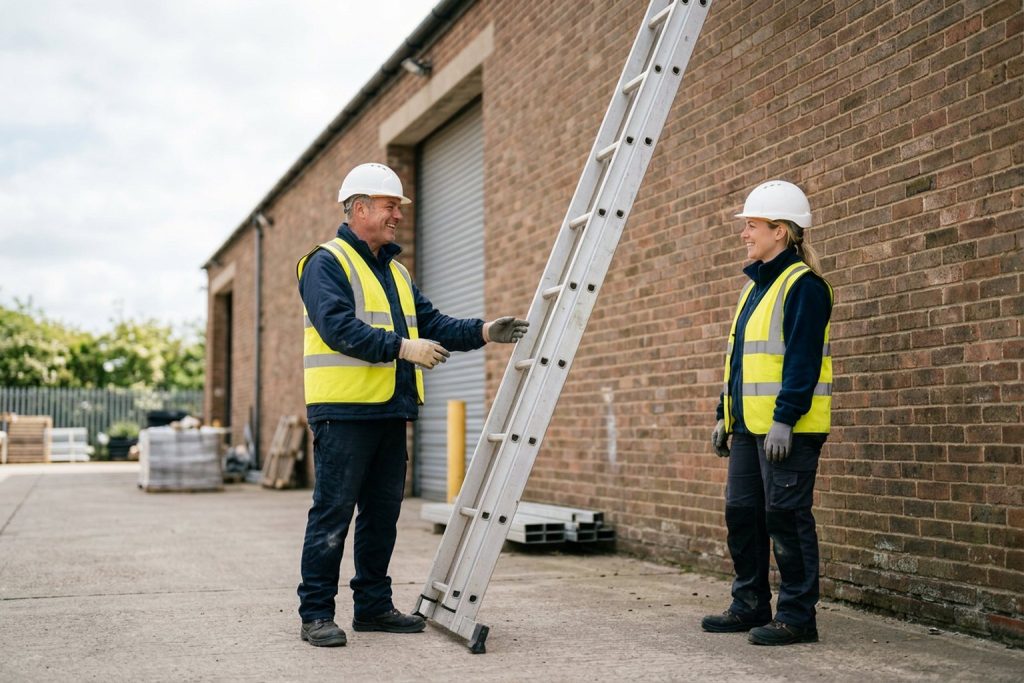
How to set up a leaning ladder safely: the 1-in-4 angle, firm ground, securing and tying, footing as a last resort, extension above a landing, stability devices, doors and traffic, overhead power lines and weather, with a pre-climb checklist.

Ordinary ladders and stepladders are unstable on stairs and no UK rule covers them specifically. See what the Work at Height Regulations 2005 require, what equipment suits a staircase and who should do the job.

There is no single legal interval for ladder inspections. Users do a pre-use check each working day and after any change; a competent person carries out recorded detailed visual inspections at fixed intervals, following the manufacturer’s instructions. As a guide, the Ladder Association suggests at least every 3, 6 or 12 months depending on use.

Use podium steps when a job needs both hands, takes more than a few minutes or means climbing up and down repeatedly; use a stepladder for light, short, low-risk jobs where you can keep a handhold. Podium steps have guardrails and a gate, so under the Work at Height Regulations 2005 it is the stepladder that has to be justified.

EN 131 is the British and European standard for portable ladders. The revised version, in force from January 2019 according to the Ladder Association, replaced Class 1, the older EN 131 trade rating and Class 3 with two classes: EN 131 Professional and Non-Professional. Both carry a 150 kg maximum total load, but Professional ladders pass tougher strength and durability tests and are the ones to buy for work.

MOT testers in Great Britain must do at least 3 hours of training for each vehicle group they test and pass DVSA’s annual assessment in every training year, from 1 April to 31 March. The 2026 to 2027 pass mark is 80%. Training is logged on the MOT testing service, and a tester with no recorded pass by 31 March is suspended until they train, pass and take a DVSA demonstration test.