
Can you carry tools up a ladder?
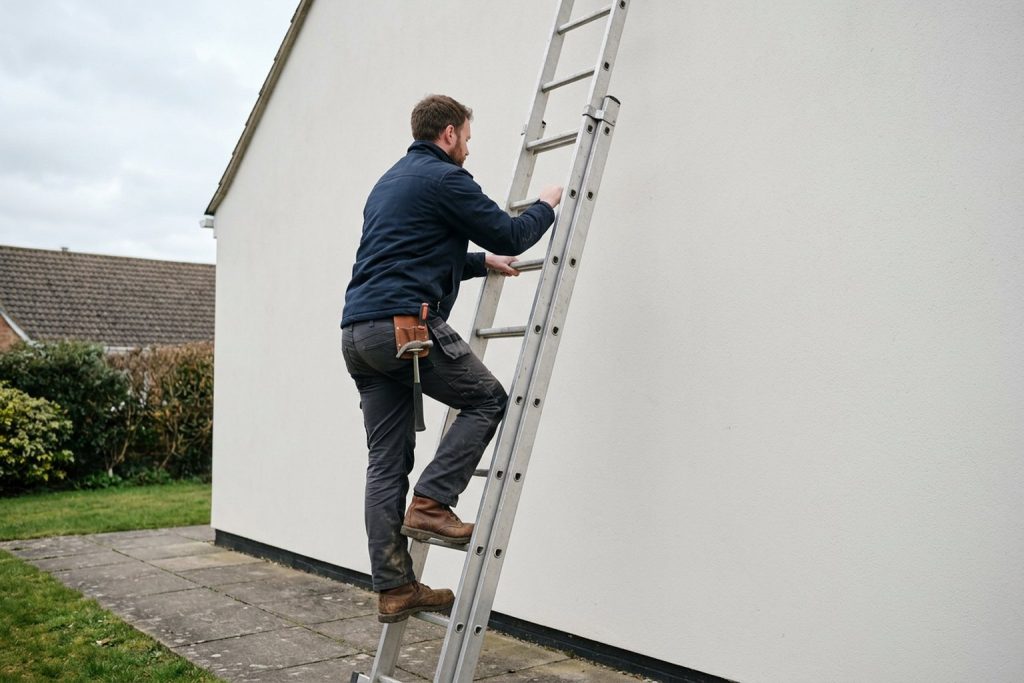
Yes, you can carry light tools up a ladder at work, and no law bans it, but you should not carry them in your hands. Schedule 6 of the Work at Height Regulations 2005 says you must be able to keep a safe handhold when carrying a load, and the HSE-backed LA455 guide says to carry only light materials and tools, avoid holding items while climbing and consider a tool belt. Heavy, bulky or awkward materials should go up another way, or the job needs different equipment.
On this page
- 1Can you legally carry tools up a ladder?
- 2What does HSE say about three points of contact?
- 3What can you carry up a ladder, and how?
- 4How do you get heavy or bulky materials up to the work?
- 5When is a ladder the wrong choice for the job?
- 6What does this look like on a real job?
- 7What should employers check?
- 8Does an awareness course replace practical ladder training?
- 9What training helps with carrying tools safely on a ladder?
- 10Frequently asked questions
- No ban. No law bans carrying tools up a ladder, but Schedule 6 says you must be able to keep a safe handhold when carrying a load.
- Light tools only. The HSE-backed LA455 guide says carry only light materials and tools, avoid holding items while climbing, and consider a tool belt.
- No official weight. HSE and LA455 give no kilogram figure for light, so follow the ladder label, your risk assessment and your employer.
- Heavy loads. Avoid the lift, raise materials separately, or choose a tower, podium or platform instead of a ladder.
This guide is for tradespeople, maintenance and facilities staff, and the managers who plan their work. It covers ladders used at work in Great Britain, checked against the sources named below on 3 November 2026. Weights, minutes and distances appear only where an official source gives them, with its date. For the wider framework, see our guide to the Work at Height Regulations 2005. General information, not legal advice.
Can you legally carry tools up a ladder?
There is no ban. HSE says in its ladder guidance (updated 5 June 2024) that ladders and stepladders are not banned under health and safety law, and can be a sensible and practical option for low-risk, short-duration tasks, though not automatically your first choice. LA455, the ladder guide the Ladder Association produced in co-operation with HSE, says the same. We read version 1, revision 1 (September 2026); its text is identical to the July 2021 edition that replaced HSE leaflet INDG455. For the ban question in full, see our articles on the regulations and on ladder safety rules.
The legal requirements for ladders sit in Schedule 6 of the Work at Height Regulations 2005, which regulation 8(e) applies to every ladder used for work at height. We read all ten paragraphs on legislation.gov.uk. None sets a weight limit for tools, a minute limit, or a rule saying “do not carry tools”. One paragraph does speak to carrying: paragraph 10 says every ladder must be used so that a secure handhold and secure support are always available, and so that the user can maintain a safe handhold when carrying a load.
The text gives one exception, and it is for stepladders only. If keeping a handhold is not practicable when a load is carried, a risk assessment must have shown that using a stepladder is justified by the low risk and the short duration of use. There is no equivalent exception for leaning ladders. That is the closest thing to a law on carrying: it does not forbid a load, it requires that you can still hold on safely while you carry it.
Read plainly, the legal question is not “tools or no tools” but “can this person keep a safe handhold the whole way up, and while working?” Someone climbing with a bucket in one hand and the other hand barely hooked round a rung is hard to defend under that test. Someone with both hands on the ladder and a few light tools on a belt is not. That reading is ours, applying the paragraph to a common situation.
Guidance is not law, and LA455 says so itself: following it helps you comply with health and safety law, but you are free to take other action. The next sections set out what it says.
Other duties sit around the question. Under regulation 4 the employer must make sure work at height is properly planned, appropriately supervised and as safe as reasonably practicable, including the choice of equipment. And under regulation 10 the employer must take suitable and sufficient steps, so far as reasonably practicable, to prevent anything falling, or to prevent anyone being struck if it does. Carrying tools is therefore something the plan should cover, not something each person improvises on the day.
What does HSE say about three points of contact?
For leaning ladders, LA455 says to maintain three points of contact when climbing and, wherever possible, at the work position. It adds that where you cannot maintain a handhold, other than for a brief period, you will need other measures to prevent a fall or reduce its consequences. Its example of a brief period is holding a nail while starting to knock it in, or starting a screw. The basic rule has its own section in our ladder safety rules article, so we only cover what matters for carrying here.
For stepladders, LA455 defines three points of contact at the working position as two feet and one hand or, when both hands need to be free for a brief period, two feet and the body supported by the stepladder. HSE’s common work at height myths page (updated 3 September 2025) lists the belief that you always need two feet and one hand on a stepladder as a myth: the body supported by the ladder can count, and a handhold should be available to steady yourself before and after.
Why does this matter when you carry things? Climbing is done one limb at a time. Hold a tool in one hand and you have one hand and two feet on the ladder; the moment you move a foot or that hand, you are down to two points of contact. That is arithmetic rather than an HSE statement, but it explains why LA455 tells you to avoid holding items when climbing. A tool belt keeps both hands free, so three limbs stay on the ladder while the fourth moves.
The same applies at the top. If the job needs both hands for more than a brief moment, LA455 expects other measures, or different equipment, not hope.
What can you carry up a ladder, and how?
LA455 gives the same instruction for both leaning ladders and stepladders: only carry light materials and tools. For leaning ladders it adds “read the manufacturer’s labels on the ladder and assess the risks” and “don’t overload the ladder”, telling you to consider your weight and the equipment or materials you are carrying before working at height. It also says to avoid holding items when climbing and to consider using a tool belt.
The guide does not say what “light” means. It gives no kilogram figure for tools or materials, and neither does HSE’s ladder guidance. If a pocket card, slide or site rule gives you a figure, treat it as that employer’s or trainer’s limit, not HSE’s. The figure that matters physically is on the ladder itself: check its label and pictogram for the maximum load, which has to cover you plus everything you carry, as our article on the EN 131 ladder standard explains.

A tool belt fixes the “hands” problem but not every problem. A belt packed with more than the job needs is a heavy load you are wearing, and LA455 still counts it toward the weight on the ladder. It does nothing about reach either: the guide says to keep your belt buckle (or navel) between the stiles, so if you must lean out to use a tool, the ladder is in the wrong place. Taking only what the next task needs is slower but safer.
Tools can also fall. Regulation 10(3) says no material or object may be thrown or tipped from height where it could injure someone. LA455 says to keep the public from using or standing too close to the area under a ladder, with barriers or cones, and to use a person standing guard at the base only as a last resort. Keep the area below clear and marked, and never drop tools down to save a trip.
The table below shows how the guidance applies to common loads. The right-hand column is our reading of LA455 and Schedule 6, not a quotation from either.
| What you need to take up | What the guidance points to |
|---|---|
| A few small hand tools, such as a screwdriver, pliers and a tape measure | Carry them on a belt or pouch, with both hands free for the ladder. This is the case LA455 describes. |
| One tool you would otherwise hold in your hand while climbing | Put it in the belt or pouch, or raise it separately. LA455 says to avoid holding items when climbing. |
| A toolbox, bucket or box of fixings | Do not carry it in one hand. Raise it separately from a secure position, or break the job into lighter loads. |
| Long or bulky items, such as boards, pipe lengths or sheet material | Not by ladder in your hands. Use a different method of delivery or different access equipment. |
| Anything you could not lift easily at ground level | Treat it as a manual handling task first and a ladder task second. |
How do you get heavy or bulky materials up to the work?
First, an honest limit on the official sources: neither HSE’s ladder pages nor LA455 describe how to hoist materials. They say not to carry beyond light tools and not to hold items while climbing, and leave the alternative to your risk assessment. The methods below are common practice that follows from those rules, so check them against your employer’s procedures.
The first question is whether the load needs to go up at all. Regulation 6(2) says work must not be carried out at height where it is reasonably practicable to carry it out safely otherwise than at height. HSE’s Working at height: A brief guide (INDG401) (January 2014) gives examples of doing as much as possible from the ground, including extendable tools used from ground level to remove the need to climb a ladder. Cutting and preparing materials on the ground, and taking up only the finished part, cuts the weight you lift. Our article on the hierarchy of control for work at height explains the order of thinking.
If the load must go up, the principle in paragraph 10 points one way: the person on the ladder should not be the one holding it. Common methods that follow are listed below.
- Raise it separately. The climber goes up first with both hands free, reaches a secure position such as a landing or platform, and raises the load on a rope in a bag that someone at the bottom has attached. The pulling should not be done from the rungs, because hauling a rope takes both hands.
- Use a hoist or lifting equipment. A hoist, pulley or mechanical lift takes the weight off people, if it is suitable for the load and kept clear of those below.
- Have it delivered to the level. For bigger jobs, deliver materials to the working level with equipment designed for it.
- Change the access. Repeated trips with materials mean the job probably needs a staircase, tower or platform, not a ladder.

Whichever method you use, regulation 10 applies: keep people out from under the load, secure what you raise so it cannot slip, and never throw or tip anything from height. Manual handling law applies too. Under regulation 4 of the Manual Handling Operations Regulations 1992, an employer must avoid hazardous manual handling so far as reasonably practicable and otherwise assess it and reduce the risk to the lowest level reasonably practicable; our guide to the Manual Handling Operations Regulations 1992 covers it. A load that is hard to lift at ground level does not get easier on a ladder, so assess it at the bottom.
When is a ladder the wrong choice for the job?
Paragraph 1 of Schedule 6 gives the legal test. A ladder may be used for work at height only if a risk assessment has demonstrated that using more suitable work equipment is not justified because of the low risk and either the short duration of use or existing features on site that cannot be altered. The two ideas work together: low risk first, then short duration. HSE’s page on How and when to use a ladder at work (updated 5 June 2024) says short duration is not the deciding factor on its own, because you must have considered the risk first.
HSE does give a guide on time. That page, HSE’s FAQs (updated 18 November 2024) and LA455 all say that if your task would require staying up a leaning ladder or stepladder for more than 30 minutes at a time, it is recommended you use alternative equipment. HSE’s common work at height myths page defines short duration as no more than 30 minutes at a time, and Working at height: A brief guide (INDG401) (January 2014) says less than 30 minutes. The wordings differ only at exactly 30 minutes, and all are guides, not a legal limit: Schedule 6 contains no number of minutes. The measure is time on the ladder at one go, not the length of the whole job.
Carrying adds its own reasons for a ladder to be the wrong tool. Each of these is a prompt to look at other equipment, rather than a ban:
- The task needs both hands for most of the time, not a brief moment.
- The materials are heavy, bulky or awkward enough that you could not keep a safe handhold while carrying them.
- You would need many trips up and down with loads, so the risk is repeated.
- The work puts side loads on a stepladder, such as side-on drilling through brick or concrete. LA455 says to tie the steps where that cannot be avoided, and otherwise to use a more suitable type of access equipment.
- The ladder cannot be placed on firm, level ground or secured, so it cannot be used safely.
What to use instead depends on the job. HSE’s Working at height: A brief guide (INDG401) leaflet lists mobile elevating work platforms such as scissor lifts, tower scaffolds and scaffolds as examples of collective protection that prevents falls, and says collective protection should come before personal protection. Our article on podium steps versus stepladders compares a low-level podium, which has guardrails and leaves both hands free, with a stepladder. If the work is over stairs, where an ordinary ladder is unstable and carrying makes matters worse, see our guide on using a ladder on stairs.
One more case catches people out. LA455 says a ladder used to access another level should be tied and extend at least 1 m above the landing point to provide a secure handhold, and that stepladders should not be used to access another level unless designed for it. If materials regularly go onto a roof or mezzanine by ladder, the planning has probably missed a better access route.
What does this look like on a real job?
This example is invented. A maintenance technician must replace an external wall light and needs a screwdriver, pliers, a replacement fitting and a box of fixings. It is a short task, so a ladder can be justified if the risk assessment says so. The technician secures the ladder and climbs with the screwdriver and pliers on a belt and the fitting in a pouch, both hands on the ladder. The box of fixings stays on the ground: only the few screws needed go in the pouch, and the technician comes down for more if the work runs short.
Now change the job: a high bracket, a heavy fitting, a drill and over an hour of work. The load is heavy, the time on the ladder is well over 30 minutes at a stretch, and both hands are needed. A tower or mobile platform is the better answer, and its set-up time is part of the cost of the job.
What should employers check?
The law puts the planning on the organisation, not on the person holding the ladder. These questions follow from regulations 4, 5, 6 and 10, Schedule 6 and LA455, and can be used to review a ladder task before it starts.
- Is a ladder justified at all? Does the risk assessment show that more suitable equipment is not justified, because of the low risk and the short duration or site features you cannot alter?
- What will be carried, and how? Does it name the tools and materials, say what goes on the person, and say how anything else reaches the work position?
- Can a safe handhold be kept? Going up, at the work position and coming down, as paragraph 10 requires?
- Is the right kit provided? Belts or pouches, and suitable ropes, bags or hoists if raising is part of the method?
- Is the ground below controlled? Are barriers or cones keeping people clear of falling tools?
- Is the ladder fit, and is the person competent? Has the user done a pre-use check, and do they know what the job needs and when to stop and ask?
LA455 says the user does a pre-use check at the start of the working day and after anything changes, such as a drop; detailed visual inspections are the employer’s responsibility, at fixed intervals and recorded. Our ladder inspection guide covers the levels of checking, and our article on ladder set-up covers the 1 in 4 angle and securing the ladder.

Does an awareness course replace practical ladder training?
No. HSE says you do not need to be formally qualified to use a ladder at work, but you must be competent, and LA455 says training should cover how to assess the risks of a ladder for a task, when it is right to use one and when it is not, and which type to use. An online awareness course gives you the knowledge side. It does not show a supervisor that you can set up, secure and climb a particular ladder safely, and it does not replace your employer’s rules. We cover this in our article on ladder set-up, and our guide to who needs working at height training explains how awareness and practical competence fit together.
What training helps with carrying tools safely on a ladder?
Three Nexis CPD courses cover the knowledge behind the points in this guide:
Together they cost £18 rather than £27 under the pay-for-2-get-3 offer, and employers training 5 or more staff pay £6 a course place on the team plan. These are awareness-level CPD courses, not regulated qualifications, and they do not replace your employer’s procedures or practical ladder training. If you take one, start with Ladder Safety Awareness: 15 questions, 80% to pass, and an instant certificate.
Ladder Safety Awareness
100% online, at your own pace. Pass the assessment and your verifiable certificate is emailed instantly.
Frequently asked questions
Can you carry tools up a ladder at work?
Yes, light tools, but not in your hands. No law bans it, but Schedule 6 of the Work at Height Regulations 2005 requires that the user can keep a safe handhold when carrying a load, and the Ladder Association’s LA455 guide, produced with HSE, says to carry only light materials and tools and consider a tool belt.
Is it illegal to carry a toolbox up a ladder?
There is no rule that names toolboxes. The test is Schedule 6, paragraph 10: you must be able to keep a safe handhold when carrying a load. A toolbox in one hand that stops you gripping properly is hard to justify, and a heavy one should be raised separately or the job planned differently.
How much weight can you carry up a ladder?
No official figure exists for what counts as light. HSE’s ladder pages and LA455 say only to carry light materials and tools and not to overload the ladder, counting your own weight plus what you carry. Check the ladder’s marked maximum load and your employer’s risk assessment.
Can you wear a tool belt on a ladder?
Yes. LA455 says to avoid holding items when climbing and to consider using a tool belt. Keep it to the light tools you need, so you are not wearing a heavy load, and keep your belt buckle within the sides of the ladder when you reach.
How do you get heavy materials up to a roof or upper floor?
Not on a ladder in your hands. Avoid the lift if you can, or raise the load separately by a method your risk assessment covers, such as a rope and bag from a secure position, a hoist or a delivery to the level. Neither HSE’s ladder pages nor LA455 describe a method, so the plan must.
Do you need a qualification to use a ladder at work?
No. HSE says you do not need to be formally qualified, but you do need to be competent: the skills, knowledge and experience to use a ladder properly for the task, or to be supervised by a competent person while you are being trained.
General information, not legal advice. This guide reflects the Work at Height Regulations 2005 (including Schedule 6), the Manual Handling Operations Regulations 1992, HSE’s ladder guidance (updated 5 June 2024), FAQs (18 November 2024) and myths page (3 September 2025), leaflet INDG401 (January 2014) and Ladder Association guide LA455 (September 2026 revision), all checked on 3 November 2026. Northern Ireland has separate regulations, and each employer sets its own ladder rules through its risk assessment. Nexis CPD courses are CPD-accredited awareness training, not regulated qualifications, and they do not replace your employer’s procedures or practical ladder training.