
No UK law says “test your fire alarm every week”. What the law requires is that fire detection and warning systems are kept maintained in efficient working order. The weekly test comes from the British Standard for fire alarm systems, BS 5839-1, and from government fire safety guidance, which recommend testing the alarm every week by operating a different manual call point each time, ideally at the same time of day, recording it in a logbook, and having the system inspected and serviced by a competent person at least every six months. In practice, that routine is what inspectors normally expect to see.
At a glance: Nexis CPD offers a £9 CPD-accredited online Fire Warden Fire Marshal course — 100% online, with an instantly emailed, employer-verifiable certificate. Any three courses cost £18.
This guide covers testing and servicing the fire alarm itself. Fire drills, which test people rather than equipment, are covered in our guide to fire safety training and UK law.
Is weekly fire alarm testing a legal requirement?
Not in those words. In England and Wales, the Regulatory Reform (Fire Safety) Order 2005, Article 13, requires the responsible person, where necessary, to make sure premises are equipped with appropriate fire detectors and alarms. Article 17 then requires those facilities to be “subject to a suitable system of maintenance” and kept in efficient working order and good repair. Neither article mentions a week, a month or six months.
Scotland and Northern Ireland use almost identical wording. The duty sits in regulation 16 of the Fire Safety (Scotland) Regulations 2006, made under the Fire (Scotland) Act 2005, and regulation 16 of the Fire Safety Regulations (Northern Ireland) 2010, made under the Fire and Rescue Services (Northern Ireland) Order 2006.
The intervals come from elsewhere. BS 5839-1 is the code of practice for fire detection and fire alarm systems in non-domestic buildings, and the Scottish Government’s practical fire safety guidance for existing non-residential premises points to it for design, installation and maintenance. The British Standard is a paid document, so the intervals in this article are taken from the government and fire sector guidance that summarises it, not from the standard itself.
So the weekly test is not a statutory rule, but it is how the enforcing authority will normally expect you to show that a “suitable system of maintenance” exists. A different routine needs a reason you can explain and records proving the alarm still works.
How often should a fire alarm be tested and serviced?
Weekly by someone on site, and at least every six months by a competent person. The Home Office guide to making small non-domestic premises safe from fire includes a simple maintenance checklist, and the Scottish guidance (chapter 4) gives more detail. Together they set out this routine:
| When | What | Who | Source |
|---|---|---|---|
| Daily | Glance at the control panel to make sure it shows normal operation, with no fault or disablement | Trained member of staff | Scottish guidance |
| Weekly | Operate a different manual call point to check the panel receives the signal and the sounders work throughout | Trained member of staff | Home Office and Scottish guidance |
| Monthly | Test any domestic-type smoke alarms (used in some small premises instead of a full system) | Trained member of staff | Home Office small premises guide |
| Six-monthly | Inspection, testing, servicing and preventive maintenance of the whole system | Competent person, usually a fire alarm contractor | Home Office and Scottish guidance |
| Every time | Record and investigate each false alarm and fault, and act on the cause | Responsible person | Scottish guidance |
The Scottish guidance adds a useful caveat: experience in your own premises may justify changing the suggested frequencies. Premises that are unstaffed or rarely used, or that have a history of faults, may need more frequent checks, not fewer. Your fire risk assessment is the place to record that decision.
Emergency escape lighting runs on a similar but separate routine: a monthly functional test by staff and an annual inspection and test by a competent person, according to the Home Office small premises guide. It is often checked alongside the alarm, but it is a different system with its own records.
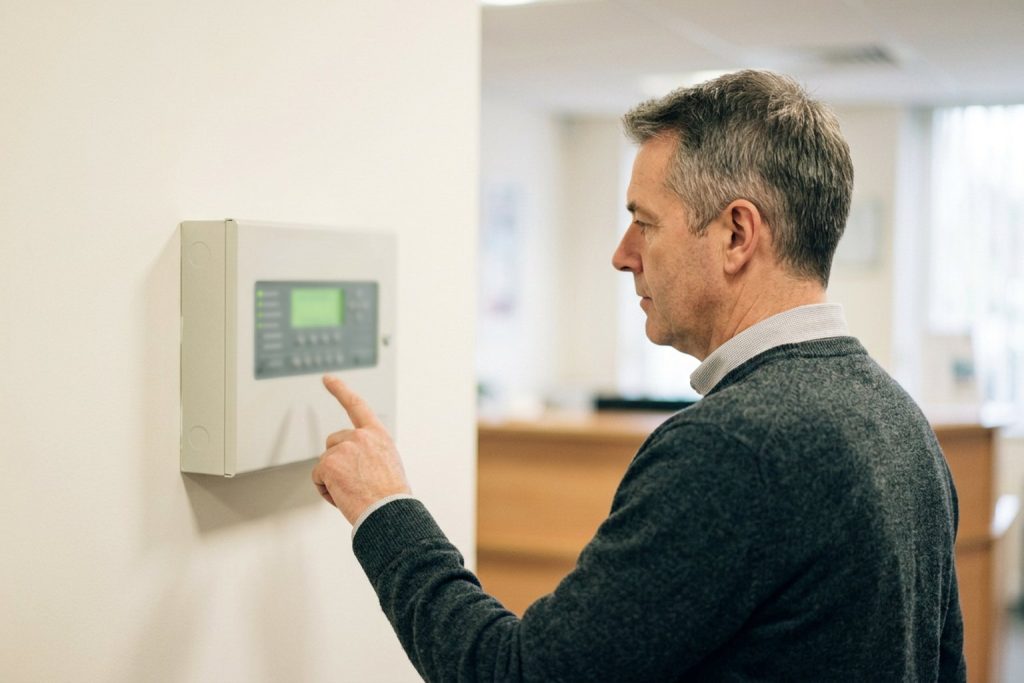
How do you carry out a weekly fire alarm test?
The test itself is short; most of the effort is in the preparation. The Scottish guidance describes it as activating a manual call point, usually with a test key, to confirm the control equipment can receive a signal and switch on the sounders. The Fire Protection Association’s guide on how to test fire alarms sets out a similar sequence. Always follow your system manufacturer’s instructions and your contractor’s handover notes first.
- Warn people first. Tell staff, and visitors if needed, that a test is about to happen and that they should not evacuate unless the sound continues.
- Contact the alarm receiving centre (ARC), if the system is monitored, and ask for it to be put on test. Otherwise the test may be treated as a real fire signal.
- Check the panel shows normal operation before you start. A fault showing beforehand needs reporting, not testing around.
- Go to the next call point on your rotation and insert the test key, which operates the call point without breaking the element.
- Confirm the sounders work throughout the premises. Ask colleagues in outlying areas, toilets, plant rooms and noisy workshops to report back if they could not hear it, and check any visual beacons.
- Check linked features. The Scottish guidance says to confirm the test releases door hold-open devices, releases electrically locked doors and returns automatic doors to manual operation, where these are fitted.
- Keep it brief. The alarm should not sound for so long that people cannot tell a test from a real activation.
- Reset the call point with the key, then silence and reset the panel as your system’s instructions describe.
- Check the panel reported the right location. On an addressable or zoned system, the FPA advises confirming the zone or device address matches the call point you used.
- Contact the ARC again to confirm it received the signal, and ask for the system to be taken off test.
- Record the result in the logbook straight away, including anything that did not work.
Weekly fire alarm test checklist
- Occupants warned the test is happening
- Alarm receiving centre told and system put on test (if monitored)
- Panel showing normal before the test
- Correct call point chosen from the rotation list
- Sounders heard in every area, including remote rooms
- Door hold-opens and maglocks released, where fitted
- Call point reset, panel reset, test key removed
- Panel showed the correct zone or address
- ARC confirmed signal received and system back on watch
- Logbook entry made: date, time, call point, result, name
- Any fault reported to the responsible person and contractor
Why should you use a different call point each week?
Because each call point is wired back to the panel in its own place, and a test only proves the path from the device you used. The Home Office guide says alarm systems should be tested “using a different manual alarm call point each week”. Rotating through every call point means each one gets tested in turn over the following weeks and months.
The Scottish guidance suggests numbering call points to help with sequential testing. A simple list in the logbook, in the order you will test them, stops the same convenient call point by the office door being used every week.
The FPA lists the common mistakes worth avoiding: not having the reset key or panel code to hand, not rotating call points, forgetting to record the test, leaving the test key in the call point, and triggering the alarm only from the panel’s evacuate control. That last one is a particular trap. Sounding the alarm from the panel proves the sounders work, but it does not prove that any call point can raise the alarm.
What time of day should you test the fire alarm?
Ideally at the same time on the same day each week, during normal working hours. Both the FPA and the Scottish guidance describe this as good practice. When people know that Tuesday at 10am is the alarm test, a sounder at any other time is more likely to be taken seriously.
There is a trade-off. The Scottish guidance also says shift workers should have the chance to hear the alarm, so if you run nights or weekends, consider occasionally testing on other shifts, with notice.
Who can carry out the weekly fire alarm test?
Any responsible person on site who has been shown how, and no formal qualification is needed for the weekly test. The Home Office guide says some testing and maintenance “you may be able to do yourself”, while other work needs a competent contractor. Oxford City Council’s guidance on fire alarm testing in HMOs goes further, suggesting weekly push-button tests can be done by cleaning or maintenance staff, or by a competent tenant.
What matters is that the person knows the system: where the panel is, how to put it on test with the ARC, how to reset the call point and panel, and what to do if something fails. Name a deputy, so that holidays do not leave weeks unrecorded.
Six-monthly servicing is different. It needs a competent person, which in practice means a fire alarm contractor. The Home Office guide suggests choosing a contractor that holds certification for the work from an independent certification body, and the FPA gives BAFE SP203-1 as an example of such a scheme. Whoever does the work, legal responsibility for the system staying in efficient working order stays with the responsible person.

What should a fire alarm logbook include?
Every test, service, fault and false alarm, with enough detail for someone else to follow what happened. The Home Office guide says a suitable record of testing and maintenance should be kept in a logbook or electronic record, and the Scottish guidance suggests keeping maintenance and testing records for at least three years for possible audit by the enforcing authority. Many fire and rescue services publish free logbook templates.
A useful logbook records:
- Weekly tests: the date and time, the call point or zone used, whether the sounders worked everywhere, and the name of the person testing.
- Servicing visits: the date, the contractor, what was tested, defects found and the certificate issued.
- False alarms: the date, time, device, likely cause and the action taken to stop it happening again.
- Faults: what the panel showed, when it was reported and when it was fixed.
- Disablements: any detector or zone isolated, why, for how long, and what extra precautions were in place.
- Changes: alterations to the system or to the building that could affect detection, such as new partitions or a room changing use.
The FPA advises keeping the logbook on site, ideally near the control panel, and available for inspection. An honest entry saying “test missed, staff absent, done Thursday” is far better than a gap or a back-filled tick.
What happens during six-monthly fire alarm servicing?
A competent person inspects, tests and services the system and fixes or reports any defects. The Scottish guidance calls it “six monthly servicing and preventive maintenance”. The detail of what is covered at each visit is set by BS 5839-1 and by your service contract, so ask your contractor to explain it rather than assuming.
The key point for building managers is what the weekly test does not prove. Operating a call point shows the panel and sounders respond, but it does not show that a smoke or heat detector will sense a fire. Detectors are checked by the contractor during servicing, using suitable test equipment, so ask for a certificate after each visit and a record of which devices were tested, and ask your contractor to confirm how every detector is covered across the year’s visits.
Do smoke and heat detectors need to be tested separately?
Not by staff in the weekly test, but they do need checking, and the right type needs to be in the right place. The Home Office guide says automatic detectors will generally be smoke detectors, or heat detectors in kitchens and other rooms where smoke detectors would cause false alarms. The Scottish guidance explains the trade-off: smoke detectors respond faster to most fires but are more prone to false alarms, while heat detectors have a good false alarm record but are not appropriate where smoke detection is needed, such as escape routes.
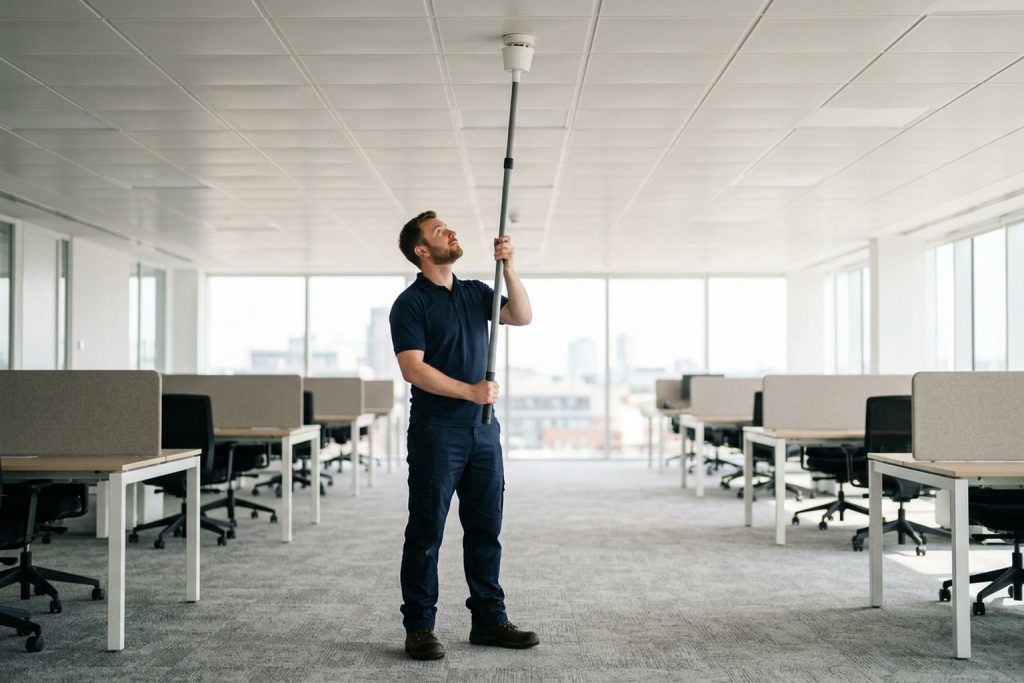
Between services, staff can usefully look out for:
- detectors covered by dust sheets, bags or caps after building work and never uncovered;
- detectors painted over, damaged or hanging loose;
- shelving, stock or new partitions built up close to detectors or call points;
- a room’s use changing, for example an office becoming a kitchenette with a toaster under a smoke detector.
Do not test detectors with a flame, lighter or improvised smoke. Report concerns to the responsible person and the contractor.
How do you reduce false fire alarms at work?
By recording every false alarm, finding the cause and fixing it. Essex County Fire and Rescue Service’s page on unwanted fire signals draws a useful distinction. A false alarm is an automatic fire alarm going off for any reason other than fire. It becomes an unwanted fire signal when the fire and rescue service is called to it. The service lists common causes as cooking fumes, steam, dust, and testing or maintenance without first telling the alarm receiving centre.
False alarms are not just a nuisance. The Scottish guidance warns that frequent false alarms can make staff complacent about a real fire. Fire and rescue services have also changed how they respond. Essex says it will not send an emergency response to calls from automatic fire alarm systems unless a 999 call confirms a fire or signs of fire, or the building is exempt. The Scottish Fire and Rescue Service has, since July 2023, questioned callers about automatic alarm calls from most non-domestic premises and does not attend if there is no fire or sign of fire, according to its consultation outcome. Premises with sleeping accommodation are exempt. Check your own fire and rescue service’s policy and make sure your fire procedures still get a 999 call made when there is a real fire.
Practical steps include:
- keep a record of every activation and investigate each one, as the Scottish guidance advises;
- always put a monitored system on test before testing or maintenance;
- agree with contractors how detectors will be protected during dusty or hot work, and make sure covers are removed when the work stops;
- ask your contractor whether a detector should be moved or changed to a different type.
One thing never to do is disable the system because it is a nuisance. The Scottish guidance is explicit that a fire warning system should not be disabled, and that specialist advice should be sought instead. Essex adds that a system with an unacceptably high false alarm rate that is not investigated may be regarded as non-compliant.
Do small businesses need a fire alarm system that is tested weekly?
Not always. Whether you need an electrical fire alarm system at all depends on your fire risk assessment. The Home Office small premises guide says that in single-storey, open-plan premises with few people, shouting “fire” or using a hand-operated bell or siren may be enough. In premises of more than one storey, an electrical system with call points, sounders and a control panel may be needed.
Some small premises use interlinked, mains-powered domestic smoke alarms instead, for example to warn someone in an inner room. For these, the same guide recommends a test every month rather than every week. If you have a full electrical system, the weekly call point test and six-monthly servicing apply in the same way as in a large building.
What are the fire alarm testing rules for landlords and HMOs?
Houses in multiple occupation (HMOs) have their own legal duty on top of the general maintenance duty. In England, regulation 4 of the Management of Houses in Multiple Occupation (England) Regulations 2006 requires the manager to keep fire alarms maintained in good working order.
Councils set expectations through licensing. Oxford City Council, for example, expects larger HMOs with full panel systems to have a call point or detector in each zone tested weekly and a six-monthly service with a certificate, with simpler interlinked systems tested on a routine set by the property’s size and risk. Check your own council’s standards.
For ordinary private lets in England, the Smoke and Carbon Monoxide Alarm (England) Regulations 2015, as amended, require landlords to check alarms are working on the day a new tenancy begins and to repair or replace them when a tenant reports a fault. Our guide to landlord training requirements covers the wider landlord duties.
Which courses help with fire alarm responsibilities?
These three £9 courses work well together for staff, fire wardens and the people who look after the building, each with a verifiable certificate:
- Fire Warden Fire Marshal — fire safety legislation, how fire starts and spreads, detection and means of escape, preventing fire and acting safely, plus the day-to-day and emergency duties of a fire warden or fire marshal.
- Fire Safety Awareness — the same fire safety foundations for every member of staff, including the five-step fire risk assessment and emergency procedures.
- Fire Safety in Offices — the Fire Safety Order in an office setting, including fire doors, detection and alarms, escape routes, emergency lighting, extinguishers, PEEPs, fire wardens and drills.
Any three courses cost £18 with the pay-for-2-get-3 offer. Add them to the cart and the discount applies automatically. These are awareness courses: CPD accredited, but not regulated qualifications. They do not make anyone a competent fire alarm engineer or fire risk assessor, and they do not replace servicing by a competent contractor.
Where can you learn more about fire alarm testing?
Nexis CPD’s Fire Warden Fire Marshal course gives the people who run the weekly test and lead evacuations a plain-English grounding in fire safety law, detection and their duties.
£9 per course. CPD accredited, 100% online, verifiable e-certificate. Pay for 2, get 3 — any 3 courses for £18. It is awareness training: it does not qualify anyone to service or maintain a fire alarm system.
Frequently asked questions
Is it a legal requirement to test a fire alarm weekly?
No law states a weekly test. The Fire Safety Order requires fire alarms to be kept in efficient working order under a suitable system of maintenance. The weekly test comes from BS 5839-1 and government guidance, and it is the routine inspectors normally expect to see recorded.
How often should a fire alarm be serviced?
At least every six months, by a competent person such as a certificated fire alarm contractor, according to Home Office and Scottish Government guidance. Ask for a certificate after each visit and keep it with your logbook.
Who is allowed to do the weekly fire alarm test?
Any trained person on site, such as a fire warden, facilities manager or office manager. No formal qualification is needed for the weekly test, but they must know how to put the system on test, reset it and report faults.
Do you have to tell the alarm company before a fire alarm test?
Yes, if the system is monitored by an alarm receiving centre. Ask for it to be put on test beforehand, confirm afterwards that the signal was received, and make sure the system is taken off test.
How long should a weekly fire alarm test last?
Only long enough to confirm the sounders work throughout the premises. Scottish Government guidance says the alarm should not sound for too long, so that people can tell a test from a real activation.
How long should you keep fire alarm test records?
There is no fixed period in the Fire Safety Order. Scottish Government guidance suggests keeping maintenance and testing records for at least three years for possible audit, which is a sensible minimum anywhere in the UK.
This article is general information about fire alarm testing in UK workplaces and is not legal advice. Follow your system manufacturer’s instructions, your contractor’s advice and your fire risk assessment. The law differs in Scotland and Northern Ireland, and local fire and rescue services and councils set their own policies. Nexis CPD courses are CPD-accredited awareness training, not regulated qualifications, and do not make anyone a competent fire alarm engineer or fire risk assessor. If there is a fire, raise the alarm, get out and call 999.