
In Wales, a self-managing landlord must complete approved training before they can be licensed. In England, no training is legally required at all. That single contrast tells you most of what you need to know about landlord training in the UK: the obligations are real but wildly inconsistent, and they depend far more on where the property is than on what the landlord does.
This guide sets out the position in each nation, the safety duties that apply everywhere regardless of training rules, and where a landlord’s time and money are actually best spent.
At a glance: Nexis CPD offers £9 CPD-accredited online courses relevant to property and compliance, with a verifiable e-certificate on passing — and any three courses cost £18. These are awareness courses, not the approved licensing training required in Wales — see below.
Wales: training is a licensing condition
Wales has the most developed system. Landlords and agents who carry out letting and management work at rental properties in Wales are legally required to hold a Rent Smart Wales licence, and the point of the licence is to establish that they are suitable and appropriately trained in their rights and obligations.
The key distinction is who does the work:
- Self-managing landlords — those who carry out letting and management tasks themselves — must complete approved training and apply for a licence. The applicant and all connected users conducting letting and management activities must complete the training before the licence application is submitted.
- Landlords who appoint an agent to do all the letting and management work do not need a licence and do not need to complete the training. They must still register.
- Landlords who use an agent but also do some of the work themselves may still need a licence, and therefore the training.
Rent Smart Wales offers both online and classroom training, and approves external providers. The training is specific to Welsh housing law, which is why a generic property course does not substitute for it.
Scotland: registration, and a separate regime for agents
Landlords in Scotland must register with the local authority, and registration is about fitness to let rather than training — there is no mandatory landlord training course equivalent to the Welsh one.
Letting agents are a different matter. Agents must be on the Scottish Letting Agent Register, must hold a relevant qualification at SCQF level 6 or above, and where that qualification is more than three years old at application must also have completed 20 hours of training over the previous three years, at least 15 hours of it formal. There is a statutory Letting Agent Code of Practice alongside it. We cover this in detail in our guide to estate and letting agent requirements.
England: no training requirement, but plenty of duties
England has no national landlord licensing scheme and no mandatory training. What it has instead is:
- Mandatory HMO licensing for larger houses in multiple occupation, with conditions attached
- Additional and selective licensing schemes run by individual councils in particular areas, each with their own conditions, which sometimes include training or accreditation
- A fit and proper person test attached to licensing where it applies
So an English landlord’s training obligation is effectively local: none by default, potentially something if the property sits in a selective licensing area or is a licensable HMO. Checking the council’s licensing pages for the specific postcode is the only reliable approach.
Northern Ireland
Northern Ireland operates its own landlord registration scheme, separate from the arrangements in Great Britain, alongside its own tenancy deposit rules and housing standards. A landlord letting in more than one nation is dealing with genuinely different systems rather than variations on one, which is the single most common source of confusion for portfolio landlords who expand across a border.
Why the nations diverged
It is worth understanding the pattern, because it predicts where things are heading. Wales legislated for a licensing-and-training model and applied it nationally. Scotland regulated agents heavily and landlords lightly. England left it to local authorities, producing a patchwork that changes postcode by postcode. Devolved housing policy means this divergence is likely to widen rather than converge, so a landlord’s compliance reading has to be nation-specific. Guidance written for “UK landlords” is almost always guidance written for England with the differences left out.

The safety duties that apply wherever you are
Training rules differ by nation. Safety duties largely do not, and these are where landlords actually get prosecuted:
- Gas. An annual gas safety check by a Gas Safe registered engineer, with a record given to tenants.
- Electrical. Periodic inspection of the installation by a qualified person, with a report provided to tenants — the interval and detail are set by regulations that apply in England and have counterparts elsewhere.
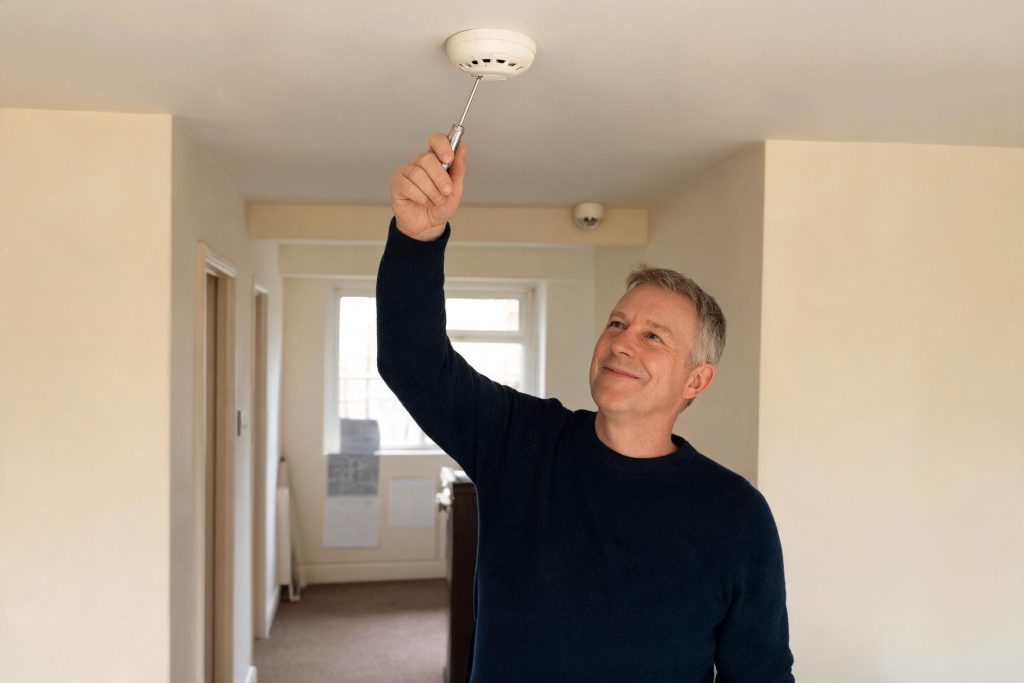
- Smoke and carbon monoxide alarms. Required on each storey and in rooms with a fixed combustion appliance, with rules on testing at the start of a tenancy and repair when reported.
- Fire safety. Furniture and furnishings regulations, escape routes, and in HMOs a full fire risk assessment under fire safety legislation.
- Legionella. Landlords must assess and control the risk from water systems. This is not a legal requirement to hold a certificate or to hire a consultant, but it is a duty to assess — see our guides to legionella risk assessments and what legionella is.
- Energy performance. A valid EPC, and minimum energy efficiency standards that restrict letting below a given rating.
- Housing conditions. Councils assess hazards under the Housing Health and Safety Rating System and can require works.
None of these requires the landlord personally to be trained. All of them require the landlord to know the duty exists, which is the practical argument for some structured learning even where the law does not demand it.
Where landlords get caught out
- Deposit protection and prescribed information. Protecting the deposit late, or failing to serve the prescribed information, can cost a penalty and block a possession claim. It is an administrative step with disproportionate consequences.
- Right to rent checks in England, done properly and at the right time.
- Legionella. Widely ignored because landlords assume it applies only to large buildings. The duty to assess applies to residential lettings.
- Licensing without realising. Selective licensing areas change, and a property that needed no licence in 2023 may need one now. Penalties for operating unlicensed are substantial.
- Record keeping. Gas certificates, alarm tests, inspection reports, correspondence about repairs. When a dispute reaches a tribunal, the landlord with dated records wins arguments the landlord with recollections does not.

A workable annual compliance rhythm
Most landlord trouble comes from dates, not from ignorance. A simple annual cycle per property prevents nearly all of it:
- Every year: gas safety check, alarm test at tenancy start and on change of tenancy, review of the legionella assessment if anything has changed in the water system.
- On a longer cycle: electrical inspection, EPC renewal, and any licence renewal (HMO, selective, or Rent Smart Wales).
- At every new tenancy: deposit protected within the statutory window, prescribed information served, right to rent checks where they apply, the required documents given to the tenant before you need them for a possession claim.
- Continuously: repairs logged with dates, correspondence kept, and contractor certificates filed on receipt rather than hunted for later.
A single spreadsheet with a row per property and a column per date does the job. Landlords who keep one rarely have licensing or tribunal problems; landlords who rely on memory eventually do.
Where training genuinely pays for itself
Even in England, where none of it is required, three areas repay a couple of hours:
- The duties you do not know exist. Legionella is the classic — a duty most landlords have never heard of, that takes an afternoon to discharge, and that a council can act on.
- Fire safety in HMOs. The gap between a domestic mindset and what an HMO fire risk assessment expects is wide, and enforcement here is active.
- Data protection. Landlords hold ID documents, bank details, references and immigration check records. Most have never considered how long they keep them or what happens when a tenant asks for a copy of everything held.
None of these is about passing an inspection. They are about the small number of things that turn a manageable landlord problem into an expensive one.
Landlords with staff or contractors
A landlord with a handful of properties and a maintenance person, or a small portfolio with an employee, picks up ordinary employer duties: health and safety training and supervision, safe systems for work at height and electrical work, and control of substances. Contractors bring their own duties, but the landlord still has to check competence rather than assume it.
For anyone managing properties as a business — including self-managing landlords in Wales, whose licence depends on it — the sensible framing is that you are running a small compliance operation whose product happens to be housing. The paperwork is the job.
New landlords: the first six things
If you are letting a property for the first time, the order that prevents the most trouble is:
- Check whether the property needs a licence — HMO rules, and your council’s selective or additional licensing scheme if it has one. In Wales, check your Rent Smart Wales position before you advertise.
- Get the safety certificates in place — gas, electrical, EPC — before a tenant moves in rather than after.
- Fit and test alarms, and record that you did it at the start of the tenancy.
- Do the legionella assessment. It is usually short, and it is the duty most first-time landlords have never heard of.
- Use a proper tenancy agreement and protect the deposit within the statutory window, serving the prescribed information.
- Tell your insurer and your lender that the property is let. Consent to let and landlord insurance are not optional extras, and a standard residential policy will not respond to a tenant claim.
None of that requires a course. It requires a list, done in order, before the keys change hands.
Accreditation schemes and landlord associations
Outside the statutory schemes, a parallel voluntary world exists: landlord accreditation schemes run by councils and by national associations, and membership bodies offering training, helplines and document templates.
Accreditation is not a legal requirement in England, and it does not replace a licence where one is needed. What it sometimes buys is practical: reduced licensing fees in some council areas, quicker processing, credibility with letting agents and lenders, and in a few selective licensing schemes, lighter conditions for accredited landlords. Whether that is worth the fee depends entirely on your council, which is a two-minute check on their licensing page.
The other thing membership tends to buy is early warning. Housing law changes frequently, and the landlords who get caught out are usually the ones who learned about a change from a tenant or an enforcement officer. A newsletter you actually read is worth more than a certificate you file.
Which courses suit landlords?
For landlords wanting structured awareness of the areas that generate the most risk:
- Legionella Awareness — the duty to assess, and what control measures look like in domestic systems
- Fire Safety Awareness — escape routes, alarms and the basics behind an HMO fire risk assessment
- Data Protection and GDPR Awareness — tenant references, ID documents and right to rent records are personal data (see what is GDPR)
Those three together cost £18 rather than £27, because any three courses trigger the pay-for-2-get-3 offer. Add them to the cart and the discount applies automatically. Landlords with contractors or staff often add Asbestos Awareness for pre-2000 properties, or Introduction to Health and Safety.
Said plainly: these are awareness courses, not the Rent Smart Wales approved training. If you are a self-managing landlord in Wales, you need the approved training for your licence, and no course from us or anyone else outside that approved list will substitute for it.
Frequently asked questions
Do landlords need training by law?
It depends on the nation. In Wales, self-managing landlords must complete approved training before applying for a Rent Smart Wales licence. In England there is no national landlord training requirement, though councils running selective or additional licensing schemes may attach conditions. Scotland requires landlord registration but no mandatory training course, while letting agents there face a qualification and training requirement.
What is the Rent Smart Wales training requirement?
Landlords and agents carrying out letting and management work at rental properties in Wales must hold a licence, and the applicant plus all connected users doing letting and management activities must complete approved training before submitting the licence application. Landlords who appoint an agent to do all that work do not need a licence or the training, but must still register.
Do landlords need a legionella risk assessment?
Landlords must assess and control the risk from legionella in water systems. There is no legal requirement to hold a certificate or to hire a consultant, and for a typical domestic property the assessment is straightforward, but the duty to assess applies. It is one of the most commonly overlooked landlord duties because people assume it only concerns large buildings.
What safety checks must landlords do every year?
An annual gas safety check by a Gas Safe registered engineer with a record given to tenants is the clearest annual duty. Electrical installations need periodic inspection by a qualified person with the report supplied to tenants, smoke and carbon monoxide alarms must be provided and tested at the start of a tenancy, and an EPC must be valid and meet minimum energy efficiency standards.
Does a landlord need a licence in England?
There is no national landlord licence in England, but mandatory HMO licensing applies to larger houses in multiple occupation, and individual councils run additional and selective licensing schemes in particular areas with their own conditions. Schemes change, so check the council's licensing pages for the specific postcode rather than relying on what was true a year ago.
Can an online course meet the Welsh landlord training requirement?
Only if it is training approved by Rent Smart Wales, which offers its own online and classroom training and approves external providers. A general awareness course from an unapproved provider does not meet the licensing requirement, however relevant its content. Check the approved list before paying for anything intended to satisfy the licence.
Compliance courses for landlords
£9 per course. CPD accredited, 100% online, verifiable e-certificate. Pay for 2, get 3 — any 3 courses for £18.
This article is general information, not legal advice. Landlord obligations differ substantially between England, Wales, Scotland and Northern Ireland, and between local authority areas within them. A CPD awareness course is not the approved training required for a Rent Smart Wales licence, and is not a qualification. Always check the current rules with your local authority, Rent Smart Wales, or the relevant registration body.