
Hand-arm vibration syndrome (HAVS) is permanent damage to the blood vessels, nerves, muscles and joints of the hands and arms, caused by regular use of vibrating tools such as breakers, grinders, hammer drills and chainsaws. It is preventable, but once it has developed it cannot be cured. Unusually for health and safety law, vibration comes with hard numbers: the Control of Vibration at Work Regulations 2005 set a daily exposure action value of 2.5 m/s² A(8), at which employers must act, and an exposure limit value of 5 m/s² A(8), which must not be exceeded. And contrary to a common belief, “anti-vibration” gloves are not a reliable way to control the risk.
At a glance: Nexis CPD’s £9 Vibration Awareness course helps workers and supervisors understand how vibration causes harm, the legal limits, the early warning signs and practical ways to reduce exposure. It is CPD accredited and 100% online with a verifiable e-certificate, and any three courses cost £18. It supports the information and training duty — it is not a substitute for an exposure assessment or for health surveillance by a competent occupational health provider.
What is hand-arm vibration syndrome?
Hand-arm vibration is vibration transmitted into the hands and arms from powered tools or equipment, or from holding materials being worked by machines. Regular, frequent exposure over months or years can cause a range of permanent conditions, together known as hand-arm vibration syndrome:
- Vascular damage — often called vibration white finger. Blood circulation in the fingers is affected, so they turn white (blanch) in attacks, typically in cold or wet conditions, then go red and painful as blood returns.
- Neurological damage — tingling, pins and needles and numbness in the fingers, loss of feeling, and difficulty with fine tasks such as doing up buttons.
- Musculoskeletal effects — loss of grip strength and pain in the hands, wrists and arms.
Vibration can also cause carpal tunnel syndrome, a nerve condition that causes pain, tingling and numbness in the hand. The damage is cumulative and, once established, largely irreversible — which is why the law focuses so heavily on prevention and early detection.
Who is at risk from hand-arm vibration?
Anyone who regularly uses hand-held or hand-guided powered equipment is potentially at risk. Common examples include:
- concrete breakers, road breakers and hammer drills;
- angle grinders, cut-off saws and other rotary tools;
- needle scalers, chipping hammers and impact wrenches;
- chainsaws, brush cutters and hedge trimmers;
- powered lawnmowers and compactors; and
- sanders and polishers, including in engineering and vehicle repair.
Construction, groundworks, highways maintenance, foundries, engineering, shipbuilding, forestry, grounds maintenance and vehicle repair are among the higher-risk sectors. Risk depends on both how much a tool vibrates and how long a person’s hands are actually in contact with it — the “trigger time” — each day.

What does the law require?
The Control of Vibration at Work Regulations 2005 apply to employers whose workers are exposed to vibration. Regulation 4 sets the key values for hand-arm vibration, averaged over an eight-hour working day, which is what “A(8)” means:
- an exposure action value (EAV) of 2.5 m/s² A(8); and
- an exposure limit value (ELV) of 5 m/s² A(8).
For whole-body vibration (explained below) the values are 0.5 m/s² A(8) and 1.15 m/s² A(8) respectively.
Around those values, HSE sets out what employers must do:
- Assess the risk — identify who is exposed and estimate their daily exposure.
- Eliminate or control exposure — above the EAV, HSE says you should be looking for “alternative processes, equipment and/or working methods which would eliminate or reduce exposure”, and in any case reduce exposure to as low as is reasonably practicable.
- Keep below the limit — make sure no one is exposed above the ELV.
- Provide health surveillance — HSE states: “You must provide health surveillance for all your employees who, despite your action to control the risk, are likely to be regularly exposed above the Exposure Action Value.”
- Give information and training — on the health effects, sources of vibration, their risk, how to recognise symptoms and how to reduce exposure, “in a way the employee can be expected to understand”.
- Consult — HSE notes that consulting trade union safety representatives or other employee representatives is a legal requirement.
What do the action value and limit value actually mean?
The EAV is the trigger point: once a worker’s daily exposure is likely to reach 2.5 m/s² A(8), the employer must take action to reduce it and must provide health surveillance and training. The ELV is a ceiling: 5 m/s² A(8) must not be exceeded. That makes vibration unusual — most health and safety duties are framed as “so far as is reasonably practicable”, but the ELV is a hard limit.
Because working in m/s² A(8) is awkward day to day, HSE provides an exposure calculator and a simple points system, in which the exposure action value is equivalent to 100 points and the exposure limit value to 400 points. Each tool is given a points-per-hour figure based on its vibration level, so a supervisor can add up a worker’s points across the tools they use in a shift and see immediately whether they are approaching the EAV or the ELV. The points and the legal values are two ways of expressing the same thing.
A worked example
Schedule 1 to the Regulations defines daily exposure as A(8) = ahv × √(T / T0), where ahv is the tool’s vibration magnitude, T is the trigger time and T0 is the eight-hour reference period. The square root is why exposure builds up faster than people expect. Take a tool with a vibration magnitude of 10 m/s²:
- after 30 minutes of trigger time, A(8) = 10 × √(0.5 ÷ 8) = 2.5 m/s² — the exposure action value is reached;
- after 2 hours of trigger time, A(8) = 10 × √(2 ÷ 8) = 5 m/s² — the exposure limit value is reached.
In other words, a heavily vibrating tool can take a worker to the legal limit well before lunch. That is why trigger time, not time on site, is the number that matters, and why the most effective controls reduce the tool’s vibration or the time the hands are on it.
How do you assess vibration exposure?
Exposure depends on two things: the vibration magnitude of the tool as used, and the trigger time. A good assessment:
- lists the tools and processes that cause vibration;
- uses representative vibration data for each tool — from the supplier, from published data for similar tools, or from measurement where needed;
- estimates realistic trigger times, which are often much shorter than the time a worker spends “on the job” but must not be guessed carelessly; and
- calculates each worker’s daily exposure against the EAV and ELV, using HSE’s calculator or points system.
The assessment is not a one-off. It should be reviewed when tools, tasks or working patterns change, and whenever health surveillance picks up a problem.
How can employers reduce vibration exposure?
The same logic as the wider hierarchy of control applies: start by designing the vibration out, and treat protective equipment as a last resort.
- Eliminate the task — for example using a remote-controlled demolition machine or a different construction method so that breaking by hand is not needed.
- Choose lower-vibration equipment — when buying or hiring, ask for vibration information and choose the tool that does the job with the least vibration.
- Maintain tools — blunt bits, worn discs and poorly maintained equipment vibrate more and take longer to do the job.
- Limit trigger time — plan work so exposure is shared, rotate tasks, and use the points system to keep each person within safe levels.
- Use the right tool for the job — an underpowered tool used for longer can give a higher exposure than a more powerful one used briefly.
- Keep workers warm and dry — cold reduces circulation in the fingers and increases the risk of blanching attacks.
Do anti-vibration gloves work?
This is a common misunderstanding. HSE advises that gloves marketed as “anti-vibration” are not particularly effective at reducing the vibration associated with the risk of HAVS, can even increase vibration at some frequencies, and that you should not generally rely on them for protection. Ordinary gloves and warm clothing are still valuable, because keeping the hands warm helps maintain circulation — but they do not control vibration exposure. The real controls are the tool, the task and the time.
What is health surveillance for vibration, and why does it matter?
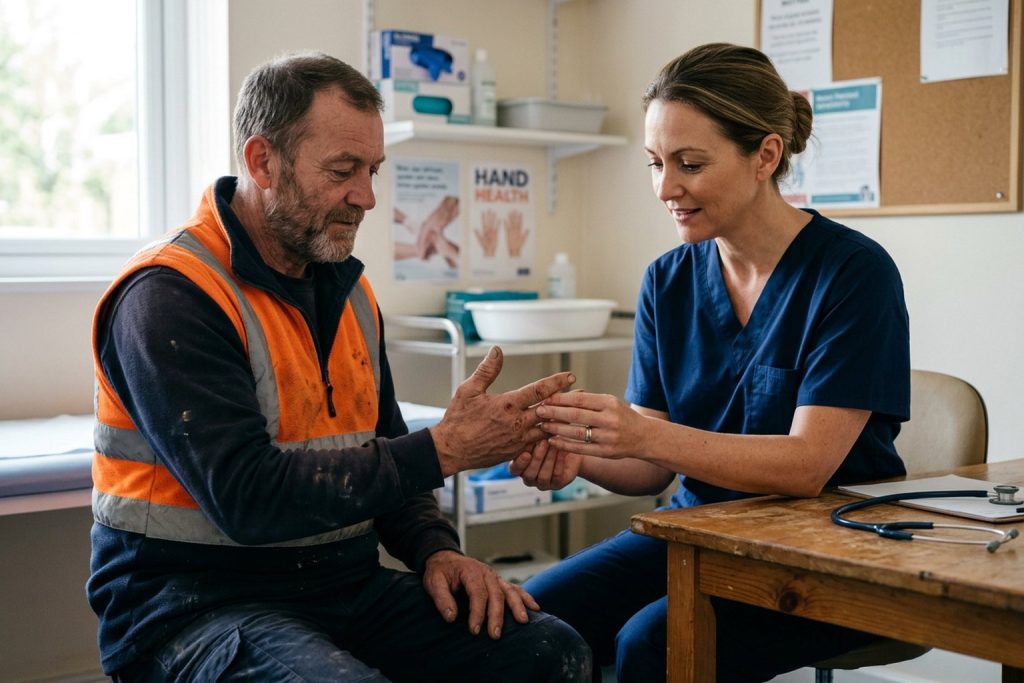
Health surveillance is a structured programme of checks, usually run by a competent occupational health provider, that looks for early signs of HAVS or carpal tunnel syndrome in workers who are regularly exposed above the EAV. Typically it involves a baseline questionnaire when someone starts vibration work, regular follow-up questionnaires, and referral for a more detailed assessment by a qualified occupational health professional if symptoms appear.
Its purpose is early detection, so that exposure can be reduced before the damage progresses. That only works if workers report symptoms honestly and early — which in turn depends on them understanding that reporting will lead to support, not to losing their job. The earlier symptoms such as tingling, numbness or fingers going white are reported, the better the chance of stopping them getting worse.
Do HAVS and carpal tunnel syndrome have to be reported?
Yes, in defined circumstances. Under RIDDOR, both hand-arm vibration syndrome and carpal tunnel syndrome are reportable occupational diseases when a doctor diagnoses them in writing and the person’s work involves regular use of percussive or vibrating tools (or, for HAVS, the holding of materials subject to percussive or vibrating processes). The employer then reports it to the enforcing authority.
What should a worker do if they notice symptoms?
Report them straight away — to your supervisor, your occupational health provider or through the health surveillance questionnaire — rather than waiting to see whether they go away. Symptoms to report include tingling or pins and needles after using tools, numbness, fingers going white (especially in the cold), pain, and reduced grip or dexterity. Early reporting allows exposure to be reduced while the damage may still be limited; carrying on regardless allows it to become permanent. Outside work, keep warm, and see your GP if symptoms persist.
What is whole-body vibration?
Whole-body vibration is transmitted through the seat or feet — typically from driving or riding on vehicles and mobile machinery over rough ground, such as quarry and construction plant, agricultural vehicles and some off-road vehicles. It is mainly associated with back pain. The same Regulations apply, with an exposure action value of 0.5 m/s² A(8) and an exposure limit value of 1.15 m/s² A(8). Controls include choosing suitable vehicles and seats, maintaining site roads and suspension, and adjusting speed to the terrain.

What vibration training do workers need?
Regulation-based training must be suitable for the risk. Workers exposed to vibration need to understand how vibration harms them, which of their tools and tasks create the highest exposure, how to recognise early symptoms, how to report them, and how to work in ways that reduce exposure — such as correct tool selection, maintenance, grip and keeping warm. Supervisors additionally need to understand exposure assessment and the points system so they can plan work within safe limits.
An online awareness course is a proportionate way to cover the knowledge element, and gives a certificate for your records. But it does not assess your workers’ actual exposure, replace health surveillance, or select your tools for you — those duties remain with the employer. Noise and vibration often come from the same tools, so see also our guide to noise at work, and for tool-specific risks our guide to abrasive wheels training.
Which courses support vibration safety?
Three £9 courses fit together well for teams using powered tools, each with a verifiable certificate:
- Vibration Awareness — HAVS, the legal limits, the points system, symptoms and controls.
- Noise Awareness — because the loudest tools are often the ones that vibrate most.
- Work Equipment Awareness — selecting, maintaining and using equipment safely.
Those three together cost £18 rather than £27, because any three courses trigger the pay-for-2-get-3 offer. Add them to the cart and the discount applies automatically. Construction employers may also find our guide to construction worker training requirements useful.
Frequently asked questions
What is hand-arm vibration syndrome (HAVS)?
HAVS is permanent damage to the blood vessels, nerves, muscles and joints of the hands and arms caused by regular use of vibrating tools. It can cause fingers to turn white in cold or wet conditions, tingling and numbness, and loss of grip strength. It is preventable but, once established, largely irreversible.
What are the legal limits for hand-arm vibration?
Regulation 4 of the Control of Vibration at Work Regulations 2005 sets a daily exposure action value of 2.5 m/s² A(8) and an exposure limit value of 5 m/s² A(8) for hand-arm vibration. At the action value employers must act to reduce exposure and provide health surveillance and training; the limit value must not be exceeded.
What is the HSE vibration points system?
HSE’s points system is a simple way of adding up a worker’s daily vibration exposure. The exposure action value is equivalent to 100 points and the exposure limit value to 400 points. Each tool has a points-per-hour figure, so supervisors can total a worker’s points across a shift to see whether they are approaching either value.
Do anti-vibration gloves protect against HAVS?
No, they should not be relied on. HSE advises that gloves marketed as anti-vibration are not particularly effective at reducing the vibration associated with HAVS and can increase vibration at some frequencies. Gloves are still useful for keeping hands warm, which helps circulation, but exposure must be controlled through tool choice, maintenance and limiting trigger time.
Is health surveillance a legal requirement for vibration?
Yes, for employees who, despite the employer’s control measures, are likely to be regularly exposed above the exposure action value. Health surveillance is usually delivered by a competent occupational health provider and aims to detect early signs of HAVS or carpal tunnel syndrome so exposure can be reduced before the condition progresses.
Is HAVS reportable under RIDDOR?
Yes, in defined circumstances. Hand-arm vibration syndrome and carpal tunnel syndrome are reportable occupational diseases under RIDDOR when a doctor diagnoses them in writing and the person’s work involves regular use of percussive or vibrating tools, or for HAVS the holding of materials subject to percussive or vibrating processes.
Protect your team’s hands today
£9 per course. CPD accredited, 100% online, verifiable e-certificate. Pay for 2, get 3 — any 3 courses for £18.
This article is general information, not legal or medical advice. Anyone with symptoms such as tingling, numbness or fingers turning white should report them and seek advice from an occupational health professional or their GP. A Nexis CPD awareness course is CPD accredited but is not a regulated qualification; it supports the information and training duty but does not replace an exposure assessment, control measures or health surveillance, which are the employer’s legal responsibilities. The Control of Vibration at Work Regulations 2005 apply in Great Britain; Northern Ireland has equivalent regulations. Values and duties cited are drawn from legislation.gov.uk and HSE guidance at the time of writing.