
No — there is no legal maximum temperature for working in the UK. The Health and Safety Executive (HSE) says so directly: “There’s no law for maximum working temperature, or when it’s too hot to work, because every workplace is different.” What the law does require, under regulation 7 of the Workplace (Health, Safety and Welfare) Regulations 1992, is that the temperature in indoor workplaces during working hours is “reasonable”. There is guidance on a minimum — normally at least 16°C, or 13°C for physically demanding work — but even that is guidance rather than a fixed legal limit.
At a glance: Nexis CPD’s £9 Managing Temperature in the Workplace course explains what the law requires, how heat and cold affect people at work, and the practical controls employers and managers can use. It is CPD accredited and 100% online with a verifiable e-certificate, and any three courses cost £18. It supports your risk assessment — it does not replace it.
Is there a maximum temperature for working in the UK?
No. Despite what many people assume, no UK law sets a temperature at which work must stop. HSE explains that an upper limit would not be practical, because in some workplaces high temperatures are an unavoidable part of the work itself — think of bakeries, commercial kitchens, foundries, glassworks and laundries. A single legal maximum would either be meaningless for those workplaces or impossible for them to meet.
Trade unions and others have campaigned over the years for a statutory maximum working temperature, but none has been introduced. So if you read online that “it’s illegal to work above 30°C”, that is not correct. The absence of a legal maximum does not mean anything goes, though. The law replaces a single number with a duty to keep conditions reasonable and to manage the risk — and that duty is enforceable.
This is an area to watch. In June 2026, HSE said it is “progressing the review of guidance and associated code of practice (ACOP) for the Workplace (Health, Safety and Welfare) Regulations 1992”, and the question of a maximum temperature for indoor workplaces was debated in the House of Lords in July 2026. At the time of writing, however, the legal position is unchanged. In HSE’s own words: “While there is no legal maximum temperature for workplaces, heat is classed as a hazard and should be treated like other hazards.” If the code of practice is updated, the guidance figures in this article may change.
What is the minimum temperature for working?
HSE guidance says the minimum temperature in an indoor workplace should normally be at least 16°C, or 13°C if much of the work involves rigorous physical effort. These figures come from the Approved Code of Practice that accompanies the Workplace Regulations. Note the word “normally”: they are the expected benchmark rather than an absolute legal limit, and there are workplaces — cold stores, chilled food production, some warehouses — where maintaining 16°C is not reasonably practicable because of the work itself. In those cases the employer must take other steps to protect people, such as providing heated rest areas, suitable clothing and limits on time spent in the cold.
What does the law actually say about workplace temperature?
Regulation 7 of the Workplace (Health, Safety and Welfare) Regulations 1992 is short. Its main requirements are that:
- “During working hours, the temperature in all workplaces inside buildings shall be reasonable.”
- Where necessary, workplaces must be adequately thermally insulated, having regard to the type of work and physical activity, and excessive effects of sunlight on temperature must be avoided.
- “A method of heating or cooling shall not be used which results in the escape into a workplace of fumes, gas or vapour” of a kind likely to be injurious or offensive to anyone.
- “A sufficient number of thermometers shall be provided to enable persons at work to determine the temperature in any workplace inside a building.”
That last point surprises many employers: you are expected to provide thermometers so people can actually check the temperature. The regulation applies to workplaces inside buildings; outdoor work is covered instead by the general duty to assess and control risks. Regulation 7 sits alongside the broad duty in section 2 of the Health and Safety at Work etc. Act 1974 to protect employees’ health, safety and welfare so far as is reasonably practicable.
What must employers do when it is too hot?
Because there is no maximum, the key legal tool is the risk assessment required by the Management of Health and Safety at Work Regulations 1999. If heat is a significant risk in your workplace, you must assess it and put sensible controls in place.
HSE describes six basic factors that affect how hot or cold people feel, and a good assessment looks at all of them rather than the thermometer alone:
- Air temperature — the temperature of the air around the person.
- Radiant temperature — heat radiating from the sun, ovens, furnaces or machinery, which can influence how hot a place feels more than the air temperature does.
- Air velocity — air movement, which can help cool people.
- Humidity — moisture in the air, which reduces the body’s ability to cool through sweating.
- Clothing — including uniforms and protective equipment, which can trap heat.
- Metabolic heat — how physically demanding the work is.
Practical controls in hot weather include:
- using fans, air conditioning or portable coolers, and opening windows where it helps;
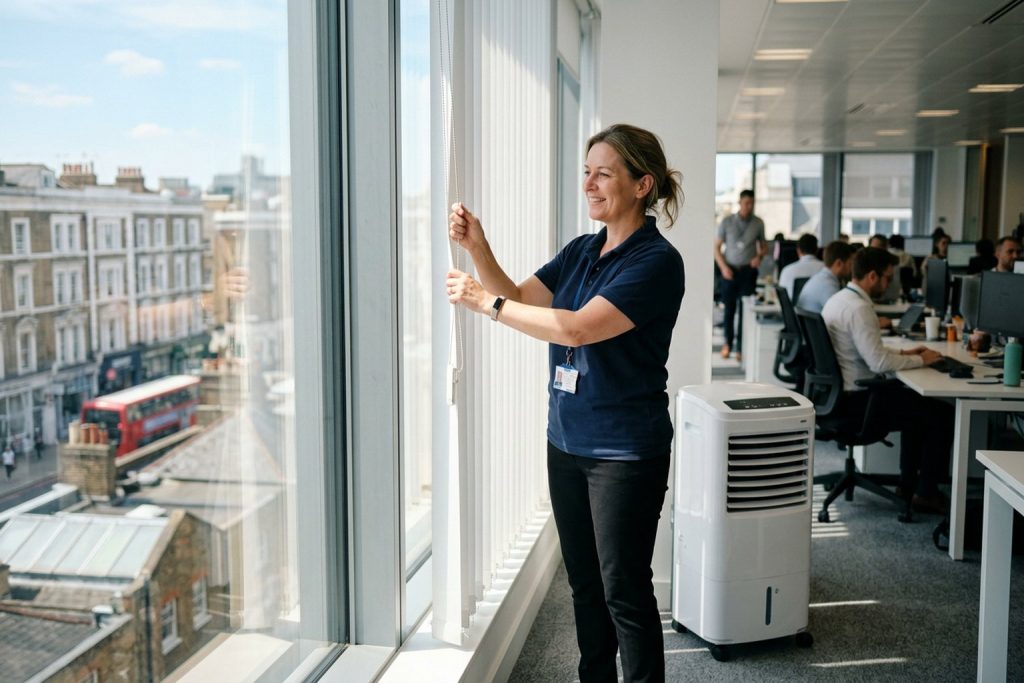
- fitting blinds or reflective film to reduce sunlight, and moving workstations away from direct sun or heat sources;
- relaxing dress codes and uniform rules where it is safe to do so;
- providing easy access to cool drinking water and encouraging people to drink regularly;
- allowing more frequent breaks, and rotating hot or heavy tasks;
- scheduling strenuous work for cooler parts of the day; and
- keeping a closer eye on people who are more vulnerable to heat.
The UK Health Security Agency issues Heat-Health Alerts during hot spells, and these are a useful prompt to review your arrangements before the heat arrives rather than during it.
Are workers entitled to water and extra breaks in hot weather?
Workers are entitled to drinking water at all times, hot or not. Regulation 22 of the Workplace Regulations states: “An adequate supply of wholesome drinking water shall be provided for all persons at work in the workplace.” In a heatwave that duty matters more than ever, and water should be easy to reach rather than locked in a distant kitchen.
Breaks are a different story. Under regulation 12 of the Working Time Regulations 1998, an adult worker whose daily working time is more than six hours is entitled to a rest break of at least 20 minutes. There is no extra statutory break entitlement triggered by heat. But an employer’s risk assessment may well show that additional or longer breaks are needed to keep people safe in hot conditions — so extra breaks are frequently the right answer even though no law names a number.
What should a workplace temperature risk assessment cover?
A useful assessment is short and practical. It should identify the areas and tasks where temperature is likely to become a problem (sun-facing offices, kitchens, warehouses, vehicles, outdoor work), consider all six thermal comfort factors rather than air temperature alone, identify who is most at risk, and set out the controls you will use and when they kick in — for example, a plan that is triggered by a Heat-Health Alert. It should also say how staff can raise concerns and how you will check that the controls are working. Review it before summer and winter, and after any incident. Our guide to risk assessment explains the five steps.
Can I refuse to work or go home if it is too hot?
There is no general legal right to stop work or go home simply because it feels too hot. If you are uncomfortable, raise it with your manager or safety representative — employers must consult employees on health and safety matters, and many issues are resolved quickly with fans, breaks or a relaxed dress code.
Separately, employment law protects employees from being dismissed or treated unfavourably for leaving, or refusing to return to, their place of work in circumstances of danger they reasonably believe to be serious and imminent. That protection is aimed at genuine danger, not ordinary discomfort, and whether it applies depends on the facts. If you believe conditions are genuinely dangerous — for example someone is showing signs of heat stroke — deal with the emergency first and escalate. This article is general information, not legal advice.
What about working in the cold?
The same “reasonable” test applies to cold indoor workplaces, with the 16°C and 13°C guidance figures as the benchmark. Where the work itself requires low temperatures — cold stores, chilled food handling, some warehouses and distribution centres — the employer should:
- provide suitable warm clothing and, where needed, insulated gloves and footwear;
- provide heated rest areas and warm drinks;
- limit time spent in the coldest areas and plan regular warming breaks;
- reduce draughts and keep doors to chilled areas closed where possible; and
- check that heating systems do not release harmful fumes, as regulation 7 requires.
Cold is not just uncomfortable. It reduces dexterity and concentration, which increases the risk of accidents, and it worsens some health conditions.

Which workers are most at risk from heat and cold?
Some people need extra attention in your risk assessment:
- New and expectant mothers — the Management Regulations require employers to assess risks to women of childbearing age and new and expectant mothers, and heat is a recognised risk in pregnancy.
- Older workers and people with health conditions such as heart or respiratory disease, or who take medication that affects how the body regulates temperature.
- Young workers, who may be less aware of risks or less willing to speak up.
- People wearing protective equipment, which can make heat far harder to tolerate.
- People working alone, who may not have anyone to notice the early signs of heat illness.
Heat and cold can also add to stress and fatigue — see our guide to work-related stress.
What about outdoor workers?
Regulation 7 applies to workplaces inside buildings, so it does not cover outdoor work. Construction workers, gardeners, road workers and delivery drivers are protected instead by the general duty to assess and manage risk. In hot weather that includes planning for sun exposure and heat illness — shade, water, breaks, suitable clothing and scheduling the heaviest work away from the hottest part of the day. In cold weather it means warm, waterproof clothing, warming breaks and awareness of cold stress.

How do you recognise heat illness?
Heat exhaustion can include headache, dizziness, nausea, heavy sweating, intense thirst, cramps and tiredness. If someone has these symptoms, move them somewhere cool, have them rest and drink water, and cool their skin. Heat stroke is a medical emergency: if a person becomes confused, stops sweating, has a very high temperature, collapses or has a seizure, call 999 and cool them while you wait. Knowing the signs is one of the most valuable things staff can learn before a heatwave. It is also worth checking that your first-aid arrangements cover hot weather — see our guide to first aid training requirements — and that people working alone have a way to call for help.
Which courses support managing workplace temperature?
Three £9 courses fit together well for managers and supervisors, each with a verifiable certificate for your records:
- Managing Temperature in the Workplace — the law, thermal comfort, heat and cold stress, and practical controls.
- Risk Assessment Awareness — because the risk assessment is where temperature duties are actually met.
- Introduction to Health and Safety — the wider framework of employer and employee duties.
Those three together cost £18 rather than £27, because any three courses trigger the pay-for-2-get-3 offer. Add them to the cart and the discount applies automatically. For how training duties work more broadly, see our guide to health and safety training requirements.
Frequently asked questions
Is there a maximum temperature for working in the UK?
No. There is no law setting a maximum working temperature. HSE states that there is no law for maximum working temperature, or when it is too hot to work, because every workplace is different. Instead, regulation 7 of the Workplace (Health, Safety and Welfare) Regulations 1992 requires indoor workplace temperatures to be reasonable, and employers must assess and control the risks of heat.
What is the minimum temperature for working indoors?
HSE guidance says the minimum temperature in an indoor workplace should normally be at least 16°C, or 13°C where much of the work involves rigorous physical effort. The figures come from the Approved Code of Practice to the Workplace Regulations and are a benchmark rather than an absolute legal limit, so workplaces that must be cold, such as cold stores, must protect workers in other ways.
Can I go home if it is too hot at work?
There is no general legal right to go home because it feels too hot. Raise the issue with your manager or safety representative, as employers must manage the risk. Employment law does protect employees who leave or refuse to return to work in circumstances of danger they reasonably believe to be serious and imminent, but that is aimed at genuine danger rather than discomfort. This is general information, not legal advice.
Do employers have to provide air conditioning?
No law specifically requires air conditioning. Employers must keep indoor temperatures reasonable and manage the risk of heat through their risk assessment, which might involve fans, blinds, moving workstations, relaxed dress codes, extra breaks and drinking water, as well as cooling systems where appropriate.
Do workplaces need a thermometer?
Yes. Regulation 7 of the Workplace Regulations requires a sufficient number of thermometers to be provided so that people at work can determine the temperature in any workplace inside a building.
Does the temperature law apply to outdoor workers?
Regulation 7 applies only to workplaces inside buildings. Outdoor workers are protected by the general duty on employers to assess and control risks to health and safety, which in hot weather includes planning for sun exposure, heat illness, water and rest breaks, and in cold weather includes warm clothing and warming breaks.
Be ready before the next heatwave
£9 per course. CPD accredited, 100% online, verifiable e-certificate. Pay for 2, get 3 — any 3 courses for £18.
This article is general information, not legal or medical advice. In a medical emergency, including suspected heat stroke, call 999. A Nexis CPD awareness course is CPD accredited but is not a regulated qualification and does not by itself satisfy an employer’s legal duties, which are met through a suitable risk assessment and the controls it identifies. The Workplace (Health, Safety and Welfare) Regulations 1992 apply in Great Britain; Northern Ireland has equivalent regulations. Duties and figures cited are drawn from legislation.gov.uk and HSE guidance at the time of writing.