
To drive a lorry, bus or coach professionally in Great Britain you must hold a valid Driver Certificate of Professional Competence (Driver CPC) and complete 35 hours of DVSA-approved periodic training every five years to keep it. New drivers must first pass the initial Driver CPC qualification alongside their vocational licence. Driving professionally without a valid Driver CPC can bring a fine of up to £1,000, and you must carry your Driver Qualification Card (DQC). One clarification up front: although people often search for “driver CPD”, the correct legal term is Driver CPC — a specific statutory scheme run by the Driver and Vehicle Standards Agency (DVSA), not general continuing professional development.
At a glance: Nexis CPD offers £9 CPD-accredited online awareness courses — such as first aid, manual handling and lone working awareness — that give professional drivers useful background knowledge. Each is 100% online with a verifiable e-certificate, and any three cost £18. Important: these are not DVSA-approved Driver CPC courses and do not count towards your 35 hours of periodic training — only approved courses at approved centres do.
What is Driver CPC — and is it the same as “driver CPD”?
Driver CPC stands for the Driver Certificate of Professional Competence. It is a legal qualification that professional lorry, bus and coach drivers must hold, introduced across the UK to raise driving standards and road safety. It is often confused with, or mistyped as, “driver CPD” — but the two are not the same. Ordinary continuing professional development (CPD) is voluntary self-directed learning. Driver CPC is a mandatory, structured scheme with defined tests, approved courses, a set number of hours and a photocard you must carry. Get it wrong and you are committing an offence; general CPD carries no such penalty.
The scheme has two parts:
- the initial qualification, which new professional drivers must pass before driving for a living; and
- periodic training — 35 hours every five years — which qualified drivers must keep doing to stay entitled to drive professionally.
It is enforced by the DVSA, and the training is delivered only by training centres and courses that the DVSA has approved. Driver CPC is one of the relatively few areas where “CPD-style” ongoing training is a genuine legal requirement rather than good practice — which is exactly why it is worth understanding precisely.
Who needs Driver CPC?
You generally need Driver CPC if you drive professionally and your vehicle needs a category C (lorry/LGV, over 3,500 kg) or category D (bus or coach/PCV) licence — including the smaller C1 and D1 categories when driving for hire or reward. “Professionally” means driving is the principal activity of your job, such as HGV work, bus and coach services, or delivery driving in large goods vehicles.
You do not need Driver CPC simply for holding the licence — you need it to use that licence commercially. There are also exemptions (covered below) for people who drive these vehicles occasionally and non-commercially. If your role is warehouse-based with some driving, our guide to warehouse worker training requirements covers the related duties around lift trucks and manual handling that sit alongside driving.
How do new drivers get their initial Driver CPC?
New drivers gain the initial Driver CPC by passing a set of tests, most of which are taken as part of getting the vocational (C or D) licence. The initial qualification is made up of four parts:
- Part 1 — theory test: multiple-choice questions and a separate hazard perception test.
- Part 2 — case studies: a computer-based test presenting real-world driving scenarios.
- Part 3 — practical driving test: the on-road driving ability test in the relevant vehicle.
- Part 4 — practical demonstration test: a “show me, tell me” style vehicle safety assessment, covering loading, security, preventing trafficking, and vehicle checks.
Parts 1 and 3 are the tests you take to get the licence itself; Parts 2 and 4 are the additional Driver CPC tests. Pass all four and you gain your first Driver Qualification Card and can drive professionally. From that point, the five-year periodic training clock starts.
What is the 35 hours of periodic training, and how often?
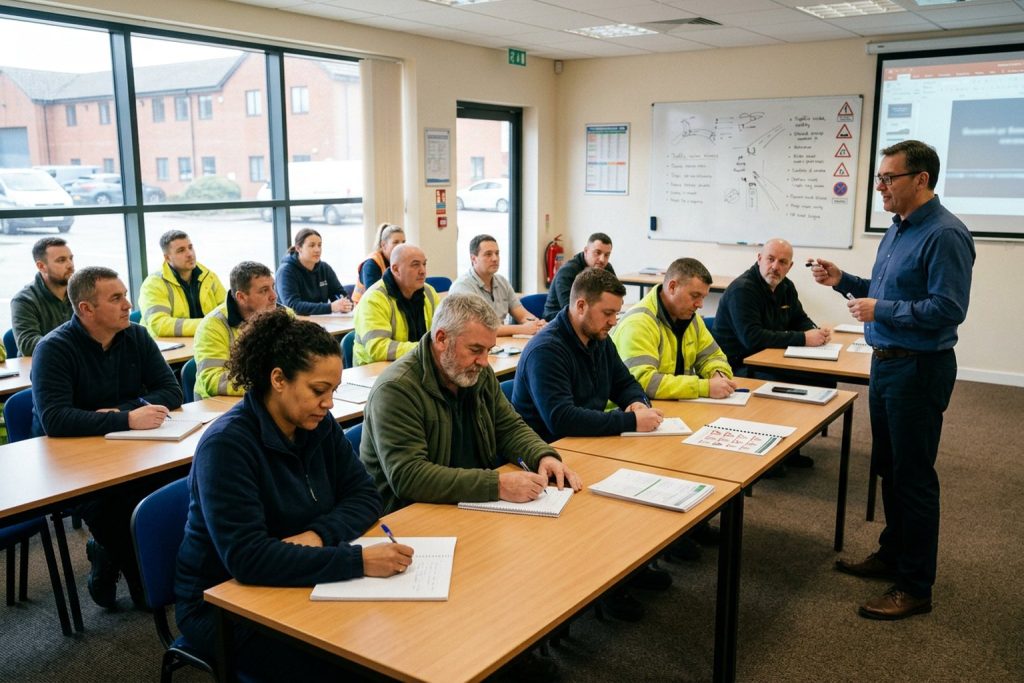
Once qualified, you must complete 35 hours of periodic training every five years to keep your Driver CPC. Miss the deadline shown on your card and you lose the entitlement to drive professionally until you have completed the 35 hours. The rules that make this training valid are specific:
- Training must be delivered by a DVSA-approved training centre on a DVSA-approved course (course and centre approval is administered through JAUPT on the DVSA’s behalf). Training from anyone else does not count.
- You can do up to 12 hours of e-learning (interactive online courses) as part of the 35 hours — the rest must be trainer-led.
- An International Driver CPC course must be at least 7 hours long, and may be split over two consecutive days.
- A National Driver CPC course must be at least 3 hours 30 minutes long.
You can spread the 35 hours across the five years however suits you — many drivers do one seven-hour module a year — or complete them in a block. You can check how many approved hours you have already done using the Government’s check your Driver CPC periodic training hours service. Courses often cover exactly the sort of safety knowledge good drivers need anyway: drivers’ hours and tachographs, safe loading, vulnerable road users, first aid at the roadside, and health and wellbeing behind the wheel.
What is the difference between National and International Driver CPC?
This is the part that has changed most recently, and it trips people up. Following reforms introduced by the Department for Transport, there are now two types of periodic Driver CPC:
- International Driver CPC — the traditional route. If you complete your full 35 hours using only International courses, you keep an International Driver CPC and can drive professionally both in Great Britain and in the EU.
- National Driver CPC — a more flexible route for drivers who only work within Great Britain. It allows shorter modules (from 3.5 hours), driving-assessment and e-learning options, and other flexibilities.
The crucial catch: if you include any National training courses in your 35 hours, you will hold a National Driver CPC and will not be able to drive professionally in Europe. To keep the ability to drive in the EU, all 35 hours must be International courses. Choose your course type deliberately based on whether you ever drive abroad for work.

What is the Driver Qualification Card, and what are the penalties?
When you complete your initial qualification (Parts 2 and 4) or your 35 hours of periodic training, the DVSA issues a Driver Qualification Card (DQC) — the photocard that proves you hold a valid Driver CPC. You must carry your DQC while driving professionally and be able to show it to enforcement officers such as the DVSA or the police.
The penalties are real. You can be fined up to £1,000 for driving professionally without a valid Driver CPC, and there are separate fines for not carrying your card. Because the DQC is valid for five years, it expires in step with your periodic-training cycle: complete your next 35 hours before the deadline and a new card is issued. Both the driver and, in many cases, the operator can face enforcement action, so keeping training up to date is a shared responsibility.
What happens if your Driver CPC lapses?
If your five-year deadline passes before you have completed the 35 hours, your Driver CPC becomes invalid and you must stop driving professionally until you have finished the outstanding training. The reassuring part is that you do not have to retake the initial qualification — the four-part tests — again. You simply complete the remaining periodic-training hours with an approved provider, and a new Driver Qualification Card is issued once you reach 35 hours. Any approved hours you had already logged in that cycle still count towards the total.
There is no grace period for continuing to drive professionally on an expired card, so employers should track every driver’s deadline well in advance. A lapsed card grounds the driver on the day it expires — not at some later renewal point — which can pull a vehicle off the road at short notice. Planning the 35 hours across the five years, rather than leaving them to the final months, is the simplest way to avoid that.
Who is exempt from Driver CPC?
Some drivers of lorries, buses and coaches are exempt, mainly where the driving is occasional, non-commercial, or clearly not the main job. Typical exemptions include driving:
- a vehicle to or from a pre-booked appointment at an official vehicle-testing centre, or to or from your Driver CPC test;
- a vehicle being used for non-commercial carriage of passengers or goods for personal use;
- a vehicle carrying material or equipment you use in your job, provided driving is not your main activity;
- a vehicle undergoing road tests for technical development, repair or maintenance; or
- in connection with certain rescue, emergency or civil-defence work.
Exemptions are specific and easy to misread, so check your exact situation against the current DVSA guidance before relying on one. If you are unsure whether your driving is “professional” for CPC purposes, treat it as in scope until you have confirmed otherwise — the fine for getting it wrong is significant.
Do online awareness courses count towards Driver CPC?
This is the most important honesty point in this article: no ordinary online awareness course counts towards your 35 hours of Driver CPC. Only courses that the DVSA has approved, delivered by approved training centres, are recorded against your periodic training total. A general CPD course — including a Nexis CPD course — is not a DVSA-approved Driver CPC course, will not appear on your official training record, and cannot be used to meet the 35-hour requirement.
What such courses can do is build genuinely useful background knowledge for a driving career — first aid, safe handling of loads, staying safe when you work alone — as part of your wider personal development or an employer’s induction. But keep the two things separate in your mind: Driver CPC hours come only from approved providers; everything else is complementary learning. Any provider suggesting a cheap online course “counts” towards Driver CPC is misleading you.
How Nexis CPD courses complement a professional driver’s development
With that boundary clearly drawn, several of our £9 courses map well onto the real risks of professional driving and make sensible complementary learning for drivers and transport employers — as background knowledge, induction support or general CPD, not as Driver CPC hours:
- Workplace First Aid Awareness — the basics of responding to an incident, useful at the roadside or depot. See our guide to first aid training requirements for what the law expects of employers.
- Manual Handling Awareness — loading, strapping and unloading are a leading cause of driver injury; our overview of manual handling training requirements explains the duties.
- Lone Working Awareness — long-distance drivers spend most of the day alone; our article on whether lone working is legal covers employer responsibilities.
Those three together cost £18 rather than £27, because any three courses trigger the pay-for-2-get-3 offer. Add them to the cart and the discount applies automatically. To book genuine Driver CPC periodic training, use a DVSA-approved training centre and check your hours on the Government service linked above.
Frequently asked questions
How many hours of Driver CPC training do I need?
Qualified professional drivers must complete 35 hours of DVSA-approved periodic training every five years to keep their Driver CPC. You can spread the hours across the five years or take them in a block, and you can check your recorded hours using the Government’s “check your Driver CPC periodic training hours” service. Up to 12 hours can be e-learning; the rest must be trainer-led.
Is Driver CPC the same as “driver CPD”?
No. The correct legal term is Driver CPC — the Driver Certificate of Professional Competence, a mandatory scheme run by the DVSA for professional lorry, bus and coach drivers. It is often mistyped as “driver CPD”, but ordinary CPD is voluntary self-directed learning, whereas Driver CPC has defined tests, approved courses, a set number of hours, a photocard you must carry, and legal penalties for non-compliance.
What is the fine for driving without Driver CPC?
You can be fined up to £1,000 for driving professionally without a valid Driver CPC. There are also separate penalties for failing to carry your Driver Qualification Card (DQC) while driving. You must carry the DQC and show it to enforcement officers such as the DVSA or police on request.
What is the difference between National and International Driver CPC?
If you complete all 35 hours using International courses, you hold an International Driver CPC and can drive professionally in Great Britain and the EU. If you include any National courses (which can be shorter and more flexible), you hold a National Driver CPC and cannot drive professionally in Europe. Choose the course type based on whether you ever drive abroad for work.
Do new drivers have to do anything before periodic training?
Yes. New professional drivers must first pass the initial Driver CPC qualification: Part 1 (theory and hazard perception), Part 2 (case studies), Part 3 (practical driving test) and Part 4 (practical demonstration/vehicle safety). Parts 1 and 3 are taken to get the vocational licence; Parts 2 and 4 are the additional Driver CPC tests. After qualifying, the five-year periodic-training cycle begins.
Do online CPD courses count towards Driver CPC hours?
No. Only DVSA-approved courses delivered by DVSA-approved training centres count towards your 35 hours. A general online awareness or CPD course — including a Nexis CPD course — is not a DVSA-approved Driver CPC course, will not appear on your official record, and cannot be used to meet the requirement. Such courses are useful complementary learning only, not Driver CPC hours.
Who is exempt from Driver CPC?
Exemptions generally cover occasional, non-commercial or non-primary driving — for example driving to or from a vehicle test or your Driver CPC test, carrying goods or passengers non-commercially for personal use, or carrying equipment you use in a job where driving is not your main activity. Exemptions are specific, so always check your exact circumstances against current DVSA guidance before relying on one.
Support your development today
£9 per course. CPD accredited, 100% online, verifiable e-certificate. Pay for 2, get 3 — any 3 courses for £18.
This article is general information, not legal advice. Driver CPC is a statutory scheme administered by the DVSA and the rules — including the National and International routes, course lengths, exemptions and penalties — can change; always confirm current requirements at gov.uk before making decisions. Nexis CPD awareness courses are CPD-accredited but are not DVSA-approved Driver CPC courses: they do not count towards the 35 hours of periodic training and confer no Driver CPC entitlement. Only DVSA-approved courses delivered by DVSA-approved training centres count. Figures cited (including the 35-hour requirement, the up-to-£1,000 fine, the 12-hour e-learning cap and the 7-hour and 3.5-hour course minimums) are drawn from gov.uk guidance at the time of writing.