
Dementia is not a disease, and it is not a normal part of getting old. It is a set of symptoms — memory loss, confusion, changes in thinking and behaviour — caused by different diseases that damage the brain. Understanding that one distinction changes how you support someone living with it: you are not treating “old age”, you are supporting a person whose brain is being affected by a specific condition, and who is still very much themselves.
This guide is a plain-English introduction for care workers, support staff, and anyone who wants to understand dementia and how to support someone living with it well.
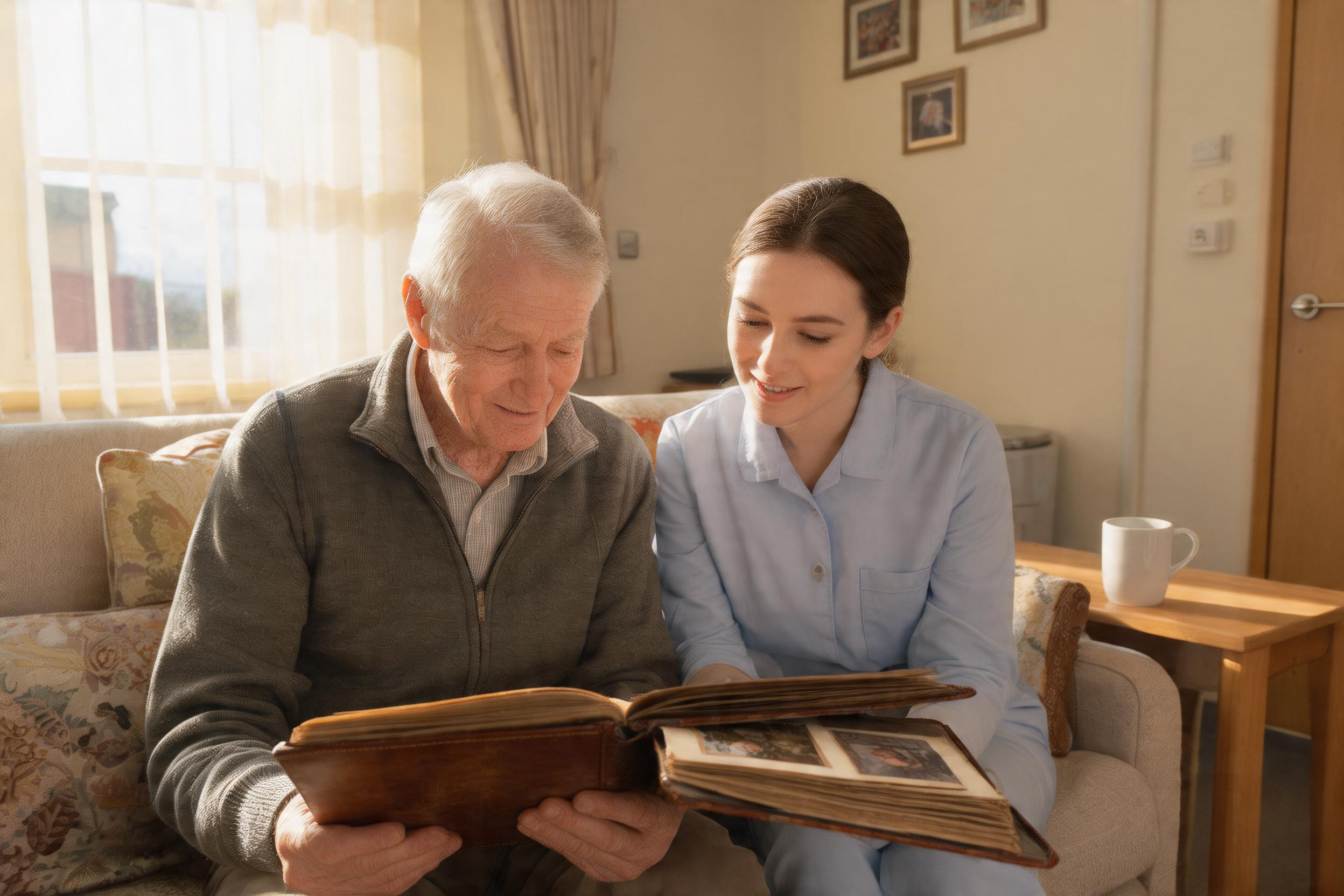
What dementia actually is
Dementia is an umbrella term. It describes a group of symptoms associated with an ongoing decline of brain function. Those symptoms are caused by diseases that damage nerve cells in the brain — which is why dementia is progressive, meaning it gets worse over time.
Common symptoms include:
- Memory loss, particularly of recent events
- Difficulty concentrating, planning or organising
- Problems with language — finding the right word, following a conversation
- Confusion about time or place
- Changes in mood, personality or behaviour
Dementia is not a natural consequence of ageing. Many people live into old age with no dementia at all. It is caused by disease, and while age is the biggest risk factor, the two are not the same thing.
Dementia and Alzheimer’s — the difference
People use the words interchangeably, but they are not the same. Dementia is the set of symptoms. Alzheimer’s disease is one of the conditions that causes it — the most common one. Saying someone “has dementia” describes what they are experiencing; saying they have Alzheimer’s names the underlying disease.
The main types
| Type | In brief |
|---|---|
| Alzheimer’s disease | The most common cause. Usually begins with memory problems, especially for recent events, and develops gradually. |
| Vascular dementia | The second most common. Caused by reduced blood flow to the brain. Can bring problems with planning and concentration, and sometimes sudden step-changes rather than gradual decline. |
| Dementia with Lewy bodies | Caused by tiny protein deposits in the brain. Can involve difficulty staying focused, visual hallucinations, sleep disturbance, and movement problems similar to Parkinson’s. |
| Frontotemporal dementia | Less common and often affecting younger people. Early changes are frequently to personality, behaviour or language, rather than memory. |
Some people have mixed dementia — more than one type at once, most commonly Alzheimer’s and vascular dementia together. The type matters, because different types bring different challenges and the support that helps one person may not suit another.
How dementia affects a person
Beyond memory, dementia can affect almost every aspect of daily life — but unevenly, and differently for each person. Someone may manage a complex conversation but be unable to work out how to make a cup of tea. They may not recognise a family member yet respond warmly to a familiar song.
Two things are consistently true and worth holding onto:
- The person is still there. Their preferences, history, sense of humour and dignity remain, even as their abilities change.
- Feelings outlast facts. A person may forget a conversation within minutes but retain the emotion it created — which is why how you make someone feel matters more than what they can recall.

Supporting someone with dementia
Good dementia support is built on a few principles that anyone can learn. This is the heart of person-centred care.
- See the person, not the condition. Know their life story, their routines, what matters to them. Care built around the individual works far better than care built around the diagnosis.
- Communicate simply and calmly. Short sentences, one thing at a time, plenty of time to respond. Use a warm tone and open body language — much is understood from how you speak, not just the words.
- Do not argue or correct unnecessarily. If someone believes it is 1975 or asks for a parent who has died, entering their reality gently is usually kinder and more effective than repeatedly confronting them with facts that distress them.
- Support independence. Do things with the person, not for them, wherever you can. Retaining ability and choice protects dignity and wellbeing.
- Watch for unmet needs behind behaviour. Distress or agitation is often communication — pain, hunger, tiredness, fear or boredom that the person cannot express directly. Look for the cause rather than just managing the behaviour.
- Adapt the environment. Good lighting, clear signs, familiar objects and reduced noise all help someone orient themselves and feel secure.
Dementia in the care sector
For anyone working in care, dementia awareness is not optional. A large proportion of people using care services are living with dementia, and understanding it underpins safe, dignified, effective support. It also connects to other duties — mental capacity, the Deprivation of Liberty Safeguards, and safeguarding, since people with dementia can be more vulnerable to abuse and neglect. See what safeguarding means.
Where to get real support
This guide is an introduction, not a substitute for medical advice or a diagnosis. Anyone worried about their own memory or someone else’s should see a GP — an early, accurate diagnosis opens the door to treatment, support and planning. For information and support:
Frequently asked questions
What is dementia?
Dementia is an umbrella term for a group of symptoms — including memory loss, confusion, and changes in thinking and behaviour — caused by different diseases that damage the brain. It is progressive, meaning it worsens over time. Dementia is not a disease in itself and is not a normal part of ageing; it is caused by underlying conditions such as Alzheimer’s disease.
What is the difference between dementia and Alzheimer’s?
Dementia is the set of symptoms; Alzheimer’s disease is one of the conditions that causes it, and the most common. Saying someone has dementia describes what they are experiencing, while saying they have Alzheimer’s names the underlying disease.
What are the main types of dementia?
The main types are Alzheimer’s disease (the most common, usually beginning with memory problems), vascular dementia (the second most common, caused by reduced blood flow to the brain), dementia with Lewy bodies (protein deposits causing focus, hallucination, sleep and movement problems), and frontotemporal dementia (less common, often younger onset, early changes to personality, behaviour or language). Some people have mixed dementia, most often Alzheimer’s and vascular together.
Is dementia a normal part of ageing?
No. Many people live into old age without any dementia. Age is the biggest risk factor, but dementia is caused by disease that damages the brain, not by ageing itself. It should not be dismissed as simply getting old.
How do you support someone with dementia?
See the person rather than the condition and know their life story; communicate simply and calmly with time to respond; avoid unnecessary arguing or correcting; support independence by doing things with the person rather than for them; look for unmet needs behind distress or agitation; and adapt the environment with good lighting, clear signs and reduced noise. How you make someone feel matters more than what they can recall, because feelings outlast facts.
Does an online dementia course qualify me to diagnose or treat dementia?
No. An awareness course builds understanding and support skills, particularly for people working in care, but it is not medical training and does not qualify anyone to diagnose or clinically treat dementia. Anyone concerned about memory or thinking changes should speak to a GP; only a qualified professional can diagnose dementia.
Dementia awareness training
Our Dementia Awareness course covers what dementia is, the main types, how it affects a person, and the principles of person-centred support.
Related: Deprivation of Liberty Safeguards (DoLS) · Safeguarding Adults Level 1 · What is safeguarding?
£9 per course. CPD accredited, 100 % online, verifiable e-certificate on completion. Pay for 2, get 3 — any 3 courses for £18.
Important: this is a CPD-accredited awareness course and general information — not medical advice, a diagnosis, or a substitute for professional healthcare. It is designed to build understanding and support skills, particularly for those working in care. It is not an Ofqual-regulated qualification and does not qualify anyone to diagnose or clinically treat dementia. Anyone concerned about memory or thinking changes, in themselves or someone else, should speak to a GP.