
Yes, and the official view has hardened. Since February 2019, the Health and Safety Executive (HSE) has treated all welding fume, including ordinary mild steel fume, as a cause of lung cancer. That followed the International Agency for Research on Cancer (IARC) classifying welding fume as carcinogenic to humans in 2017. The practical change is that good general ventilation is no longer enough on its own. For indoor welding, HSE expects engineering controls such as local exhaust ventilation (LEV), plus suitable respiratory protective equipment (RPE) where extraction does not control all the fume. Outdoors, it expects suitable RPE.
At a glance: Nexis CPD offers a £9 CPD-accredited online COSHH Awareness course — 100% online, with an instantly emailed, employer-verifiable certificate. Any three courses cost £18.
This guide covers how welding fume harms the body, what changed in 2019, what HSE expects from employers, choosing extraction and RPE, and how stainless steel, mild steel and galvanised work differ.
Is welding fume dangerous to your health?
Welding fume is a mixture of very fine metal particles and gases. In the heat of the arc or flame, some of the metal vaporises and then cools into tiny particles in the air. The particles are small enough to reach deep into the lungs, and the mixture depends on the process, the metal, any coating and the consumable being used.
HSE’s page on the health risks from welding says occupational lung disease, including lung cancer, is the most common health risk. The main effects it describes are:
- Lung cancer. IARC concluded that welding fume causes lung cancer and may cause kidney cancer.
- Occupational asthma. Metals in the fume, such as hexavalent chromium, nickel and cobalt, can cause asthma. Stainless steel fume contains these metals, and some processes, such as manual metal arc (MMA or “stick”) welding, put more of them into the fume.
- Metal fume fever. Flu-like symptoms a few hours after welding, often worse at the start of the working week. HSE links it mainly to welding or hot work on galvanised metal, though high exposure to mild steel fume can also cause it.
- Pneumonia. Welders are at increased risk of pneumococcal pneumonia. HSE says it kills about two welders a year.
- Neurological effects. Studies suggest that manganese, which is present in mild steel fume, can cause symptoms similar to Parkinson’s disease, including speech and balance problems.
- Throat and airway irritation. Gases such as ozone, especially from tungsten inert gas (TIG) welding of stainless steel and aluminium, and nitrogen oxides can cause coughing and chest tightness.
HSE also estimates that breathing metal fume at work leads to 40 to 50 welders being admitted to hospital each year. Cancer and asthma can take years to appear, so a welder who feels fine today is no proof the controls work.
Is mild steel welding fume carcinogenic?
Yes, and many workshops have not caught up. For years mild steel was seen as the “safe” metal and stainless steel, with its chromium and nickel, as the one needing serious control. That changed in two steps.
First, an IARC working group met in Lyon in March 2017 and classified welding fume as carcinogenic to humans (Group 1), up from “possibly carcinogenic” (Group 2B) in its 1989 evaluation. A summary appeared in The Lancet Oncology in April 2017, and the full evaluation was published as IARC Monographs Volume 118 in 2018. The same evaluation also placed ultraviolet radiation from welding in Group 1, linked to melanoma of the eye.
Second, HSE asked its independent Workplace Health Expert Committee to review the evidence. The committee endorsed the reclassification, and in February 2019 HSE issued safety alert STSU1-2019, Change in Enforcement Expectations for Mild Steel Welding Fume. It said there is new scientific evidence that exposure to all welding fume, including mild steel welding fume, can cause lung cancer, with limited evidence of a link to kidney cancer. With immediate effect, HSE strengthened its enforcement expectations for all welding fume “because general ventilation does not achieve the necessary control”. The alert also states that HSE will no longer accept any welding carried out without suitable exposure control measures, whatever its duration, because there is no known level of safe exposure.
What does HSE require for welding fume?
Welding fume is a substance hazardous to health, so it falls under the Control of Substances Hazardous to Health Regulations 2002 (COSHH), alongside the general duties in the Health and Safety at Work etc. Act 1974. HSE’s guide Welding fume: protect your workers says the duty to control the risk applies to specialist welders and to workers who do some welding, “no matter how small the amount”. In practice, an employer needs to:
- carry out a COSHH risk assessment covering the process, amount of welding, metal and consumable, updated for the post-2019 expectations;
- prevent exposure where reasonably practicable, or otherwise adequately control it, using engineering controls such as LEV first;
- provide suitable RPE where LEV alone does not adequately control exposure, and for welding outdoors;
- maintain, examine and test controls, and run an RPE programme;
- provide health surveillance where the risk assessment shows it is needed; and
- give information, instruction and training so welders know the risks and how to use the controls.
Because welding fume is now treated as a carcinogen, and some fume contains substances that cause asthma, COSHH’s general principle applies: exposure must be reduced to as low as is reasonably practicable, not merely kept below a number. For the basics, see our guide to what COSHH is.
There is one nuance worth knowing. HSE’s page on controlling the risks from welding distinguishes regular welders from “sporadic” welders. It says engineered fume controls will not normally be expected for occasional welding carried out less than once a week and lasting less than an hour; in that case RPE and good general ventilation should be provided, and others nearby must still be protected. That is a narrow exception for jobs such as a mechanic’s occasional exhaust bracket repair, not a loophole: some control is always needed.
What are the controls for welding fume, in order?
HSE asks employers to consider controls in a set order for all welding work. Use this as a checklist when reviewing a welding bay or writing a risk assessment:
- Eliminate or substitute. Could the job use cold joining instead, such as bolts, rivets or adhesives? Could you buy parts in already cut or formed?
- Reduce the fume at source. Reduce the amount of welding; choose a process or consumable that makes less fume (HSE gives MIG instead of MMA as an example); clean and prepare the metal properly; automate or mechanise, for example with turntables or distance welding.
- Capture the fume with LEV. Use on-torch extraction, an extracted bench or booth, or a movable extraction arm, positioned so the welder works within the hood’s capture zone and the fume does not pass through their breathing zone.
- Add suitable RPE for the residual fume. If you can still see uncaptured fume, or smell ozone during TIG welding, the risk is not controlled and RPE is needed as well. Outdoors, RPE is the main control.
- Keep it working and keep people informed. Pre-use checks, maintenance, thorough examination of LEV, an RPE programme, training, supervision, good general ventilation, screens to protect others, and health surveillance where needed.
A common mistake is treating an open roller door as “the ventilation”. HSE says natural ventilation from open doors and windows is not sufficient to disperse the fume in most welding workshops, and general ventilation supports LEV rather than replacing it. Another is jumping straight to masks: RPE only protects the wearer, and only when it fits.
What type of extraction is best for welding?
The most effective way to reduce welding fume is to capture it at source, before it reaches the welder’s face or spreads around the workshop. HSE describes four common types of LEV:
- On-torch extraction, built into the welding gun, which HSE says can be very effective for MIG welding.
- Extracted benches, a good choice for small and medium jobs that can be brought to the bench.
- Extracted booths, large enough to house bigger workpieces.
- Movable LEV with a swing-arm hood. It works only if the welder positions the hood correctly and moves it as the weld progresses.
The movable arm is the one most often misused. A hood left a metre away, or pointed at the ceiling, captures very little. Welders need to know how to position the hood and keep working inside its capture zone. Where extracted air is returned to the workshop, HSE says it must be filtered.
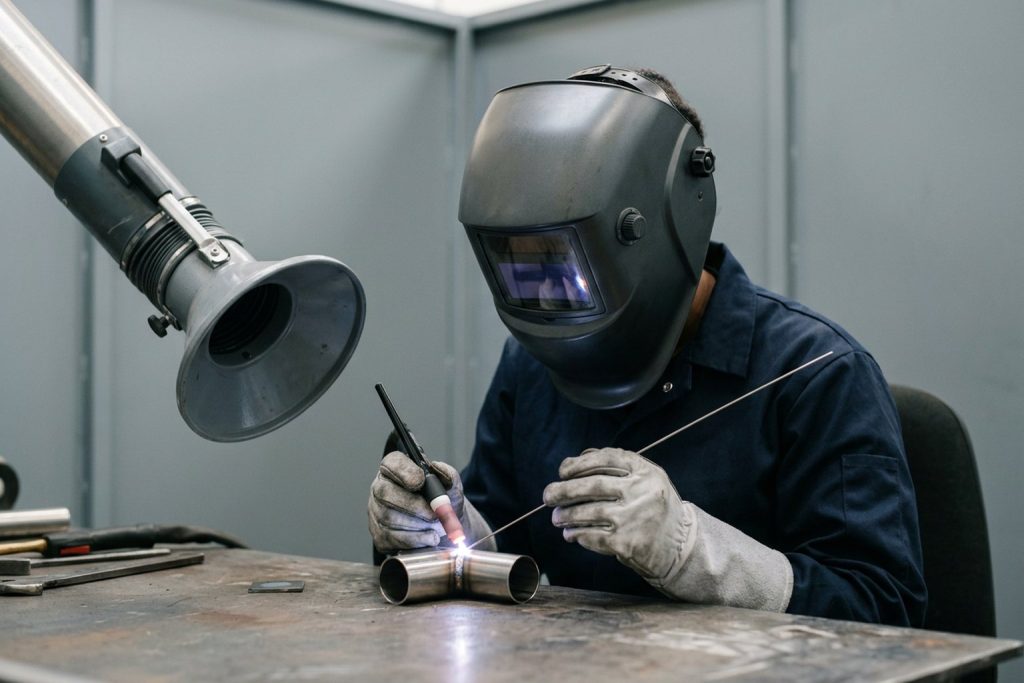
LEV also has to keep working. COSHH requires it to be thoroughly examined and tested by a competent person, and HSE’s welding guidance says this means at least every 14 months, with records kept for at least five years. HSE adds that LEV performance should be judged on how well it actually captures the fume, not on airflow readings alone. Our explainer on COSHH employer duties covers maintenance and examination of controls in more detail.
What RPE should welders wear?
Where LEV does not adequately control exposure, or it is not reasonably practicable to provide it, the employer must provide suitable RPE. HSE’s guidance for welding is specific:
- For longer work, a battery-powered air-fed respirator (powered air) or supplied-air respirator with an assigned protection factor (APF) of at least 20. HSE says a powered or supplied-air unit that combines respiratory, eye and face protection is the best option for arc welders, because tight-fitting masks worn for long periods under a welding helmet become uncomfortable and tend to be loosened or removed.
- For work not expected to exceed one hour, an FFP3 disposable mask or a reusable half mask with a P3 filter may be adequate against particles, provided the wearer is clean-shaven.
- Gases are different. HSE points out that particle filters do not protect against the gases in welding fume, such as ozone, which is one more reason to capture fume at source.
RPE must suit both the job and the wearer. Any tight-fitting mask needs a face-fit test for each person, and the wearer must be clean-shaven where the mask seals. Our guide to whether face-fit testing is a legal requirement explains how that works. HSE notes that stubble and beards stop a tight-fitting mask sealing, but alternative RPE that does not rely on a tight fit to the face is available, such as many powered air welding helmets.
HSE also expects an RPE programme: face-fit testing, spare batteries and filters, inspection before each use, clean storage, maintenance records for reusable RPE, and compatibility with the welding visor.
Do you need extraction when welding outdoors?
Working outside does not make welding fume harmless. The 2019 alert says appropriate RPE should be provided for welding outdoors, and HSE’s controls guidance explains why: you cannot rely on LEV to capture welding fume effectively in the open air, because wind and draughts carry the fume away from the hood. For any outdoor welding, HSE says you must provide suitable RPE and consider the protection of others nearby.
That covers site work such as steel erection, pipelines and mobile repairs, with the same RPE rules as indoors.
Is stainless steel welding more dangerous than mild steel?
Each metal brings its own extra hazards, but the post-2019 position is that all welding fume can cause lung cancer, so none of them is “safe”. The differences change what you add to the baseline controls, not whether you need them.
- Mild steel. Now treated as a cause of lung cancer. The fume also contains manganese, linked to neurological effects. HSE says extraction also controls exposure to manganese.
- Stainless steel. The fume contains chromium (including hexavalent chromium, a carcinogen), nickel and cobalt. These can cause occupational asthma and allergic skin reactions, which is why HSE expects respiratory health surveillance for stainless steel welders. TIG welding of stainless steel also produces ozone.
- Galvanised steel. The zinc coating vaporises and is the classic cause of metal fume fever. Good extraction at source is the key control.
- Aluminium. HSE notes that TIG welding aluminium produces ozone, which irritates the throat and lungs.
- Painted, coated or dirty metal. Coatings, paint and contamination add their own substances to the fume, which is why HSE lists properly cleaning and preparing the metal as a control. Welding or cutting steel coated with old lead paint creates lead fume and brings in the Control of Lead at Work Regulations 2002 rather than COSHH; see our guide to lead at work.
Your COSHH assessment should name the metals, coatings and consumables actually used, because one welder may handle all three in a shift.
What is the workplace exposure limit for welding fume?
There is no single workplace exposure limit (WEL) for “welding fume” as a whole in EH40/2005, the list of limits used with COSHH. Instead, individual components of the fume have their own limits. In the current edition (fourth edition, 2020), examples include:
- manganese and its inorganic compounds (as Mn): 0.2 mg/m³ inhalable fraction and 0.05 mg/m³ respirable fraction, both as 8-hour time-weighted averages; and
- chromium (VI) compounds (as Cr): 0.01 mg/m³, with a limit of 0.025 mg/m³ for process-generated chromium (VI), such as welding fume, as an 8-hour time-weighted average.
HSE warns that the respirable manganese WEL is highly likely to be exceeded during many welding activities unless effective controls are introduced and used properly. Exposure monitoring by a competent person can show whether you comply.
A WEL is a ceiling, not a target. Because welding fume can cause cancer, and some components cause asthma, COSHH requires exposure to be reduced as far below the limit as is reasonably practicable. Staying under a number on paper does not mean the controls are adequate. For how WELs are set and used, see our explainer on workplace exposure limits and EH40.
Do welders need health surveillance?
Sometimes, and stainless steel welding is the clearest case. HSE’s health surveillance guidance for welding says employers should provide respiratory health surveillance when welding stainless steel, where a known asthma-causing agent such as chromium is present in the fume, unless the risk assessment shows there is no reasonable likelihood of asthma developing. HSE says it should include:
- a baseline questionnaire and spirometry (a breathing test);
- a further questionnaire at around 6 and 12 weeks after starting work; and
- an annual questionnaire and spirometry.
Welders should know to report wheezing, coughing or breathlessness, and employers should take advice from an occupational health provider. For the cancer risk, HSE says it may be helpful to keep an individual health record for everyone exposed to welding fume, including a history of the jobs involving exposure; an employer who chooses to do this should keep those records for at least 40 years.
How do you protect others from welding arc flash?
Welding produces intense ultraviolet (UV) and infrared radiation as well as fume. Arc eye is a painful injury to the front of the eye that usually appears a few hours after exposure, and HSE also notes that UV from welding is associated with ocular melanoma, a rare eye cancer. Welders’ skin can redden like sunburn too.
The welder’s own protection is a welding helmet or visor with the correct filter, kept down whenever the arc is struck, plus clothing that covers the arms and legs and suitable gloves. Passers-by and nearby workers need protecting as well. HSE recommends welding curtains or screens that conform to BS EN ISO 25980, or offer at least the same protection. Semi-transparent screens let people see that someone is welding while filtering out the harmful light; HSE says it is not aware of any clear curtains that conform to the standard.
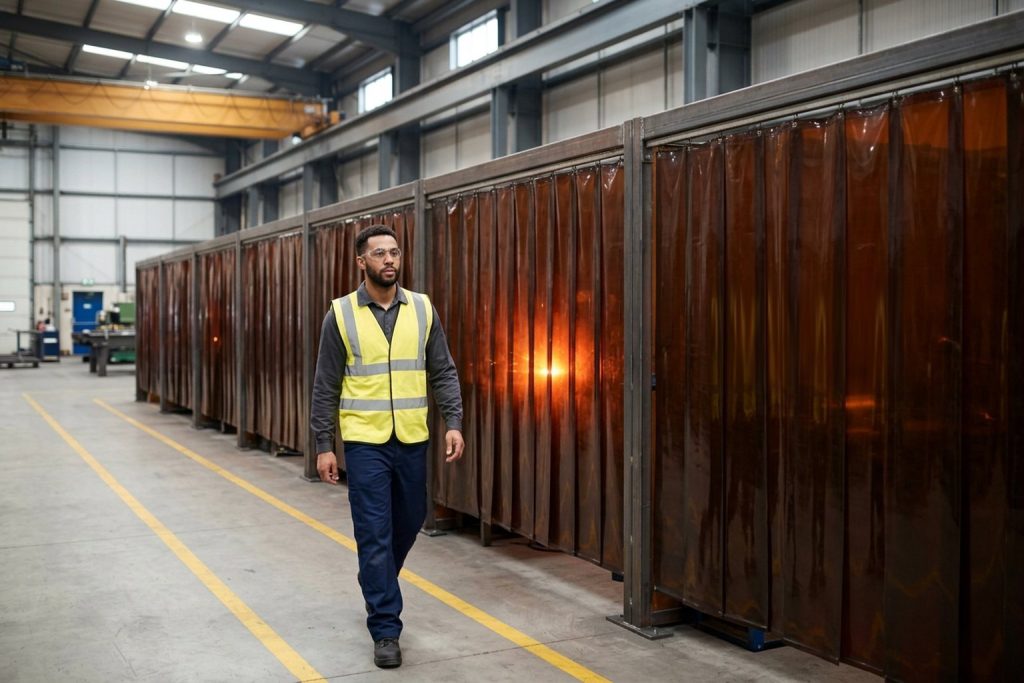
Screens and extraction work together: curtains block the arc light, while LEV stops fume drifting over the curtain to people without RPE. HSE says nearby workers are unlikely to need RPE only if general ventilation clears the fume quickly and no haze lingers where they work.
Does welding need a hot work permit?
Often, yes, when welding happens outside a dedicated workshop bay. Heat, sparks, and drips of molten metal and slag can travel a considerable distance and start fires, including in adjacent rooms. HSE advises clearing combustible materials first and, where hot work cannot be done in a safe area, keeping a fire watch during the work and for at least 30 minutes afterwards, extended to 60 minutes where a fire could be slow to develop or hard to detect. Many sites manage this through a hot work permit; our guide to what a permit to work is explains how hot work permits operate. Welding in tanks, pits and other confined spaces brings an extra danger: shielding gases such as argon and carbon dioxide can displace oxygen and cause asphyxiation without warning.
What training do welders need on fume?
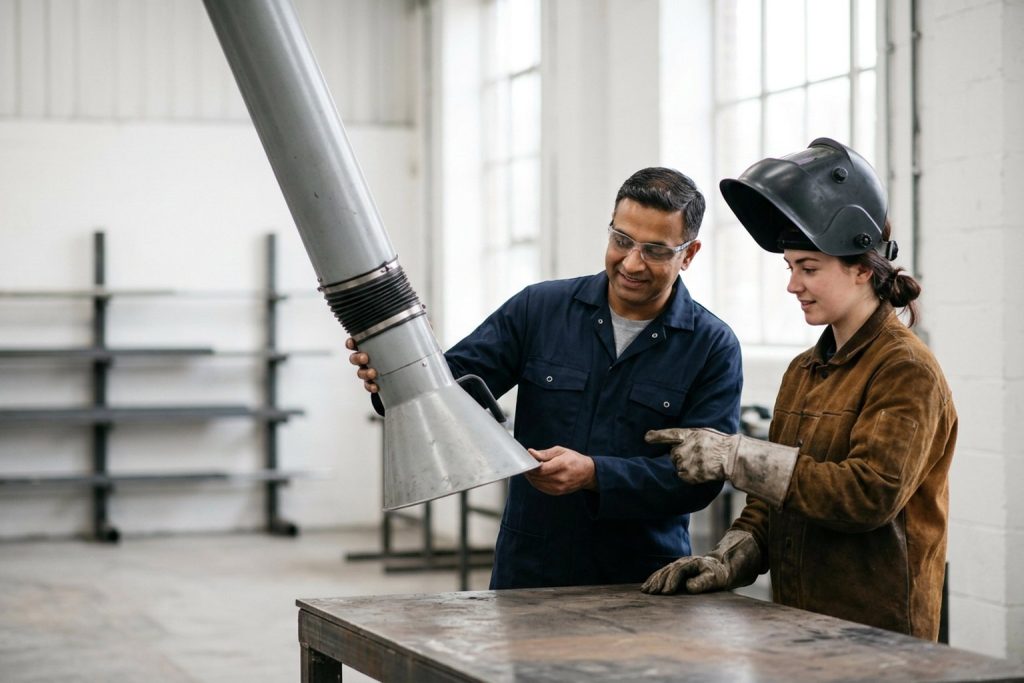
HSE says employers must train workers, especially those new to the job, and tell them that fume and dust from welding and cutting can cause lung cancer and other lung conditions if not properly controlled. Its training guidance covers the health risks, where to stand and how to angle the weld, pre-use checks on equipment and LEV, positioning movable extraction, looking after RPE and PPE, and what to do if something goes wrong.
Only the employer can show a welder how their own extraction and RPE work; online awareness training supports that by explaining the law and the reasons behind the controls. Nexis CPD’s COSHH Awareness course covers how hazardous substances harm the body, COSHH assessments, the hierarchy of control and workers’ own responsibilities, including health surveillance. It pairs naturally with Respiratory Protective Equipment (RPE), for assigned protection factors, face-fit testing and looking after respirators, and Fire Safety Awareness, for the fire risks that come with hot work.
£9 per course. CPD accredited, 100% online, verifiable e-certificate. Pay for 2, get 3 — any 3 courses for £18. These are CPD-accredited awareness courses, not Ofqual-regulated qualifications. They do not qualify anyone as a welder, an LEV examiner, an occupational hygienist or a face-fit tester, and they do not replace the employer’s COSHH assessment, LEV examination, face-fit testing or practical training.
Frequently asked questions
Is welding fume carcinogenic?
Yes. The International Agency for Research on Cancer classified welding fume as carcinogenic to humans (Group 1) in 2017, and HSE has treated all welding fume, including mild steel fume, as a cause of lung cancer since its February 2019 safety alert.
Is general ventilation enough for welding?
Not for regular indoor welding. HSE expects engineering controls such as local exhaust ventilation, because general ventilation does not achieve the necessary control. Suitable RPE is needed as well where extraction does not control all the fume. For occasional welding done less than once a week and lasting under an hour, HSE says engineered controls are not normally expected, but RPE and good general ventilation still are.
Do you need a mask for welding outdoors?
Yes. HSE says local exhaust ventilation cannot be relied on to capture fume outdoors, so suitable respiratory protective equipment must be provided for any outdoor welding, and people nearby must also be protected.
What RPE is best for welding?
HSE says a powered air or supplied-air respirator with an assigned protection factor of at least 20, combined with eye and face protection, is the best option for arc welders. For work of up to an hour, an FFP3 mask or a half mask with a P3 filter may be adequate if the wearer is clean-shaven and has passed a face-fit test.
How often must welding LEV be tested?
Under COSHH, local exhaust ventilation must be thoroughly examined and tested by a competent person at least every 14 months, and records must be kept for at least five years. Welders should also check it is working before each use.
Do stainless steel welders need health surveillance?
Usually, yes. HSE says employers should provide respiratory health surveillance when welding stainless steel because chromium in the fume can cause asthma, unless the risk assessment shows no reasonable likelihood of asthma. It includes a baseline questionnaire and spirometry, follow-up questionnaires and an annual check.
This article is general information, not legal or medical advice. It summarises HSE guidance and the law in Great Britain as at 11 October 2026. Always follow your employer’s COSHH assessment and current HSE guidance, and take advice from a competent person on extraction, RPE and health surveillance. If you have symptoms such as wheezing, breathlessness or a persistent cough, speak to your GP or NHS 111 and mention your welding work. Nexis CPD courses are CPD-accredited awareness training, not regulated qualifications.