
Controlling legionella comes down to a single principle: keep water outside the temperature range where the bacteria breed, and never let it sit still. Hot water hot, cold water cold, everything moving. Almost every control measure in a water system is a way of achieving one of those three things.
This guide sets out the temperature regime the HSE expects, the balance against scalding, and the day-to-day monitoring that turns a control scheme from a document into a working defence.
The temperature regime
Legionella multiplies between 20 °C and 45 °C, is dormant below 20 °C and does not survive above 60 °C. The entire hot-and-cold temperature regime follows from those numbers. HSG274 Part 2 sets it out:
| Point in the system | Target |
|---|---|
| Hot water — storage (in the calorifier) | Stored at 60 °C or above |
| Hot water — distribution | Reaches 50 °C (55 °C in healthcare premises) within one minute at the outlet |
| Cold water | Stored and distributed below 20 °C, reached within two minutes at the outlet |
The logic is simple. Store hot water hot enough to kill the bacteria; deliver it hot enough that the pipes do not sit in the growth range; keep cold water genuinely cold so it never enters that range either. When both hot and cold are held at their targets, the danger zone in between is squeezed out of the system.
The scalding problem — and thermostatic mixing valves
Here is the tension at the heart of legionella control. Water hot enough to kill legionella — 60 °C at storage — is hot enough to cause a serious scald in seconds. A full-thickness scald can occur in around one second at 60 °C, and much faster for children and elderly skin.
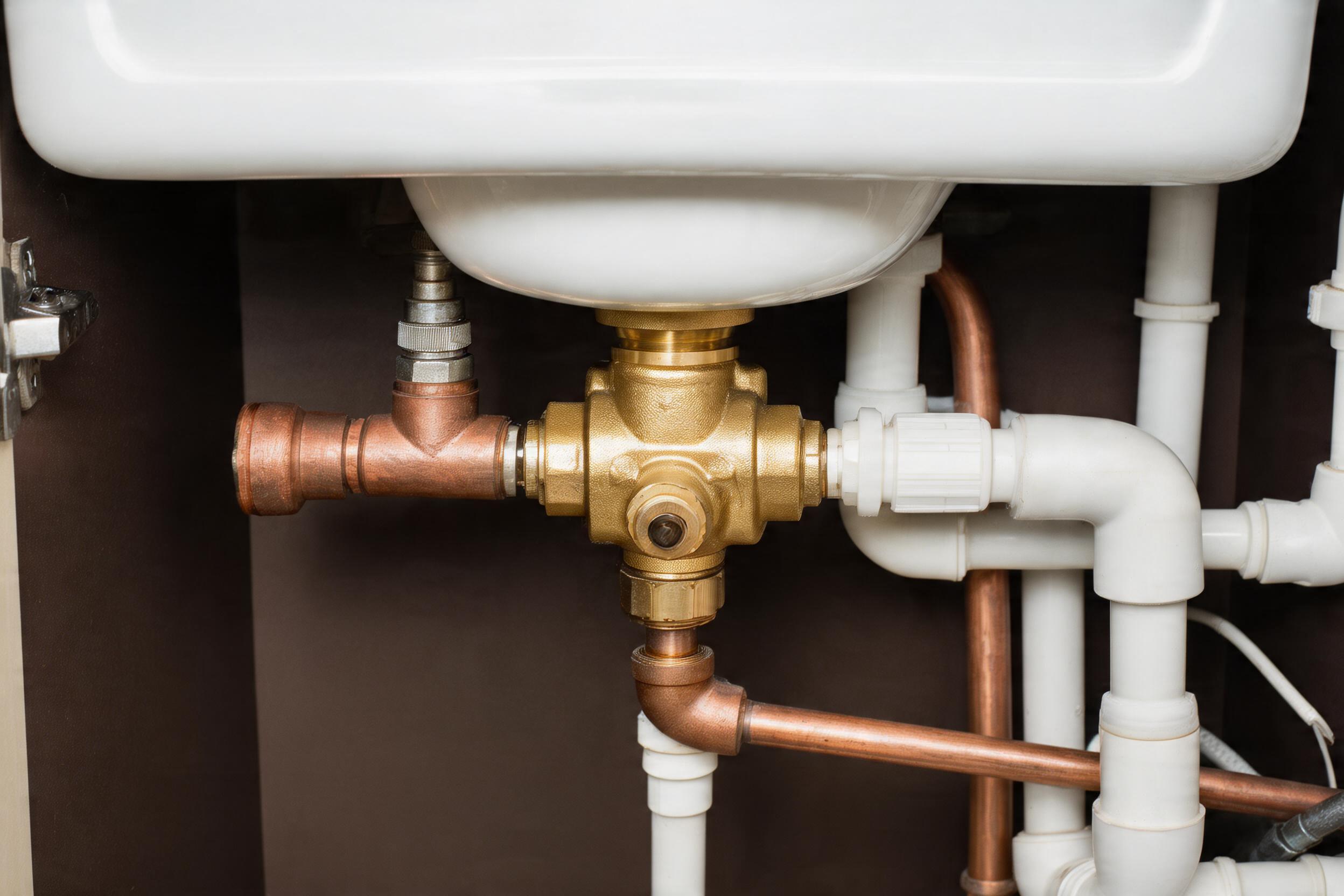
You cannot solve this by simply turning the temperature down, because that hands the win back to the legionella. The answer is to keep the system hot but cool the water at the point of use, using a thermostatic mixing valve (TMV). The TMV blends hot and cold to deliver a safe outlet temperature — typically around 41 °C for a bath or basin — while the pipwork behind it stays hot enough to control bacteria.
TMVs matter most where vulnerable people are present: care homes, hospitals, schools, nurseries, and facilities used by the elderly, the very young or people with sensory impairment or reduced mobility. They are not optional extras in those settings; they are how the two risks are reconciled. TMVs also need their own maintenance, because a failed valve can itself become a small stagnant blending chamber in the growth range.
Stagnation — the other half of the problem
Temperature control fails if water is not moving. Stagnant water cools (if hot) or warms (if cold) toward room temperature, drifting into the danger zone, and gives biofilm time to establish. The main offenders:
- Dead legs — lengths of pipe with no throughflow, often left when a fitting is removed but the pipe is not. These should be identified and cut back to the point of connection.
- Little-used outlets — the shower in a spare room, the tap in a rarely-entered store. These must be flushed regularly — weekly is the common standard — to draw fresh water through.
- Oversized or redundant tanks — more stored water than the building turns over, so some sits for too long.
- Buildings after a shutdown — schools over summer, offices after a closure, any system left idle. These need flushing through before reoccupation.
The monitoring routine
A control scheme is only as good as the checks that prove it is working. A typical monitoring regime, following HSG274, includes:
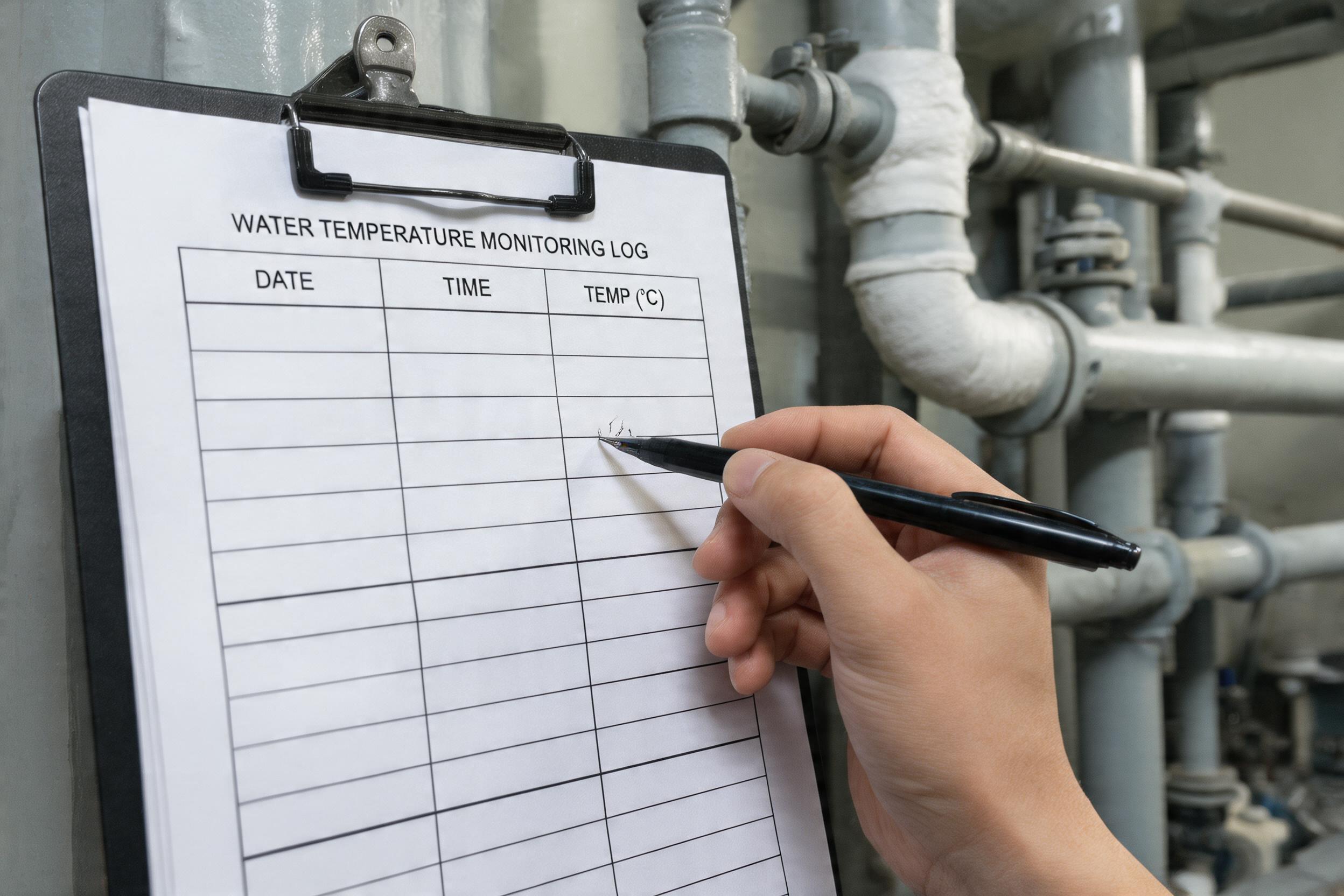
- Monthly — temperature checks at a rotating selection of sentinel outlets (the nearest and furthest from each hot and cold source), so that over time the whole system is covered
- Monthly — checking the calorifier flow and return temperatures
- Weekly — flushing of little-used outlets
- Quarterly — checking the temperature of water in cold water storage tanks, and their condition
- Annually — inspecting cold water tanks internally, and cleaning and disinfecting where required
- Periodically — descaling and disinfecting showerheads and spray taps
Every check is recorded. The records are not bureaucracy for its own sake — they are the evidence that the scheme is live, and the first thing an inspector or an insurer asks to see. Records should be kept for at least five years.
When temperature control is not enough
In some systems temperature alone cannot control the risk, and a supplementary or alternative treatment is used, such as:
- Chlorine dioxide or copper-silver ionisation — continuous chemical dosing, common in large or complex systems
- Point-of-use filters — in high-risk healthcare areas serving the most vulnerable patients
These are specialist measures, specified by a competent water-treatment professional as part of the control scheme, not a substitute for the basic temperature and stagnation controls.
Sampling for legionella
Routine temperature monitoring is the backbone of control. Sampling — actually testing the water for legionella bacteria — is a separate check, used where temperatures cannot reliably be maintained, where an alternative treatment is in use, in higher-risk premises, or when a problem is suspected. A clear sample is reassuring but is a snapshot, not a substitute for maintaining the regime; a positive sample is a trigger to act, review the assessment and investigate.
The common failures
- Hot water turned down to save energy or prevent scalds, without TMVs — the single most common way a system slides into the danger zone.
- Dead legs left in place after refurbishments and removals.
- Flushing logged but not done — or done for a few weeks then quietly abandoned.
- Tanks never inspected, accumulating sediment and debris that feed the bacteria.
- Systems reoccupied after a shutdown without flushing through first.
- No records, so even a well-run system cannot prove it.
Further reading
- HSE HSG274 Part 2 — Hot and cold water systems (PDF)
- HSE — Controlling legionella in hot and cold water systems
- HSE ACOP L8
Frequently asked questions
What temperature should hot and cold water be to control legionella?
Following HSG274 Part 2: hot water should be stored at 60°C or above and distributed so it reaches 50°C (55°C in healthcare premises) within one minute at the outlet. Cold water should be stored and distributed below 20°C, reached within two minutes at the outlet. This keeps water out of the 20–45°C range in which legionella multiplies.
How do you control legionella without causing scalds?
Keep the system hot enough to control legionella but cool the water at the point of use with a thermostatic mixing valve (TMV), which blends hot and cold to deliver a safe outlet temperature of around 41°C while the pipework behind it stays hot. TMVs are essential where vulnerable people are present, such as care homes, hospitals, schools and nurseries, and they need their own maintenance.
What is a dead leg in a water system?
A dead leg is a length of pipe with no throughflow, often left behind when a fitting is removed but the pipe is not. Water stagnates in it and drifts into the legionella growth range, so dead legs should be identified and cut back to the point of connection. Little-used outlets are a related problem and must be flushed regularly, commonly weekly.
How often should legionella temperatures be monitored?
A typical HSG274 regime includes monthly temperature checks at rotating sentinel outlets and of the calorifier, weekly flushing of little-used outlets, quarterly checks of cold water storage tank temperature and condition, and annual internal inspection of tanks. Every check is recorded, and records should be kept for at least five years.
Is water sampling required to control legionella?
Routine temperature monitoring is the backbone of control. Sampling — testing the water for legionella bacteria — is a separate check used where temperatures cannot reliably be maintained, where alternative treatment is in use, in higher-risk premises, or when a problem is suspected. A clear sample is a snapshot rather than a substitute for maintaining the regime; a positive sample is a trigger to act and review the risk assessment.
Legionella awareness training
Our Legionella Awareness course covers the temperature regime, the role of TMVs, stagnation and flushing, and the monitoring routine behind a working control scheme.
Related: What is legionella? · Legionella risk assessment guide · COSHH Awareness
£9 per course. CPD accredited, 100 % online, verifiable e-certificate on completion. Pay for 2, get 3 — any 3 courses for £18.
Important: this is a CPD-accredited awareness course and general information, not legal or engineering advice. Temperature figures and monitoring frequencies reflect current HSE guidance (ACOP L8 and HSG274) and should always be checked against the latest published guidance and the specifics of your system. Designing or modifying a control scheme, specifying water treatment, or working on a complex system requires a competent water-treatment or legionella specialist. The legal duty remains with the duty holder.