
What Are the Rules for Selling Food Online? Registration, Labelling and Delivery
Selling food online is treated the same as selling it in a shop: you must be a registered food business, follow food hygiene law, and give customers the allergen and other food information before they buy and again when the food arrives. Registration is free and must be done at least 28 days before you start trading. You are also responsible for keeping the food safe on its journey, and consumer law adds rules on cancellations, refunds and honest descriptions.
On this page
- 1Do the same food rules apply when you sell online as in a shop?
- 2Who counts as a food business when you sell online?
- 3How do you register an online food business, and do you get a hygiene rating?
- 4What information must an online food listing show before the customer buys?
- 5How do you give allergen information when selling food at a distance?
- 6How should you pack and deliver food so it stays safe?
- 7Which foods should you avoid sending by post or courier?
- 8Who is responsible when you use couriers, drivers or online platforms?
- 9What are the rules on cancellations, returns and refunds for food sold online?
- 10What can you say about food in online descriptions, photos and health claims?
- 11What traceability, recall and record-keeping duties do online sellers have?
- 12What are the rules in Scotland, Wales and Northern Ireland?
- 13What happens if an online seller breaks food law?
- 14What mistakes do online food sellers make most often?
- 15What is a checklist for launching an online food shop?
- 16What training helps people who sell food online?
- 17Frequently asked questions
- Same rules as a shop. Selling food online makes you a food business: register with your council at least 28 days before trading (free), follow hygiene law and keep food safe in transit.
- Information first. Allergen information must be available before the customer buys and again at delivery. Prepacked food also needs its other mandatory details beforehand, except the date mark.
- Delivery. For mail order in England the test is whether food arrives at a temperature that risks health, so pack, time and trial your delivery and keep records.
- Returns. Personalised and fast-perishing food has no 14-day right to cancel, but customers can still reject goods that are unsafe, spoiled or not as described.
This guide is for people who sell food through their own website, an app, a marketplace, a delivery platform or social media, from home, a shop or a commercial kitchen. It covers England, checked on 2 November 2026, with a table on Scotland, Wales and Northern Ireland. It is a summary: your council’s food safety team advises on food law and Trading Standards on consumer law. General information, not legal advice.
Do the same food rules apply when you sell online as in a shop?
Yes. The Food Standards Agency (FSA) says anyone selling food online, for example through social media or a website, or through distance selling, must register as a food business. Distance selling means “any selling that happens without face-to-face contact with the consumer”, and the FSA’s list covers your own website, a platform such as Deliveroo, text messages, phone calls, mail order and Facebook Marketplace (Starting a food business, last updated 19 August 2026). Three sets of rules apply:
- Food law. Food must be safe, hygienically made, packed and transported, honestly described and traceable, under procedures based on HACCP (hazard analysis and critical control points). Local authority food teams enforce it.
- Consumer law. The FSA names the Consumer Contracts (Information, Cancellation and Additional Charges) Regulations 2013 as the main law for selling without face-to-face contact, and adds the Electronic Commerce Regulations 2002 for internet sellers. Both cover all goods.
- Advertising rules. Claims about taste, origin, nutrition or health must be true and, for health claims, permitted.
Who counts as a food business when you sell online?
A food business is “any undertaking, whether for profit or not and whether public or private” that produces, processes or distributes food (Article 3(2) of assimilated Regulation (EC) 178/2002). The FSA says that if you supply food regularly to the public, for free or otherwise, you must register. Genuinely occasional activity can fall outside the rules (see our guide for community groups and charities), but an online shop is not occasional.
| Seller | Food business? | Online point to watch |
|---|---|---|
| Home baker with an online shop | Yes, if you supply the public regularly. Your home kitchen is registered as the food premises. | Allergen and ingredient information on every listing, and a label on every parcel. See do I need a food hygiene certificate for the training duty. |
| Shop with a website | Yes, and already registered. | Delivery adds new risks. The FSA says businesses that start delivering should review their food safety management system, and the council must be told of significant changes in activities. |
| Caterer or takeaway with online ordering | Yes. | Allergen information when taking the order and again at delivery, and staff who know how to take allergy orders. |
| Delivery-only kitchen (sometimes called a dark kitchen) | Yes. Register the kitchen where the food is prepared. | Platform conditions, such as minimum hygiene ratings, sit on top of the law. See our food hygiene rating guide. |
| Social media seller | Yes. Food Standards Scotland says selling food online, including via social media, is operating a food business. | Allergen information must be available before the customer orders, not only after payment or on request. |
| Subscription box | Yes. | Every box needs its own information and safe packing. Where it applies, the total cost per billing period and how to end the contract must be shown before the customer is bound. |
How do you register an online food business, and do you get a hygiene rating?
Register with your local authority at least 28 days before you start trading. It is free and cannot be refused, and if you are already trading you should register as soon as possible (GOV.UK). The legal duty is to notify the competent authority of each establishment and keep the details current, including significant changes and closures (Article 6(2) of assimilated Regulation (EC) 852/2004). The form asks for every address where you carry out food operations, including an office, and several trading names can go on one registration.
Some businesses handling products of animal origin, such as meat, fish or dairy, need approval rather than registration where Regulation 853/2004 requires it (Article 6(3)), so ask your council first. After registration an inspection is arranged if needed, including a visit to your home if that is your premises.
Online-only sellers do get a food hygiene rating if they supply consumers directly. The FSA’s rating guidance (last updated 30 June 2026) exempts only low-risk businesses, such as newsagents selling pre-wrapped goods that need no refrigeration, and childminders and businesses that offer caring services at home. A home baker is in neither group, though only the first part of a private postcode is published. Displaying the rating is voluntary in England and required in Wales and Northern Ireland, and platforms may set minimum ratings (see how ratings and delivery platforms interact).
What information must an online food listing show before the customer buys?
Article 14 of assimilated Regulation (EU) 1169/2011 is the distance-selling rule (legislation.gov.uk). For prepacked food, the mandatory food information, except the date mark, must be available before the purchase is concluded, on the material supporting the sale or through another clearly identified means that costs the customer nothing extra. All mandatory particulars must be available at delivery. For non-prepacked food, the Article 44 particulars, in practice the allergen information, must be made available the same way. The first table shows a prepacked listing, and our guide to what must be on a food label explains each item.
| Information | Legal basis | When the customer needs it |
|---|---|---|
| Name of the food | Article 9(1)(a), assimilated Regulation 1169/2011 | Before purchase and at delivery |
| Ingredients list | Article 9(1)(b) | Before purchase and at delivery |
| Any of the 14 allergens, emphasised in the ingredients list | Article 9(1)(c) and Annex II | Before purchase and at delivery |
| Quantity of certain ingredients, and net quantity | Article 9(1)(d) and (e) | Before purchase and at delivery |
| Use by or best before date | Article 9(1)(f) | At delivery only. Article 14(1)(a) excludes it from the before-purchase duty. |
| Storage conditions and instructions for use | Article 9(1)(g) and (j) | Before purchase and at delivery |
| Name and address of the responsible food business, or the importer | Article 9(1)(h) and Article 8(1) | Before purchase and at delivery |
| Country of origin where required | Article 9(1)(i) | Before purchase and at delivery |
| Alcohol strength above 1.2%, and nutrition declaration unless exempt | Article 9(1)(k) and (l) | Before purchase and at delivery |
Consumer law adds its own list, which applies to every distance sale of goods:
| Information | Legal basis |
|---|---|
| Main characteristics of the product, and the total price including taxes and any delivery charges | Consumer Contracts Regulations 2013, Schedule 2(a), (f) and (g); Digital Markets, Competition and Consumers Act 2024 (DMCC Act) section 230 |
| Your trading name, geographic address and contact details, including an email address | Consumer Contracts Regulations Schedule 2(b) and (c); Electronic Commerce Regulations 2002, regulation 6; the FSA factsheet suggests a “Contact us” page |
| Arrangements for payment and delivery, the delivery time, and your complaints policy | Consumer Contracts Regulations Schedule 2(j) and (k) |
| The right to cancel and how to use it, or the fact that there is none for this product | Consumer Contracts Regulations Schedule 2(l) and (o) |
Whether a product is prepacked, prepacked for direct sale (PPDS, the category covered by Natasha’s Law) or non-prepacked can depend on where and when it is packed. The FSA’s allergen technical guidance (updated 29 October 2026) says the PPDS ingredients-list rule does not apply to PPDS food sold online, because Article 14 governs distance sales (paragraph 104). Food Standards Scotland tells sellers to ask their council if unsure. Our suggestion: put a full ingredients list with allergens emphasised on both listing and pack, kept identical. For imports, the responsible business is the importer if the brand owner is not established in the British Islands (Article 8(1)); the FSA’s factsheet (December 2016) advises checking the label before buying foreign stock.
How do you give allergen information when selling food at a distance?
Allergen information must be available free of charge before the purchase is concluded and again at delivery, and be current and accurate (FSA technical guidance, paragraphs 72 and 86 to 88). A phone line for oral information must not cost extra, and the FSA’s food delivery guidance says your website should state where to get it.
The law allows oral or written information, but the FSA’s best practice guidance (24 February 2025, not law) says to give written allergen information both before the order and on delivery (paragraph 46). In practice:
- Website. Put the allergens on the product page or main menu, or no more than “one click away” with a clear link.
- App or platform. Say clearly, before the order, where the information is. Platforms may have their own requirements too.
- Social media post. Food Standards Scotland says the information must be available before the customer orders and again at delivery, and that after payment or on request is not enough. Put the allergens in the post, or link to them, rather than “message me for details”.
- At delivery. Use stickers on containers, a sheet in the bag that lets the customer match each item to its allergens, or written information from the person delivering, and show any changes or substitutions.
- Allergy orders. Pass the requirements to the person preparing the food in writing, label the container, and store allergen-free meals separately in transit to avoid spillages contaminating them.
Under Article 14 of Regulation 178/2002 food is judged unsafe having regard to the information given to the consumer, so a missing allergen warning is a safety failure. See our guides to the 14 allergens and Natasha’s Law.
How should you pack and deliver food so it stays safe?

All food must be delivered in a way that ensures it does not become unsafe or unfit to eat. Annex II to assimilated Regulation 852/2004 sets the duties:
- Transport (Chapter IV, which covers all transportation). Containers must be clean and in good repair, not used for anything that could contaminate food, separated from other loads or cleaned effectively between them, and, where necessary, able to hold and monitor appropriate temperatures.
- Packaging (Chapter X). Materials must not be a source of contamination, must be stored protected, and packing must avoid contaminating the product.
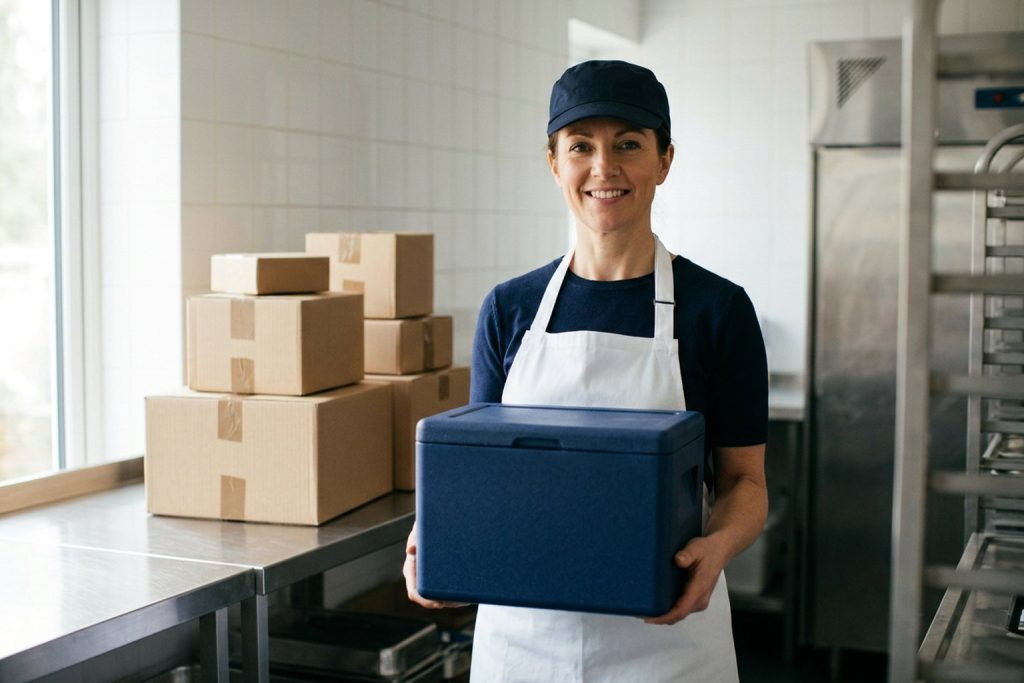
The FSA adds: chilled food in an insulated box with coolant gel or a cool bag, hot food in an insulated bag after proper heating, raw and ready-to-eat food kept apart, and, for a domestic vehicle, cleaning between loads, an updated HACCP plan and a council that is satisfied the vehicle is suitable.
The temperature numbers differ by journey. In England, Schedule 4 to the Food Safety and Hygiene (England) Regulations 2013 makes it an offence to keep food that supports bacterial growth above 8°C, or cooked food that needs hot holding below 63°C when kept for service or display, at or in food premises. Mail order is treated differently. The 8°C offence does not apply to food being conveyed to the consumer in a mail order transaction, but you must not supply by mail order food conveyed by post or carrier at a temperature that has given rise, or is likely to give rise, to a risk to health (paragraph 2(3)). Whether your own driver’s local delivery counts as mail order is a question for your council. The FSA’s Q&A (December 2016) says food need not be chilled in transit but must not travel at risky temperatures, with extra steps in warmer months. See our guides to food temperature control and the 4 Cs.
The Q&A also asks whether the delivery service is fast and reliable, and whether the parcel shows a dispatch date and says it contains perishable items. Our suggestion: trial a probe thermometer in a parcel on your longest journey in warm weather, and keep the result.
Which foods should you avoid sending by post or courier?
No law lists foods you may not post. The test is whether the food arrives safe. Food that can be kept at room temperature for its whole shelf life with no risk is outside the chill-holding rules (Schedule 4, paragraph 3(b)), and the FSA says perishable goods need further consideration. Our suggestions, which are judgement and not law:
- Treat cooked meat and fish, cream and custard desserts, ready-to-eat salads and use by foods as high risk, and do not post them unless you have tested the packaging and service.
- Avoid dispatching perishables when a parcel could sit in a depot over a weekend.
- Ask your council before shipping raw or animal-origin products, as approval may be needed.
- Keep hot food to short journeys in insulated bags.
- Mark parcels “perishable, keep refrigerated” with the dispatch date.
Who is responsible when you use couriers, drivers or online platforms?

You are. Chapter IV of Annex II applies to all transportation, and under the Consumer Rights Act 2015 goods stay at the trader’s risk until they reach the consumer, unless the consumer chose their own carrier (section 29). Food handlers, which can include your own drivers, must be supervised, instructed or trained in proportion to their work (Annex II, Chapter XII).
Platforms add rules but do not replace yours. The FSA reported on 18 October 2022 that Just Eat, Uber Eats and Deliveroo had developed a Food Safety Charter committing them to check that businesses are registered and meet a minimum hygiene rating standard (FSA blog). Thresholds change, so read current partner terms. Under Article 8 of Regulation 1169/2011 the business under whose name food is marketed is responsible for its food information, so a marketplace listing is your listing.
What are the rules on cancellations, returns and refunds for food sold online?
This summarises two Acts. Trading Standards and GOV.UK’s distance selling guidance give the detail.
The 14-day right to cancel. Under the Consumer Contracts Regulations 2013, a consumer can cancel a distance sale within 14 days of receiving the goods without giving a reason (regulations 29 and 30). Regulation 28 excludes goods made to the consumer’s specifications or clearly personalised, and goods liable to deteriorate or expire rapidly. Personalised cakes and fresh or chilled perishables are therefore likely to be excluded, and long-life items such as jars or biscuits included. That is our reading, so confirm it for your products. Schedule 2 requires you to say before purchase where there is no right to cancel. Where it applies, refund payments, including standard delivery, within 14 days of getting the goods back (regulation 34).
Faulty or spoiled food. The Consumer Rights Act 2015 applies regardless. Goods must be of satisfactory quality, including safety and durability (section 9), and match their description (section 11), which includes your listing’s main characteristics. Deliver within 30 days unless you agree a time (section 28). A consumer can reject faulty goods within 30 days, or within the shorter period in which perishables can reasonably be expected to perish (section 22). So a spoiled chilled order can be rejected even though fresh food has no right to cancel.
Recent changes. Most DMCC Act 2024 consumer provisions came into force on 6 April 2025 (CMA, 7 April 2025). They include showing the total price including unavoidable fees (section 230) and a ban on fake reviews (Schedule 20, paragraph 13). The Act’s subscription-contract rules (from section 254) were still shown as not in force on legislation.gov.uk on 2 November 2026, so subscription box sellers should check GOV.UK.
What can you say about food in online descriptions, photos and health claims?

Your listing is a label and an advertisement. Under the Food Safety Act 1990 it is an offence to sell food to the purchaser’s prejudice that is not of the nature, substance or quality demanded (section 14), and to give a label, or publish an advertisement, that falsely describes food or is likely to mislead as to its nature, substance or quality (section 15). Article 16 of Regulation 178/2002 adds that information made available through any medium must not mislead. On indictment these offences can carry up to two years in prison (section 35(2)). In practice:
- Photos and weights. Show what the customer will get.
- Origin and quality words. The FSA’s Q&A gives selling farmed salmon as wild as a food fraud example.
- Free-from claims. The FSA says “gluten-free” should be used where strict controls ensure no more than 20 mg/kg of gluten.
- Nutrition and health claims. Only authorised claims on the Great Britain nutrition and health claims register (Department of Health and Social Care, updated 19 May 2026) may be made in Great Britain, and the Advertising Standards Authority’s CAP Code rule 15.1 requires evidence that the conditions of use are met. The FSA’s factsheet says nutrition labelling is needed if you make such a claim.
- Reviews and prices. No fake reviews, and show the full price before checkout.
What traceability, recall and record-keeping duties do online sellers have?
Article 18 of Regulation 178/2002 requires you to identify who supplied you and which businesses you supplied, and to produce that information on demand. The FSA’s Q&A says you need not record every consumer, and that records should cover addresses, products, quantities and dates and be kept for at least the shelf life. If food may be unsafe, Article 19 requires you to withdraw it, tell the authorities and inform consumers, recalling it if needed. Remove the listing first, and see our guide to food recalls and withdrawals for the steps.
Article 5 of Regulation 852/2004 requires permanent procedures based on HACCP principles. A small seller can use the FSA’s Safer Food, Better Business pack (our HACCP explainer covers the principles), and pest control applies to home kitchens too. Our suggested online-specific records:
- Packing and dispatch. Temperature check, courier and service, dispatch date.
- Listing review. The date each listing was checked against the recipe, and a note whenever an ingredient or supplier changes.
- Supplier and label checks. Copies of labels for bought-in and imported stock.
- Complaints and late deliveries. What happened, what you did, and whether the food was safe.
What are the rules in Scotland, Wales and Northern Ireland?
Article 14 of Regulation (EU) No 1169/2011 applies in each nation, but the enforcement regulations and guidance bodies differ. We checked that each instrument below exists on legislation.gov.uk.
| Nation | Food information law and guidance | Points to note |
|---|---|---|
| England | Food Information Regulations 2014; FSA guidance | Improvement notices can enforce the distance-selling duties in Article 14 (Schedule 5). Failing to provide allergen information for food that is not prepacked is an offence with a fine of up to level 5 on the standard scale (regulations 10 and 11). |
| Wales | Food Information (Wales) Regulations 2014; FSA guidance | The FSA’s online selling and allergen guidance applies in Wales. Displaying a food hygiene rating at premises is a legal requirement, and takeaway menus carry a bilingual rating statement. |
| Scotland | Food Information (Scotland) Regulations 2014; Food Standards Scotland | FSS says selling food online is operating a food business, registration is free and due 28 days before trading, failure to register is an offence, and the council you are registered with should be stated on your social media profile. The 8°C chilled limit is recommended rather than legal in Scotland. |
| Northern Ireland | Food Information Regulations (Northern Ireland) 2014; FSA in Northern Ireland | The FSA’s online selling and allergen guidance applies. Displaying a food hygiene rating at premises is a legal requirement. The Great Britain claims register does not cover Northern Ireland, so check claims with the FSA there. |
What happens if an online seller breaks food law?
Local authority officers can inspect, serve improvement notices and prosecute. In England the Food Information Regulations 2014 make some allergen failures a criminal offence, and the Food Safety Act 1990 creates separate offences. We have not listed individual cases because we could not verify dated official examples linked to online orders; council and FSA enforcement news has current ones. Commercial consequences are often faster: a low rating that platforms act on, or a customer with an allergic reaction.
What mistakes do online food sellers make most often?
This is our list, built from the rules above and not from enforcement statistics:
- Giving allergen information only after payment or on request.
- Sending chilled food in ordinary cardboard without testing it.
- Trading unregistered because it is “just a side business”.
- Changing a recipe or supplier without updating the listing, label and delivery sheet.
- Leaving out the “no right to cancel” statement for fresh and personalised food.
What is a checklist for launching an online food shop?
These are our suggestions, adapted from the sources above:
- Register at least 28 days before your first order, and write down your food safety procedures, including delivery.
- Decide whether each product is prepacked, PPDS or non-prepacked, and ask your council if unsure.
- Show the name, ingredients, allergens, storage, quantity, responsible business and origin on every listing before checkout.
- Put allergen information on the pack or in the parcel.
- Trial your packaging with a probe thermometer on your longest delivery.
- Show your trading name, address, email, delivery times and complaints policy.
- State the cancellation position for each product.
- Check every claim, and keep supplier labels.
- Know how you would pause listings and contact buyers in a recall.
What training helps people who sell food online?
Three Nexis CPD courses cover the knowledge behind this guide:
Together they cost £18 rather than £27 under the pay-for-2-get-3 offer, and employers training 5 or more staff pay £6 a course place on the team plan. These are awareness-level CPD courses, not Ofqual-regulated qualifications, and we do not offer a Level 3 food safety course. They do not replace your food safety procedures or your council’s advice. Start with Food Safety and Hygiene (Retail) Level 2: 20 questions, 80% to pass, and an instant certificate.
Food Safety and Hygiene (Retail) Level 2
100% online, at your own pace. Pass the assessment and your verifiable certificate is emailed instantly.
Frequently asked questions
Do I have to register as a food business to sell food online?
Yes, if you supply food regularly to the public. Register with your local authority at least 28 days before you start trading. It is free and cannot be refused.
Do I need allergen information on my website or social media posts?
Yes. It must be available free of charge before the customer completes the order and again at delivery. The FSA’s best practice is written information at both points.
Can I post chilled food to customers?
You can, but in England it must not arrive at a temperature that causes or is likely to cause a risk to health. The 8°C limit that applies at food premises does not apply to mail order, so test your packaging and keep records.
Can customers return food they bought online?
Often not under the 14-day cancellation right, because personalised goods and goods that deteriorate rapidly are excluded. Food that is unsafe, spoiled on arrival or not as described can still be rejected under the Consumer Rights Act 2015.
Does an online-only home baker get a food hygiene rating?
Yes, once inspected, if you supply food directly to consumers. The FSA exempts only low-risk pre-wrapped sellers, childminders and businesses offering caring services at home.
Does a Nexis CPD course qualify me to sell food online?
No. The courses are CPD-accredited awareness training, not Ofqual-regulated qualifications, and we have no Level 3 course. You must still register, keep food safety procedures and follow your council’s advice.
General information, not legal advice. This guide reflects the legislation and FSA, Food Standards Scotland and CMA guidance named above, as checked on 2 November 2026. Several FSA online selling documents are dated December 2016 and refer to EU law that is now assimilated law, so check current guidance. Rules differ in Scotland, Wales and Northern Ireland. Nexis CPD courses are CPD-accredited awareness training, not Ofqual-regulated qualifications, and they do not replace your food safety procedures or your council’s advice.