
Moving and handling people is not the same as manual handling, and treating it as if it were is how carers get hurt. A box does not feel pain, resist, panic or have a right to be asked first. A person does. That single difference changes the technique, the equipment, the assessment and the law you are working to.
This guide explains what moving and handling means in care, the legal duties, the techniques that are banned, and how to do it safely for both the person and yourself.
What moving and handling means in care
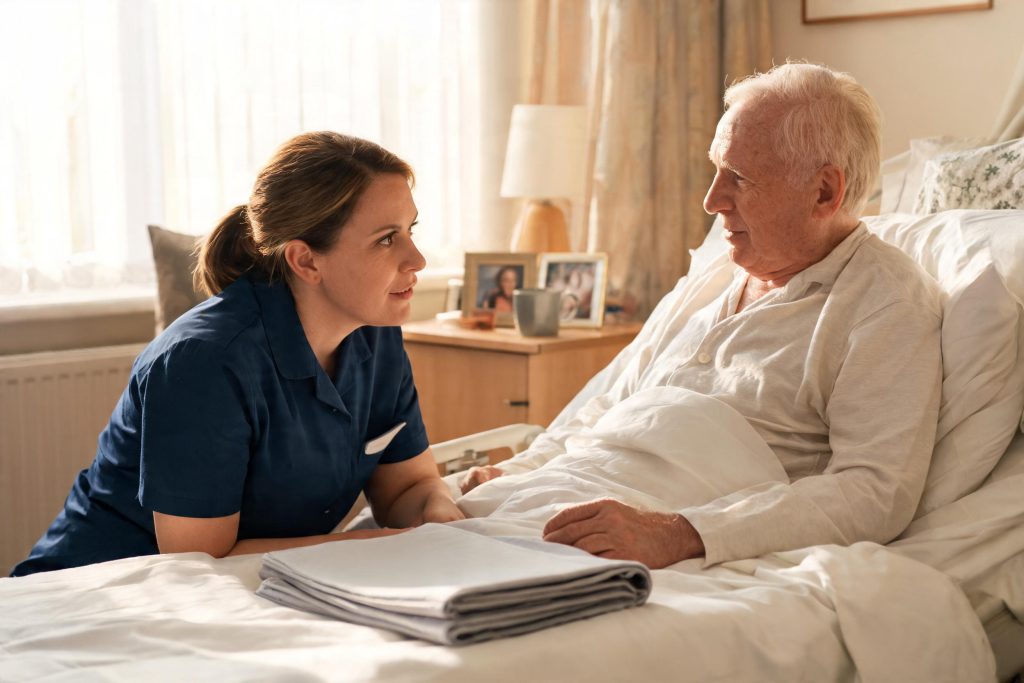
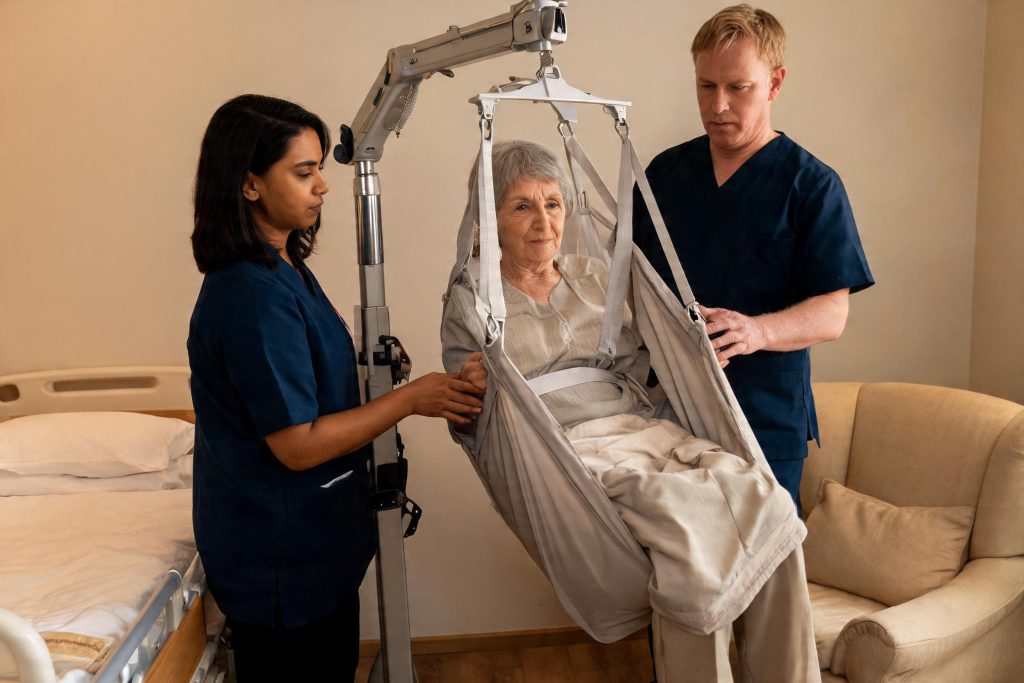
Moving and handling in care means assisting a person to move, transfer or reposition safely — with their dignity and choice intact. It covers helping someone from a bed to a chair, repositioning them to prevent pressure damage, supporting them to walk, and using equipment such as hoists, slide sheets and transfer boards.
Musculoskeletal disorders remain one of the biggest causes of work-related ill health in health and social care, and back injuries end careers. This is not paperwork — it is the difference between a long career and a bad back at forty.
The law behind it
- Manual Handling Operations Regulations 1992 — avoid hazardous manual handling where reasonably practicable; assess what cannot be avoided; reduce the risk so far as reasonably practicable.
- Health and Safety at Work etc. Act 1974 — employers must provide safe systems of work, training and supervision; employees must follow that training and not put themselves or others at risk.
- Lifting Operations and Lifting Equipment Regulations 1998 (LOLER) — hoists and slings are lifting equipment for lifting people and must be thoroughly examined every 6 months.
- PUWER 1998 — equipment must be suitable, maintained and used only by trained people.
The Care Quality Commission also expects staff to be competent in safe moving and handling as part of safe care.
The techniques that must never be used
Some historic “lifts” are unsafe for both parties and have no place in modern care:
- The drag lift — hooking under the armpits to haul someone up. It can dislocate shoulders, tear fragile skin and wreck the carer’s back.
- The Australian / shoulder lift — two carers lifting with a shoulder under the person’s armpits.
- Manually lifting a person from the floor after a fall — use a lifting cushion or hoist.
- Any lift where a carer takes the person’s full body weight.
If you were shown one of these informally on a shift, unlearn it and say so. “It’s how we’ve always done it” is not a defence.
Assessing before you move anyone
Every person needs their own moving and handling assessment in their care plan, covering their weight and height, medical conditions and pain, cognition and ability to follow instructions, ability to weight-bear, what they can do for themselves, the equipment and correct sling type and size, how many carers are needed, and the environment. Review it whenever their condition changes — a stale assessment is one of the most common causes of injury.
This is exactly where risk assessment meets person-centred care: the safest handling plan is one built around that individual.
Doing it safely — the principles
- Ask and explain first. Consent and communication are part of the technique, not a nicety — and rushing someone is what makes them grab, twist or panic.
- Encourage independence. Let the person do everything they safely can; assist rather than lift.
- Position yourself well — stable base, knees soft, back straight, load close, no twisting.
- Use the equipment provided, with the right sling size and type, checked before use.
- Never improvise or work alone where the plan says two carers.
- Report faults and near-misses. Some injuries are reportable under RIDDOR.
Protecting the person’s dignity throughout is part of your duty of care.
Frequently asked questions
What is moving and handling in care?
Moving and handling in care means assisting people to move, transfer or reposition safely — helping someone from a bed to a chair, repositioning them to prevent pressure damage, supporting them to walk, or using equipment such as a hoist or slide sheet. It is different from general manual handling because the load is a person, who can move unpredictably, feel pain or fear, and who has rights, dignity and preferences that must be respected.
Is manual handling training a legal requirement in care?
The Manual Handling Operations Regulations 1992 require employers to avoid hazardous manual handling where reasonably practicable, assess what cannot be avoided, and reduce the risk. The Health and Safety at Work etc. Act 1974 requires adequate training and supervision. So while no single line of law says 'you must attend a moving and handling course', an employer cannot meet those duties without training staff, and in regulated care the Care Quality Commission expects staff to be competent in it.
Why is the drag lift banned?
The drag lift — hooking under a person's armpits to haul them up — is condemned in care practice because it can dislocate shoulders, tear fragile skin, cause pain and bruising, and injure the carer's back. It is not a recognised technique, no employer should permit it, and it appears in safeguarding and negligence cases. If you were taught it informally, unlearn it: use a recognised technique or the correct equipment instead.
What is a moving and handling risk assessment?
It is a person-specific assessment recorded in the care plan covering the individual's weight, height, medical conditions, pain, cognition and ability to weight-bear or follow instructions; what they can do for themselves; the equipment needed including the correct sling type and size; how many carers are required; and the environment. It must be reviewed whenever the person's condition changes — an out-of-date assessment is one of the most common causes of injury.
How often should moving and handling training be refreshed?
There is no single legally fixed interval. Employers must ensure staff remain competent, and in practice most care providers refresh moving and handling training annually, with additional training whenever new equipment is introduced, a person's needs change significantly, or a member of staff returns after a long absence. Practical handling skills also need workplace assessment, not just an online course.
Further reading
- HSE — Moving and handling in health and social care
- Manual Handling Operations Regulations 1992
- HSE — LOLER and lifting equipment
Moving and handling training
At a glance: Nexis CPD offers a £9 CPD-accredited online Moving and Handling of People course — 100% online and self-paced, with an instant, verifiable e-certificate on passing.
Our Moving and Handling People Awareness course covers the legal duties, person-specific assessment, safe principles, equipment and the techniques to avoid.
Related: Manual handling training requirements · Duty of care · Person-centred care · Care Certificate
£9 per course. CPD accredited, 100 % online, verifiable e-certificate on completion. Pay for 2, get 3 — any 3 courses for £18.
Please note: this is a CPD-accredited awareness course and general information. Moving and handling people also requires practical, workplace-assessed competence on the specific equipment and individuals you support — an online course builds the underpinning knowledge but does not by itself make anyone competent to hoist or transfer a person. Always follow the person’s care plan and your employer’s policy. It is not an Ofqual-regulated qualification.