
Every UK employer must keep electrical systems and equipment safe under the Electricity at Work Regulations 1989, made under the Health and Safety at Work etc. Act 1974. Here is what most people get wrong: there is no such thing as a legal “electrician’s licence”, and portable appliance testing — the part everyone fixates on — is only a small corner of the picture. The law does not name a certificate; it demands competence, and the biggest electrical risks are usually the fixed wiring and working on equipment that is still live, not the office kettle.
At a glance: Nexis CPD’s £9 Electrical Safety Awareness course helps general staff understand everyday electrical dangers, spot faults and work safely around electricity. It is CPD accredited and 100% online with a verifiable e-certificate, and any three courses cost £18. It is an awareness course for non-electricians — it is not an electrical qualification and does not make anyone competent to carry out electrical work.
What are the Electricity at Work Regulations 1989?
The Electricity at Work Regulations 1989 (EAWR) are the main law governing electrical safety in Great Britain’s workplaces. They sit under the umbrella of the Health and Safety at Work etc. Act 1974 and apply to all work activities and all electrical systems, from a national grid substation to a laptop charger, wherever people are at work.
The Regulations place duties on dutyholders — employers, the self-employed and, importantly, employees themselves, who must co-operate and not create danger. The overarching aim is simple: to prevent death and injury from electricity, whether by electric shock, burns, or fires and explosions started by electrical energy. The Health and Safety Executive (HSE) enforces them, and its guidance HSR25 explains what dutyholders must do.
What does the law actually require?
The core duty is in Regulation 4. So far as is reasonably practicable, electrical systems must be constructed and maintained to prevent danger; work on or near an electrical system must be carried out in a way that does not give rise to danger; and any protective equipment provided must be suitable, maintained and properly used. In plain terms, the law asks three things of every employer:
- Build and keep systems safe — installations and equipment must be suitable for the conditions and kept in a safe condition through inspection and maintenance.
- Work safely — the way electrical work is carried out must not create danger.
- Provide the right equipment — including insulated tools and personal protective equipment where needed.
“So far as is reasonably practicable” is the same risk-based test that runs through health and safety law: you weigh the risk against the time, trouble and cost of controlling it, and you cannot ignore a real risk because dealing with it is inconvenient. Every duty here starts from a suitable and sufficient risk assessment.
What are the main electrical hazards at work?
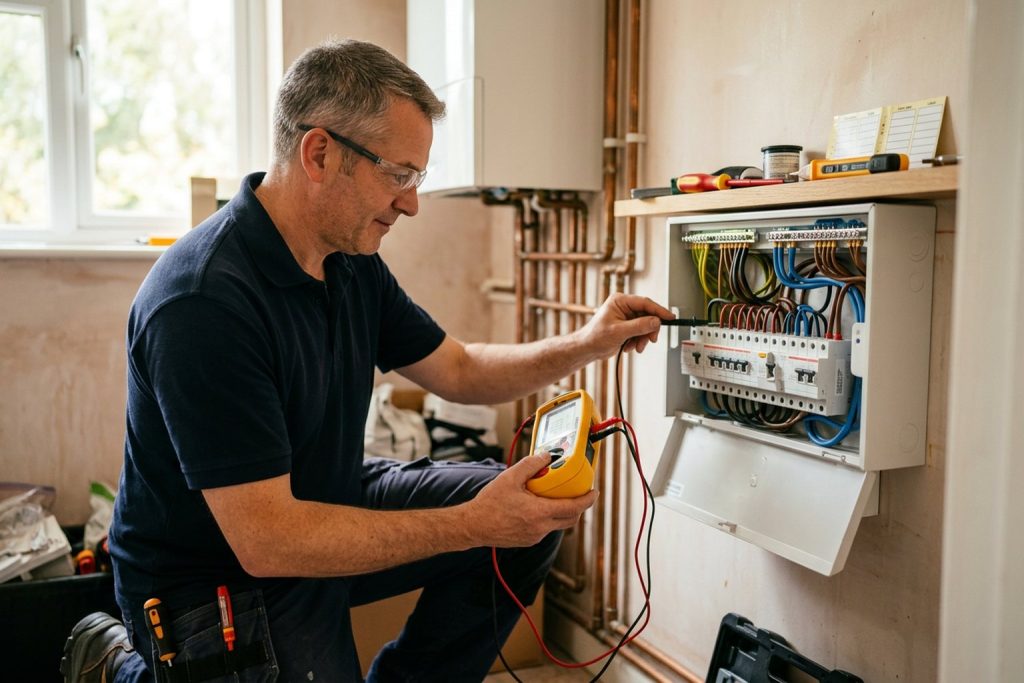
Electricity injures and kills in several distinct ways, and good awareness means recognising all of them:
- Electric shock — current passing through the body can stop the heart or make muscles lock onto a conductor. Even a shock at 230 volts, standard UK mains voltage, can be fatal.
- Burns — from contact with live parts or from current passing through the body.
- Arc flash — a sudden release of energy through the air during a fault, producing intense heat and a blast that can cause severe injury even without direct contact.
- Fire — faulty wiring, overloaded circuits, damaged cables and loose connections are a leading cause of workplace and domestic fires.
- Explosion — electrical equipment can be the ignition source in a flammable or explosive atmosphere, which is why electrical work in such areas is also governed by the Dangerous Substances and Explosive Atmospheres Regulations 2002 (DSEAR).
Wet conditions, cramped or confined spaces, and outdoor or construction environments all increase the danger, because they make contact more likely and shocks more severe. Portable tools, extension leads and temporary supplies on sites deserve particular attention.
Do you need to be a qualified electrician to do electrical work?
The law does not issue an “electrician’s licence”, and it does not name a particular qualification. What it requires instead is competence. Regulation 16 puts it directly:
“No person shall be engaged in any work activity where technical knowledge or experience is necessary to prevent danger or, where appropriate, injury, unless he possesses such knowledge or experience, or is under such degree of supervision as may be appropriate having regard to the nature of the work.”
In other words, whoever does the work must have the knowledge and experience to do it safely, or be properly supervised by someone who does. For most electrical installation and repair work, that competence is demonstrated through recognised qualifications and, in the domestic world, membership of a registered competent-person scheme such as NICEIC or NAPIT — which also handles notification under Part P of the Building Regulations for electrical work in homes in England and Wales. The national technical standard for installations is BS 7671 (the IET Wiring Regulations, currently the 18th Edition); it is not itself law, but following it is the usual way to show your installation is safe.
The honest point for training buyers: an online awareness course — including ours — builds general safety knowledge, but it is not an electrical qualification and does not make anyone competent to install, repair or test electrical systems. That work needs a competent person.
Is it legal to work on live electrical equipment?
Almost never by choice. Regulation 14 makes dead working the default and effectively prohibits live working unless three conditions are all met: it is unreasonable for the conductor to be dead; it is reasonable in all the circumstances for the work to be done live; and suitable precautions (such as insulated tools, barriers, and trained, supervised staff) are taken to prevent injury.
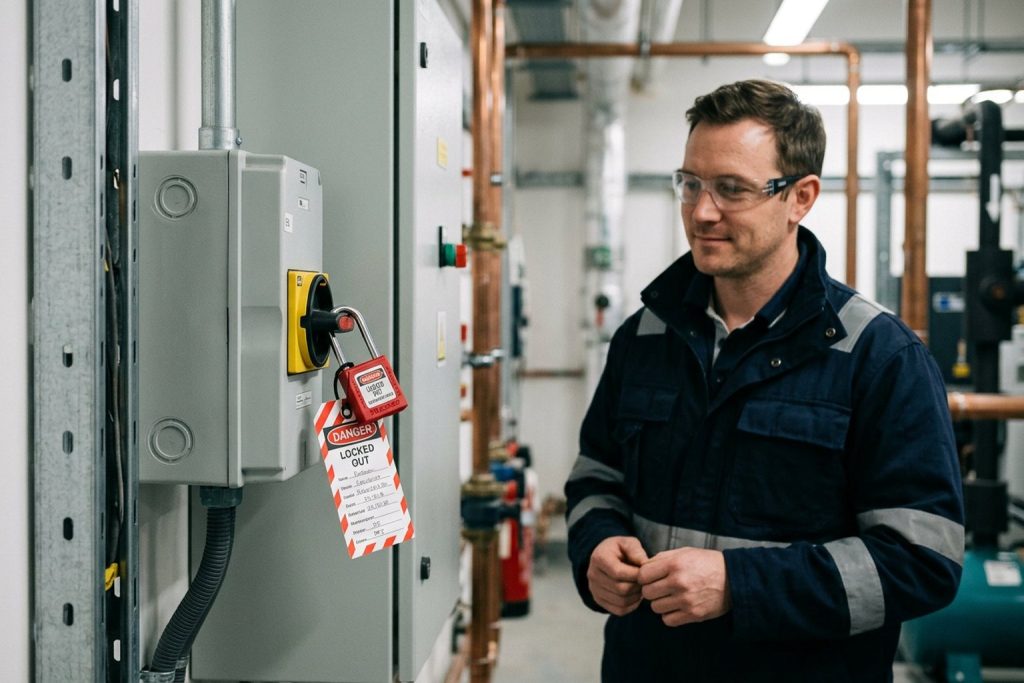
The safe approach is to isolate the circuit, prove it is dead with an approved voltage tester, and lock off the isolation so it cannot be switched back on while work is in progress. Deaths still happen because people assume a circuit is off, or work live to save time. Safe isolation is not bureaucracy — it is the single control that most reliably prevents electrocution.
What is safe isolation?
Safe isolation is the process of switching off, securing and proving dead an electrical circuit before anyone works on it — the practical way to comply with Regulation 14’s preference for dead working. In outline, a competent person:
- identifies the correct circuit or supply to isolate;
- switches it off and isolates it at a point that removes the supply;
- locks off the isolation with a padlock or lock-out device and applies a warning tag, so it cannot be switched back on by someone else;
- proves the circuit is dead with an approved voltage indicator, which is itself first checked against a known live source or a proving unit, as recommended in HSE guidance note GS38.
Only when the circuit is proven dead and secured does work begin. The most common — and most avoidable — cause of serious electrical injury is someone assuming a circuit is off without proving it, or a circuit being switched back on because it was never locked off. Safe isolation is a competence in its own right, not something to improvise.
How is this different from PAT testing?
This is where a lot of confusion sits. Portable appliance testing (PAT) is the in-service inspection and testing of plug-in electrical equipment. It is a useful way to help meet the Regulation 4 duty to maintain equipment — but, as we explain in our guide to whether PAT testing is a legal requirement, no law actually names “PAT testing” or sets a fixed testing interval. It is one tool, aimed at one category of kit.
The Electricity at Work Regulations are far broader. They cover the fixed electrical installation — the wiring, distribution boards, sockets and switches built into the building — which carries much higher energy and, when neglected, far greater risk than a frayed kettle lead. Fixed installations are checked through periodic inspection and testing, resulting in an Electrical Installation Condition Report (EICR). If your electrical safety programme is all PAT stickers and no attention to the fixed wiring, it is focused on the wrong risk. Our guides to what PAT testing is and PAT testing labels and record keeping put PAT in its proper, limited place.
What are the rules for landlords and fixed installations?
Landlords face a specific, dated duty. Under the Electrical Safety Standards in the Private Rented Sector (England) Regulations 2020, private landlords in England must ensure the fixed electrical installation in a rented property is inspected and tested by a qualified and competent person at least every five years, obtain a report (an EICR), give a copy to tenants, and carry out any remedial work identified. The requirement applied to new tenancies from 1 July 2020 and to all existing tenancies from 1 April 2021.
Similar expectations flow through other settings — social housing, workplaces and public buildings — via the general EAWR duty to keep installations safe. If you manage property, our guide to landlord training requirements covers the wider picture. Scotland, Wales and Northern Ireland have their own private-rented electrical safety rules, so check the position for your nation.

Who is responsible for electrical safety at work?
The main dutyholder is the employer — or the self-employed person, or whoever is in control of the premises or the electrical system. They must manage electrical risk so far as is reasonably practicable: providing safe installations and equipment, competent people, inspection and maintenance, and the right protective equipment. Regulation 3 of the 1989 Regulations also places duties directly on employees, who must co-operate with their employer on safety matters and must not misuse or interfere with anything provided to keep people safe.
In shared or let premises, duties can rest on more than one party at the same time — a landlord and a tenant business, for example — so who is responsible for which parts of the electrical system should be agreed and written down, not assumed. And accountability cannot simply be contracted away: hiring a contractor does not remove the employer’s own duty to check that the person is competent and the work is safe.
What electrical safety training do workers need?
It depends entirely on the role. There are two broad groups:
- People who work on electrical systems need genuine competence under Regulation 16 — recognised qualifications, experience and, where relevant, scheme registration. An awareness course does not meet this.
- Everyone else — office staff, care workers, warehouse operatives, site workers — needs general electrical awareness: recognising damaged cables and plugs, not overloading sockets or daisy-chaining extension leads, keeping water away from electrics, reporting faults instead of using taped-up equipment, and never attempting repairs they are not competent to do.
No law names a specific awareness course, but the duty to provide “such information, instruction, training and supervision as is necessary” (from the 1974 Act) applies to electrical risk like any other. A short awareness course is a proportionate way to cover the knowledge element for non-electricians; see our overview of health and safety training requirements for how that duty works.
Which courses support electrical safety at work?
For general staff and managers, three £9 courses work well together, each with a verifiable certificate for your training records:
- Electrical Safety Awareness — everyday electrical dangers, safe use and fault reporting for non-electricians.
- Risk Assessment Awareness — because every electrical safety decision starts from a suitable and sufficient risk assessment.
- Fire Safety Awareness — since electrical faults are a leading cause of workplace fires.
Those three together cost £18 rather than £27, because any three courses trigger the pay-for-2-get-3 offer. Add them to the cart and the discount applies automatically. For work on the electrics themselves, use a competent, suitably qualified person.
Frequently asked questions
What are the Electricity at Work Regulations 1989?
They are the main law on electrical safety in Great Britain’s workplaces, made under the Health and Safety at Work etc. Act 1974. They apply to all work activities and all electrical systems, and require dutyholders — employers, the self-employed and employees — to prevent danger from electricity so far as is reasonably practicable, through safe construction, maintenance, work practices and competence.
Do you legally need to be a qualified electrician?
The law does not issue an electrician’s licence or name a specific qualification, but Regulation 16 requires anyone doing work where technical knowledge is needed to prevent danger to possess that knowledge and experience, or be appropriately supervised. In practice, electrical installation and repair work needs recognised qualifications and, for domestic work in England and Wales, a registered competent-person scheme to meet Part P of the Building Regulations. An awareness course is not a qualification.
Is it illegal to work on live electrics?
Regulation 14 makes dead working the default and effectively prohibits live working unless three conditions are met: it is unreasonable for the conductor to be dead, it is reasonable for the work to be done live, and suitable precautions are taken to prevent injury. The safe approach is to isolate the circuit, prove it dead with an approved tester, and lock off the isolation. Live working to save time is a common cause of serious injury.
Is PAT testing a legal requirement?
No law names “PAT testing” or sets a fixed interval. Portable appliance testing is one way to help meet the general duty to maintain electrical equipment in a safe condition, but it applies only to plug-in equipment. The fixed electrical installation — the building’s wiring and distribution boards — carries higher risk and is checked separately through periodic inspection and an Electrical Installation Condition Report (EICR).
How often should a fixed electrical installation be inspected?
There is no single universal figure, but private landlords in England must have the fixed installation inspected and tested at least every five years under the Electrical Safety Standards in the Private Rented Sector (England) Regulations 2020, obtaining an EICR. Many workplaces adopt a similar risk-based interval. The frequency should be set by a competent person based on the installation, its age, use and environment.
What electrical safety training do office and general staff need?
General staff need electrical awareness rather than technical competence: recognising damaged cables and plugs, not overloading sockets, keeping liquids away from equipment, reporting faults, and never attempting repairs they are not competent to do. Only people with the competence required by Regulation 16 should work on electrical systems. A short awareness course covers the knowledge element for non-electricians but is not an electrical qualification.
Improve electrical safety today
£9 per course. CPD accredited, 100% online, verifiable e-certificate. Pay for 2, get 3 — any 3 courses for £18.
This article is general information, not legal advice. A Nexis CPD awareness course is CPD accredited but is not a regulated qualification and does not make anyone competent to carry out electrical work — only a competent person, as required by Regulation 16, should install, repair or test electrical systems. BS 7671 is a technical standard, not law. The Electricity at Work Regulations 1989 apply across Great Britain; the private-rented electrical safety rules cited apply in England, and Scotland, Wales and Northern Ireland have their own. Regulations and duties cited are drawn from legislation.gov.uk, HSE guidance and gov.uk at the time of writing.