
What is end of life care? It is support for people who are in the last months or years of their life — not only the last few days. NHS guidance says people are “approaching the end of life” when they are likely to die within the next 12 months, which is why end of life care can last many months, or sometimes more than a year, and can run alongside other treatment. It is a form of palliative care, not a separate service: palliative care can start from diagnosis of an illness that cannot be cured, and end of life care is the part of it given as death comes closer. Its aim is to help the person live as well as possible until they die, and to die with dignity, in the way and place they would choose.
At a glance: Nexis CPD’s £9 End of Life Care course covers the principles and frameworks of end of life care, sensitive communication, advance care planning, comfort and symptoms, the last days of life, care after death, supporting families and looking after your own wellbeing. It is CPD accredited and 100% online with a verifiable e-certificate, and any three courses cost £18. It is awareness training for care and support workers, not a regulated qualification, and does not replace clinical or specialist palliative care training.
What does end of life care mean?
The NHS describes it simply: “End of life care is support for people who are in the last months or years of their life.” It “should help you to live as well as possible until you die and to die with dignity”, and the people providing care should ask about the person’s wishes and preferences and take them into account.
Three features set it apart from ordinary care. It is holistic, covering emotional, social and spiritual needs as well as physical comfort. It includes the family — the NHS says carers “should also support your family, carers or other people who are important to you”. And it is led by the person’s choices: people have the right to express wishes about where they would like to receive care and where they want to die, whether at home, in a care home, in a hospice or in hospital.
When does end of life care start?
This is where most people’s assumptions are wrong. Many picture end of life care as the final days in bed. The NHS definition is much broader:
“People are considered to be approaching the end of life when they’re likely to die within the next 12 months, although this is not always possible to predict.”
That includes people whose death is expected soon, and also people with an advanced incurable illness such as cancer, dementia or motor neurone disease; people who are generally frail with other conditions that mean they are expected to die within 12 months; people with existing conditions who could die if their condition suddenly gets worse; and people with a sudden life-threatening condition caused by an event such as a serious accident or stroke. The NHS adds that end of life care “should begin when you need it and may last a few days or months, or sometimes more than a year”.
Two practical consequences follow for care services:
- Planning should start early. If a resident with advancing dementia or frailty is only recognised as “end of life” in their final days, the chance to ask what they want — while they can still answer — has usually been lost.
- Predictions are uncertain. The 12-month marker is a prompt, not a countdown. Some people live well beyond it; others deteriorate suddenly. The point is to have the conversations and plans in place, not to label someone as dying.
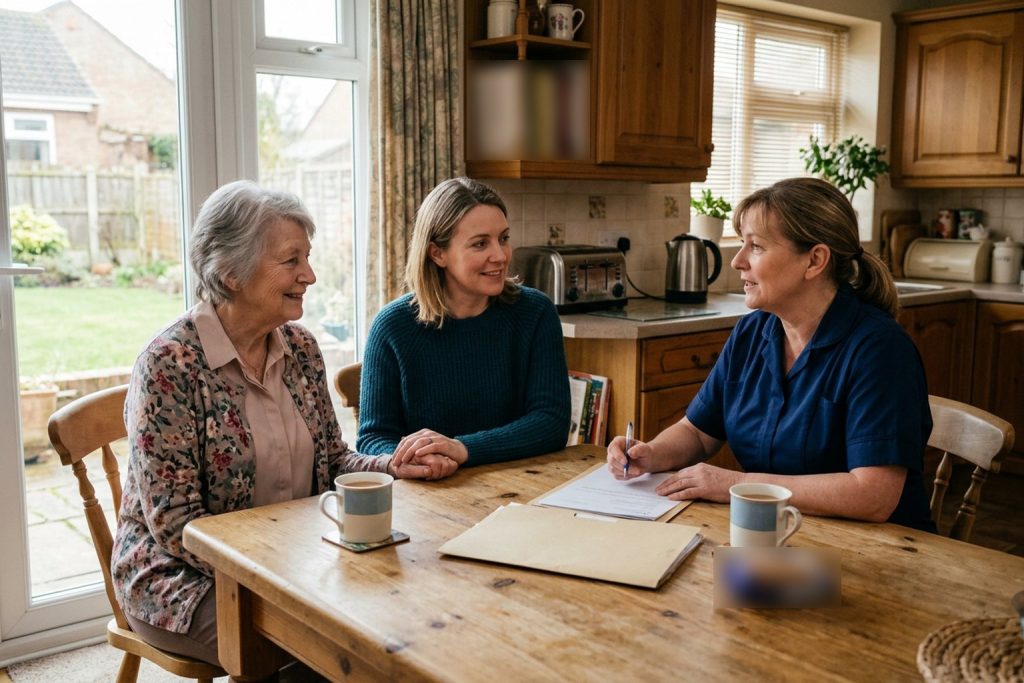
What is the difference between palliative care and end of life care?
The terms are often used as if they mean the same thing. They overlap, but they are not identical. The NHS puts it this way: “End of life care is a form of palliative care you receive when you’re close to the end of life.”
Palliative care is the wider umbrella. For someone with an illness that cannot be cured, it aims to make them as comfortable as possible by managing pain and other distressing symptoms, and it “also involves psychological, social and spiritual support” for the person and their family. The key differences are timing and treatment:
- Palliative care can begin at diagnosis. The NHS says it “is available when you first learn you have a life-limiting (terminal) illness”, and people may receive it “while you’re still receiving other therapies to treat your condition” — sometimes for years.
- End of life care is the later stage of that palliative approach, when the person is approaching the end of life — generally the last year, including the last days and hours.
Every person receiving end of life care is receiving palliative care, but not everyone receiving palliative care is at the end of life.
Who provides end of life care?
Almost everyone in health and social care can be involved. The NHS lists hospital doctors and nurses, GPs, community nurses, hospice staff and counsellors, as well as “social care staff, chaplains (of all faiths or none), physiotherapists, occupational therapists or complementary therapists”. Two points are worth knowing precisely:
- At home or in a care home, the GP leads. The NHS says: “If you’re being cared for at home or in a care home, your GP has overall responsibility for your care.” Care workers deliver much of the day-to-day care, but clinical decisions — medicines, investigations, whether a person is dying — sit with the clinical team.
- Specialist palliative care is for more complex needs. Many professionals provide palliative care as part of their normal job; some people also need consultants in palliative medicine, specialist palliative care nurses or specialist therapists.
Since 1 July 2022, when the Health and Care Act 2022 rewrote section 3 of the National Health Service Act 2006, each integrated care board in England has palliative care in its list of services to arrange: section 3(1)(h) refers to “such other services or facilities for palliative care as the board considers are appropriate as part of the health service”. What is actually available still varies from area to area, which is why the NHS advises asking the GP what support exists locally.
What are the five priorities of care for the dying person?
For the last days and hours of life, the national standard in England is One Chance to Get it Right, published on 26 June 2014 by the Leadership Alliance for the Care of Dying People, a group of 21 national organisations. It responded to More Care, Less Pathway, the independent review of the Liverpool Care Pathway (LCP), which found that in some places the LCP had become standardised care “carried out irrespective of whether that was right for the particular person”. Use of the LCP was to be phased out by 14 July 2014.
In its place came five Priorities for Care. When it is thought that a person may die within the next few days or hours:
- This possibility is recognised and communicated clearly, decisions made and actions taken in accordance with the person’s needs and wishes, and these are regularly reviewed and decisions revised accordingly.
- Sensitive communication takes place between staff and the dying person, and those identified as important to them.
- The dying person, and those identified as important to them, are involved in decisions about treatment and care to the extent that the dying person wants.
- The needs of families and others identified as important to the dying person are actively explored, respected and met as far as possible.
- An individual plan of care, which includes food and drink, symptom control and psychological, social and spiritual support, is agreed, co-ordinated and delivered with compassion.
The word that runs through all five is individual. NICE’s guideline NG31, Care of dying adults in the last days of life (published 16 December 2015) builds on the same principle, recommending an individualised care plan, a named lead healthcare professional, and monitoring for changes at least every 24 hours.
What happens in the last days of life?
The NHS page on changes in the last hours and days of life explains that physical changes “happen to most people during the terminal (dying) phase, whatever condition or illness they have”, and that this phase can last hours or days.:
- Drowsiness. The person sleeps more and may slip in and out of consciousness.
- Not wanting to eat or drink. This is common, and swallowing medicines may become difficult.
- Changes in breathing. Breathing may become irregular, including Cheyne–Stokes breathing — shallow breathing alternating with deeper, rapid breathing, sometimes with pauses. Mucus can build up and cause a rattling sound.
- Confusion, hallucinations or restlessness. The medical team can look for treatable causes such as pain, breathing problems or infection, and there are medicines that can ease distress.
- Cold hands and feet. Skin may look slightly blue; on darker skin tones this may be easier to see on the lips, nose, ears, tongue or inside the mouth.
NICE NG31 warns that improvement “could indicate that the person may be stabilising or recovering”. Recognising dying is a clinical judgement, and it can be uncertain. The care worker’s job is to notice, record and report changes promptly, not to decide that someone is dying.
Because symptoms can change quickly, often at night, prescribers commonly arrange “just in case” (anticipatory) medicines in advance. NICE recommends an “individualised approach to prescribing anticipatory medicines for people who are likely to need symptom control in the last days of life”, planning for symptoms such as agitation, anxiety, breathlessness, nausea and vomiting, noisy respiratory secretions and pain. Non-drug measures matter too — NICE gives the examples of repositioning to manage pain and using fans to ease breathlessness.
Should a dying person be given food and fluids?
The honest answer is that it depends on the person. The NHS says families “do not need to make you eat”, because as someone gets closer to dying their body will not be able to digest food properly. If the person cannot swallow, carers can wet their lips with water.
NICE NG31 recommends that staff support the dying person to drink if they wish to and are able to, checking for swallowing problems or risk of aspiration; offer frequent care of the mouth and lips, including “frequent sips of fluid”; encourage people important to the dying person to help with mouth care or drinks if they wish; and assess hydration, preferably daily, reviewing whether clinically assisted hydration (a drip or tube) is needed.
NICE is candid about the evidence: “it is uncertain if giving clinically assisted hydration will prolong life or extend the dying process” and “it is uncertain if not giving clinically assisted hydration will hasten death”. Decisions should be individual and discussed with the person and their family. And the NHS makes a dignity point worth holding on to: in the last days of life, a person can decide whether they feel like eating and drinking “even if your need for food and fluid is already being met another way”. Offering a favourite drink or keeping the mouth moist and comfortable is part of care, not a failure of it.
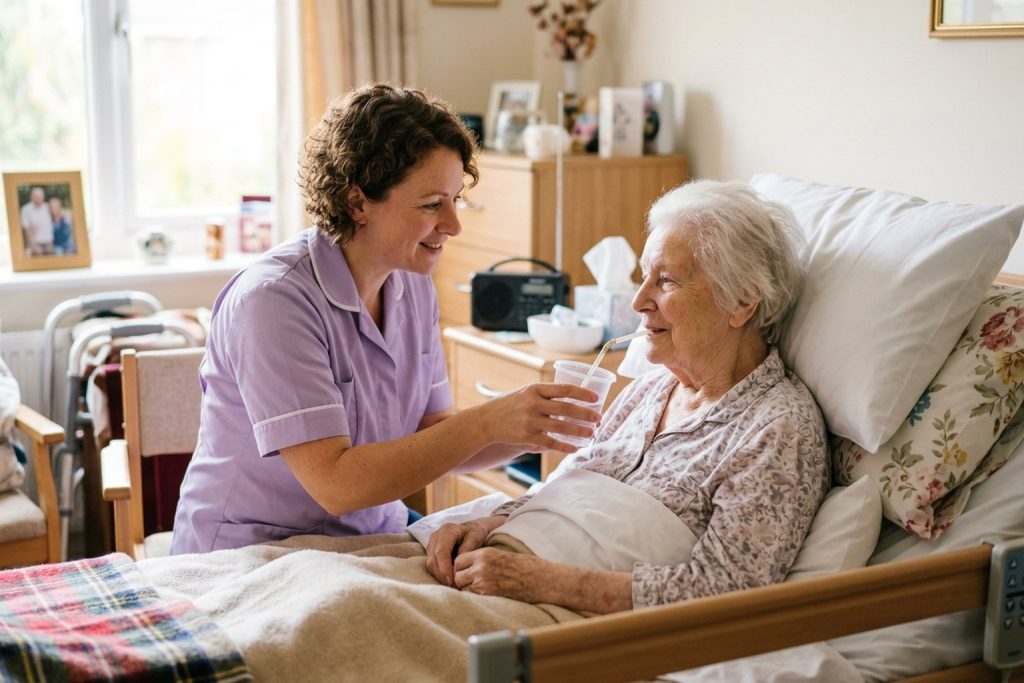
What is advance care planning?
Advance care planning means talking about and recording a person’s wishes for future care while they can still make and communicate decisions. Several different documents can come out of it, and they carry very different legal weight:
- Advance statement. A written statement of preferences, wishes, beliefs and values — where the person would like to be cared for, faith needs, how they like things done. The NHS says it is not legally binding, “but anyone who’s making decisions about your care must take it into account”.
- Advance decision to refuse treatment (ADRT). Lets a person aged 18 or over, with capacity, refuse specific treatments in the future. An ADRT is legally binding if it complies with the Mental Capacity Act, is valid and applies to the situation. If it refuses life-sustaining treatment, it must be written, signed by the person and a witness, and state that it applies even if their life is at risk.
- Lasting power of attorney (LPA) for health and welfare. Appoints people to make health and care decisions if the person loses capacity.
- ReSPECT. A process used in many areas to record personalised recommendations for care in a future emergency. Resuscitation Council UK notes the form is not legally binding and can be reviewed if circumstances change.
For care workers, the practical rules are: know whether the people you support have any of these documents and where they are kept, make sure they travel with the person on a hospital admission, and raise it with a senior colleague if what you are asked to do seems to conflict with a documented wish. If a person lacks capacity and has no valid ADRT, decisions are made in their best interests under the Mental Capacity Act 2005 — see our guides to the Mental Capacity Act and to consent in health and social care, which explains why next of kin cannot simply consent on an adult’s behalf.
What does a DNACPR decision mean?
DNACPR stands for “do not attempt cardiopulmonary resuscitation”. It records that CPR should not be attempted if the person’s heart or breathing stops. The NHS explains that everyone has the right to refuse CPR, and that for some people there will be no chance of benefit from it; where a person lacks capacity and has no ADRT, the healthcare team may consult their next of kin about what they know of the person’s wishes to make a best-interests decision.
The most important thing for care staff to understand is what a DNACPR decision does not mean. Resuscitation Council UK is explicit:
“DNACPR only specifies whether a person will receive CPR or not. Patients will still receive appropriate treatment for their health issues and all personal care needs will be attended to.”
A DNACPR form is not a “do not treat” order. A person with a DNACPR decision who chokes, falls or becomes unwell should still get help — first aid, a call to the GP, NHS 111 or 999 as appropriate. Our guide CPR explained covers what CPR involves and why it is not always the right treatment.
What is the role of a care worker in end of life care?
Care workers spend more time with dying people than anyone else in the care team. Their role is being present, noticing and making each day as comfortable as possible:
- Knowing the person — their preferences, routines, faith, who matters to them and what they have said about the end of their life. This is person-centred care at its most important.
- Comfort care — mouth and lip care, gentle repositioning, skin care to protect against pressure ulcers, and a calm environment with familiar objects, light and sound.
- Dignity — privacy, being spoken to and not about, being told what is happening even when they seem unresponsive. See our guide to dignity in care.
- Observation and escalation — noticing pain, agitation, breathing changes or new symptoms, recording them and reporting promptly.
- Supporting the family — welcoming visitors, explaining what is normal, and passing their questions to someone who can answer them.
Care workers also need to know their limits. NICE recommends identifying the most appropriate team member to explain prognosis, based on their competence, confidence and rapport. A care worker who is asked “Am I dying?” should not brush the question aside — but should listen, acknowledge it, and make sure the right person follows up.
This work is meaningful and emotionally demanding. Good employers build in time to talk after a death, regular supervision that covers the emotional side of the job, and training so staff know what to expect. If you are worried that someone’s end of life care is poor — pain not managed, wishes ignored, a DNACPR treated as a reason to withhold other care — raise it early, and use your service’s safeguarding or whistleblowing routes if needed.
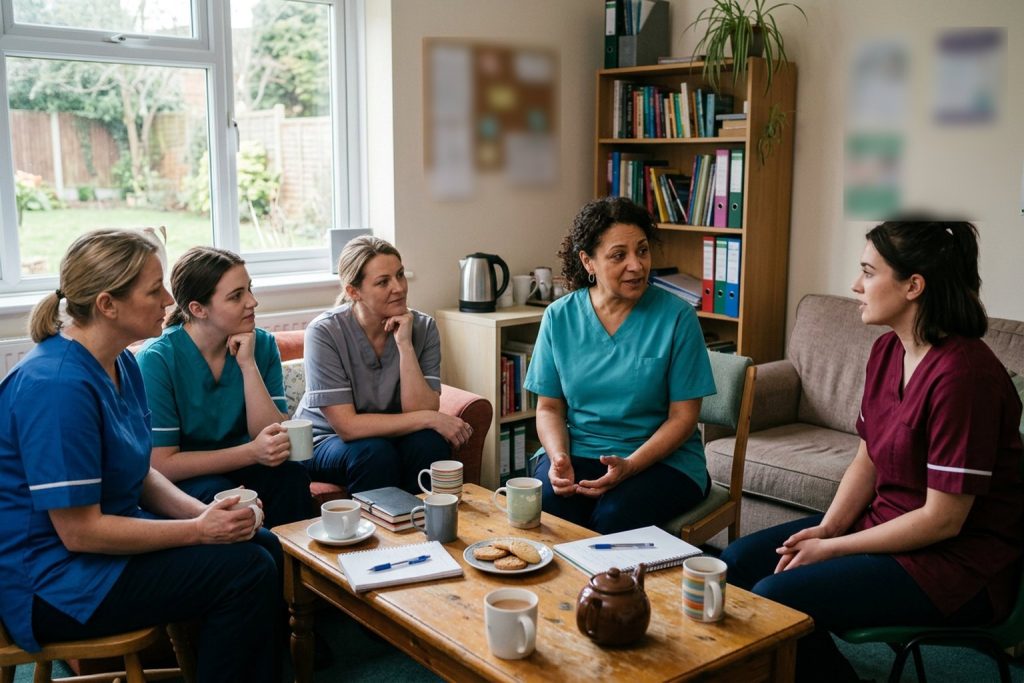
What happens after someone dies?
Care after death is still care. Each service should have a policy covering what staff do when a person dies, including how an expected death is handled differently from a sudden or unexpected one, who is contacted, and how the person’s body, belongings and cultural or religious wishes are respected.
The legal process after a death in England and Wales changed on 9 September 2024. Under the death certification reforms, every death not investigated by a coroner is independently reviewed by a medical examiner — a senior doctor not involved in the person’s care. A doctor who attended the person during their lifetime completes the medical certificate of cause of death, the medical examiner scrutinises it and offers the bereaved family a chance to raise questions, and the death cannot be registered until the registrar has been notified of the cause of death by the medical examiner or coroner. The next practical steps for families are set out in GOV.UK’s what to do when someone dies guide.
If a family is unhappy with the care their relative received, the NHS page on what to expect from end of life care notes that every GP practice, hospital, hospice and care home must have a complaints procedure, with the Parliamentary and Health Service Ombudsman or the Local Government and Social Care Ombudsman as the next step.
Which courses support good end of life care?
These £9 courses fit together for care and support workers, each with a verifiable certificate for training records:
- End of Life Care — principles and frameworks, communication, advance care planning, comfort and symptoms, the last days of life, care after death, supporting families and your own wellbeing.
- Palliative Care — how palliative care differs from end of life care, holistic care and “total pain”, the multidisciplinary team and hospices, and recognising and escalating deterioration.
- Dignity in Care — the principles behind respectful, dignified care at every stage of life.
The Mental Capacity Act course is a useful alternative third choice. Any three courses cost £18 with the pay-for-2-get-3 offer — add them to the cart and the discount applies automatically. These are awareness courses: they are not regulated qualifications and do not replace clinical training, your employer’s induction, or specialist palliative care education where your role requires it.
Frequently asked questions
How long does end of life care last?
It varies. The NHS says it may last a few days or months, or sometimes more than a year. People are considered to be approaching the end of life when they are likely to die within the next 12 months, although this is not always possible to predict.
Is palliative care the same as end of life care?
Not exactly. Palliative care is the wider approach for anyone with an illness that cannot be cured and can start from diagnosis, alongside other treatment. End of life care is the part of palliative care given when a person is approaching the end of their life.
Does a DNACPR mean no other treatment?
No. A DNACPR decision only means that CPR will not be attempted if the person’s heart or breathing stops. Resuscitation Council UK says patients will still receive appropriate treatment for their health issues and all personal care needs will be attended to.
Is an advance statement legally binding?
No. An advance statement of wishes is not legally binding, but anyone making decisions about the person’s care must take it into account. An advance decision to refuse treatment can be legally binding if it is valid and applies to the situation.
Do dying people need to eat and drink?
Not wanting to eat or drink is common near the end of life, and families do not need to make the person eat. NICE recommends supporting the person to drink if they wish and are able to, and offering frequent mouth and lip care. Clinically assisted hydration is an individual decision for the clinical team.
Care that makes the last months count
£9 per course. CPD accredited, 100% online, verifiable e-certificate. Pay for 2, get 3 — any 3 courses for £18.
This article is general information, not legal or medical advice. It describes the position in England, with the death certification changes applying in England and Wales; Scotland, Wales and Northern Ireland have their own health and care frameworks. Clinical decisions should always be made by the person’s healthcare team. A Nexis CPD awareness course is CPD accredited but is not a regulated qualification and does not replace clinical or specialist palliative care training. References are drawn from the NHS website, NICE, GOV.UK, Resuscitation Council UK and legislation.gov.uk at the time of writing.